|
Excerpt
from Splash
Across Texas
by Chandra Moira Beal :
Salado, which means 'salty', is an old Tawakoni Indian settlement,
although Paleo-Indian tribes were there even earlier. Bustillo y Ceballos
probably stopped here, too. Originally called Salado Springs,
it was settled in 1851 by Archibald Willingham and became a well-known
stage stop on the Chisholm Trail. A stone wall was erected
around the springs to keep the cattle out, since the springs supplied
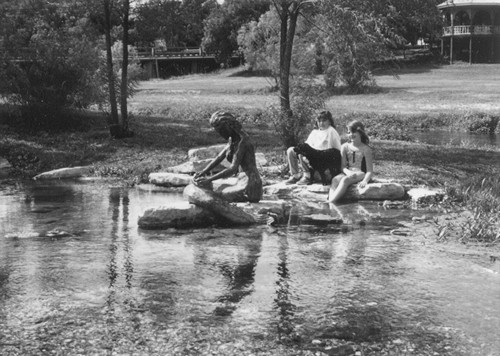
water for the town. Today it is a large, wide swimming hole behind
a dam located downtown. One hundred years ago, the springs gushed
so strongly that they produced a five-foot fountain. Between 1851
and 1868, eleven mills were built in Salado around the springs. |
Salado Springs
Photo courtesy Chandra Moira Beal |
W.A. PACE PARK
Take
exit 284 from IH35, go right at the first stop sign, cross Main Street,
and continue on into the park.
This park was given to the people of Salado by John W. and Elizabeth
Pace Hodges in honor of their parents, William Alexander Pace and
Sarah Jane Hankons Pace, on August 16, 1936. The land was once at
the northwest corner of a 100-acre tract set aside by Colonel E.C.
Robertson in 1859 to be sold to benefit Salado College. The property
was purchased by a man named Stinnett who resold it to Pace in 1888.
Pace was a Virginian who came to Texas to farm and had 17 children
with his wife. During the Civil War, Pace Park was a safe haven to
Company G.
Pace Park is a very simple park with few amenities. The main attractions
are Salado Creek and lots of open, grassy space. The creek
is shallow and suitable for wading. There are picnic tables and gazebos
on the gently sloped shores, and private property is on the opposite
side. The picnic tables are built of natural, uncut rocks from the
creekbed. Cottonwoods provide shade. A covered pavilion has ceiling
fans, a fireplace, and electricity.
Addendum:
Salado Creek and Pace Park were the state's first designated natural
landmark. Wagon wheel ruts can still be seen in the limestone creek
bed just north of the park, leftover from when Main Street was part
of the Chisholm Trail.
May,
2001
Copyright Chandra Moira Beal and La Luna Publishing |
 |
Salado
Chamber of Commerce
Post Office Box 849
Salado, Texas 76571
(254) 947-5040
Salado
Hotels > Book Hotel Here |
Salado,
Texas Chronicles
Institute
for the Humanities at Salado by Byron Browne
This Texas hamlet offers much more than many of us have imagined.
Having undergone a regeneration of sorts, the town now boasts several
interesting and enthralling businesses and has established itself
as a destination rather than simply another interstate oasis. more
From
Patty Hearst to Salado by Clay Coppedge
Charles Turnbo writes about history but he has also witnessed a
fair amount it... more
The
Chisholm Trail Rides Again by Clay Coppedge
Anyone wanting to follow the Old Chisholm Trail through Bell County
would find part of the quest relatively easy, at least as easy as
driving on IH-35. The old trail roughly paralleled the Interstate
from Salado to Belton.
After that following the old trail might get a little trickier,
though anyone who spends much time here passes or crosses it many
more times than they could ever know... more
Jesse
James, Supposedly by Clay Coppedge
"...That the James and Younger brothers spent some time
in Texas is not in dispute, and local legends of the James and Younger
brothers in Bell and surrounding counties abound..." more
|
Salado, Texas
Forum
Subject: Salado
and Benoit
Dear TE, A web search for Benoit, Texas, led me to your excellent
site. My father, Maj. Gen. Thomas R. Rampy was born and reared in
Salado. He wrote a detailed account of those years (1898-1916) in
a book titled "Choice and Chance." I have posted it (PDF), including
many photos, on the web at: http://www.upamerica.org/family/trrbook.htm.
I believe those of your readers who are familiar with Salado would
find the first of the three sections to be a good account of how things
were on a Central Texas farm a hundred years ago.
The town of Benoit
was featured in an incident recounted in my father's book (above).
He relates a tale of travel from his home to that tiny village in
Runnels County by train in 1910: A
Railroad Adventure
Thanks for the great job you are doing to preserve our precious past.
- Gordon Rampy, Warrenton, Virginia, August 11, 2007 |
| Texas
Escapes, in its purpose to preserve historic, endangered and vanishing
Texas, asks that anyone wishing to share their local history
and vintage/historic photos, please contact
us. |
|
|
 HOME
HOME
 Texas
Gulf Coast
Texas
Gulf Coast East
Texas
East
Texas Central
Texas North
Central
Texas North Central
Texas South
Central
Texas South Texas
Panhandle
Texas
Panhandle South
Texas
South
Texas Texas
Hill Country
Texas
Hill Country West
Texas
West
Texas Texas
Ghost Towns
Texas
Ghost Towns Texas
Counties
Texas
Counties