|
|
The Treasure
of Salado
Institute for the Humanities at Salado
by Byron Browne |
|
Salado,
Texas has been, for myself at least, only one of those small
Texas towns that line the highway along the route between Austin
and Sherman;
a potential rest stop for my wife and myself when we drive to see
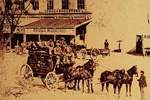
our son in college. The Stagecoach Inn being the town’s sole iconic
marker along the way. However, this Texas hamlet offers much more
than many of us have imagined. Having undergone a regeneration of
sorts, the town now boasts several interesting and enthralling businesses
and has established itself as a destination rather than simply another
interstate oasis.
One of the town’s attractions, familiar to its citizens and aficionados
of lectures and things didactic, is the Institute for the Humanities
at Salado. The organization, founded by Dr. and Mrs. Harry Wilmer
in 1980, was created in order to, “…provide[s] life-long learning
opportunities to explore the ideas, history, literature and values
that make up the human story. The purpose of the Institute is to increase
knowledge, to stretch minds and to foster compassion in light of our
rapidly changing world. Its goals are to promote the exchange of ideas
and the search for wisdom.” At first thought this may seem a goal
set on a too-distant horizon. However after attending one of the Institute’s
lectures and meeting Tom Wilmer, one of the organization’s founder’s
sons and a writer from California, and his mother, the wife of the
late Dr. Harry Wilmer, the purpose and mission of the Institute not
only appear attainable but, after witnessing the size of the audience
and noticing their adherent attentions, many of its goals have already
been realized. |
 |
Dr. Harry Wilmer
was, by most accounts, one of those persons whose catalog of accomplishments
is so expansive that you might think the list belongs to more than
a single individual. The following is from the Institute’s website
on Dr. Wilmer’s obituary:
Dr. Wilmer graduated from The University of Minnesota, from which
he earned BA, MB, Ph.D. and M.D. degrees. He trained in psychiatry
at the Mayo Clinic where he was also on the staff. He also has been
on the faculty of Johns Hopkins University, Stanford, and the University
of California, where he was professor of psychiatry before coming
to Texas. He received his Jungian analyst training in Zurich on a
Guggenheim Fellowship. From 1955-57, he served as a Captain in the
US. Navy, assigned to the U.S. Naval Hospital in Oakland California
and the National Naval Medical Research Institute, in Bethesda, Maryland.
The obituary continues, Dr. Wilmer was responsible for helping
introduce the practice of group therapy to North America at Oak Knoll
Naval Hospital in Oakland, CA. His book, Social Psychiatry in Action,
was made into the 1961 Emmy-nominated TV docudrama "People Need People."
In addition to this impressive list Dr. Wilmer was also the author
of several books on Jungian psychiatry and group therapy. For anyone
interested, Dr. Wilmer’s accomplishments are astounding; a search
on his name will yield amazing results.
I have been inside the doctor’s home office. Twice. The atmosphere
within, calm and mesmerizing, is nothing short of astounding. Books
aligned, shelf upon shelf to the ceiling, topics as eclectic as a
Latin dictionary from the early 20th century as well as analyses of
Jungian psychiatry written in a language as foreign as the subject
itself. I was told by Tom Wilmer that his father had not only read
every text in the place but could recall details from each with a
supernatural precision. It was not difficult to imagine that celebrities
and dignitaries alike had sat in that office hoping for and expecting
some insight into their respective personalities, anxieties, concerns,
dreams and nightmares.
The lecture that my wife and I were invited to attend was given by
Dr. William Dement of Stanford University. The talk was on the subject
of sleep, sleep disorders, sleep apnea and the dangers of sleep deprivation.
Dr. Dement gave a lively, entertaining, educated and oftentimes humorous
talk. Several minutes were given to the subject of snoring and its
treatments. A topic that was, at first, taken lightly by the audience
until the talk began to center on the effects of sleep deprivation
caused to the “partner”. It seemed that most in the audience could
relate to that scenario and, after Dr. Dement demonstrated some of
the more serious results of this situation, the group settled into
a more attentive state as the subject took on a greater personal signal.
The room was full -standing room only- and all were engrossed by speaker
and subject alike. Afterwards, it was easy to understand why Dr. Dement
is so well respected around the globe. We also learned that his classes
are some of the most sought after on the Stanford campus; he has developed
a sort of cult-like following among the students.
The Institute at Salado likewise has developed a following. The citizens
of the town understand what a treasure they have with the Institute
and its founder and his widow, Mrs. Jane Wilmer. The day of the lecture,
it seemed that many of the town’s residents flocked to the old school
building where the meeting was to be held, just as residents of small
towns do for Sunday worship services. The opportunity to hear such
a noted speaker was a powerful draw. Small wonder. The list of previous
speakers, such as: Barbara Jordan, Lee Marvin, Maya Angelou, Liz Carpenter
and Robert Bly, would pique anyone’s interest in subsequent lectures.
Indeed, former Secretary of State James Baker is slated to give a
talk this Fall 2010.
The Institute’s stated purpose, in addition to the aforementioned
goals, is to honor the memories of Dr. Wilmer and Hank Wilmer, the
oldest son of the family who passed away in 1997. The family’s attempts
to honor their relatives, by giving back, not only to the community
of Salado,
but to all of us through education and spiritual enlightenment, is
a gift that is beyond thoughtful and could, in no way, ever be repaid.
However, I doubt any of the Wilmer family would ever expect anything
other than our attention to their message. It is, after all, intended
only for our benefit.
A special thank you to Sara Mackie, the Institute’s Director, for
assistance with material and photograph of Dr. Wilmer. http://www.salado-institute.org/
© Byron Browne
Notes From Over Here July
17, 2010 Column
Byron Browne can be reached at Byron.Browne@gmail.com
Salado
| Salado Hotels |
|
|
|
Books
by
Byron Brown
Order Here |
|
|