|
 |
History in
a Pecan Shell
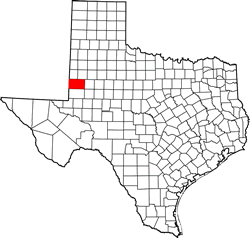
Gaines
County is named after James Gaines, signer of the Texas
Declaration of Independence.
Seagraves was originally called Blythe. This was about 1911
when the post office was on the Blythe ranch.
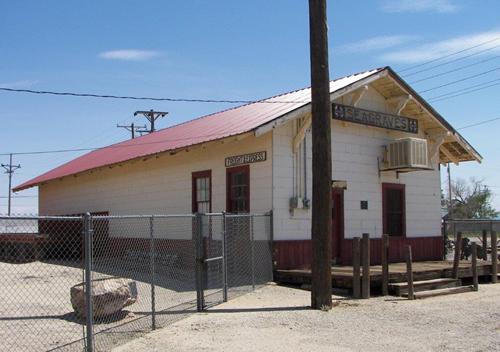
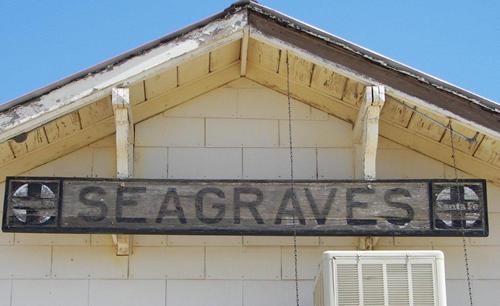
The Santa Fe Railroad make Seagraves the end of a spur running from
Lubbock
and a land company owned by the railroad promoted the town around
1917. There was already a Blythe on the Santa Fe line (although
it was in California) so the name was changed to that of C. L. Seagraves,
a Santa Fe Railroad Official.
An oil boom in the mid-thirties made up for a fire that nearly leveled
the town in 1928. 1950 was an unpleasant milestone for the town
when it lost its title as most populated Gaines
County town to the county seat of Seminole.
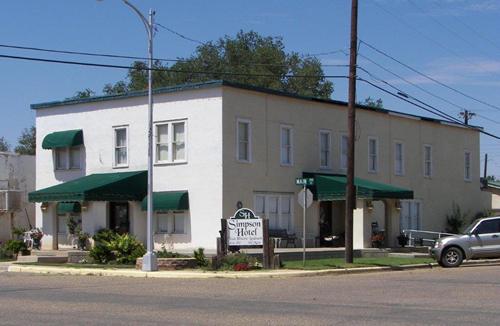
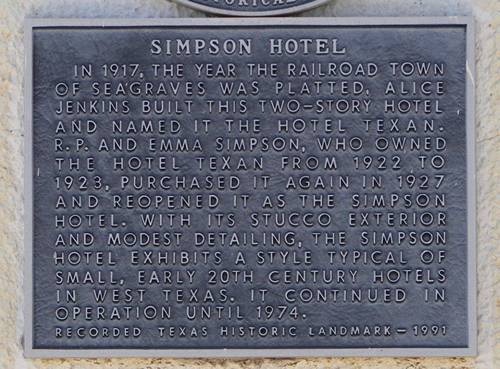
One of the few buildings that survived the 1928 fire was the Simpson
Hotel. The Hotel was awarded a Texas Historical Commission Medallion
in 1992.
Seagraves experienced an oil boom in the 1930s which lessened some
of the impact of the Great Depression. At one point in the 1950s,
the chamber of commerce touted Seagraves as "The Caged Egg Production
Center of the World." That slogan may have lost it's meaning
to a lot of people, but to us here at Texas Escapes, Seagraves will
always be The Caged Egg Production Center of the World.
|
Seagraves Attractions
/ Landmarks
Seagraves-Loop
Museum & Art Center
Main Street and Hill Avenue
806-546-2810
|
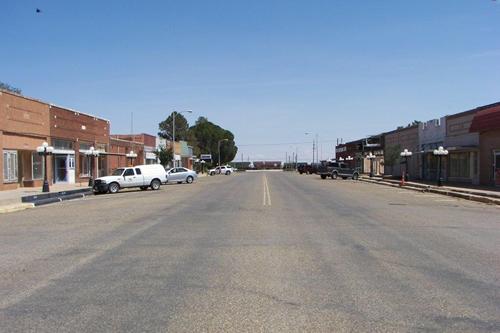
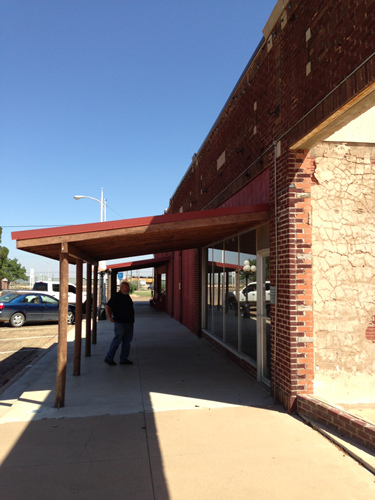
Seagraves
Main Street today
Photo courtesy Terry
Jeanson, July 2013 |
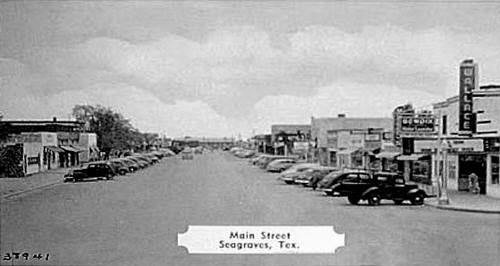
Seagraves Main
Street
Photo courtesy texasoldphotos.com |
| Texas
Escapes, in its purpose to preserve historic, endangered and vanishing
Texas, asks that anyone wishing to share their local history, stories,
landmarks and recent or vintage photos, please contact
us. |
|
|
 HOME
HOME