|
|
The
Hollies said it best in the words of a song: “The road is long with
many a winding turn.” The road, after traveling it for eight years,
has indeed become long, and tedious, for me. My weekly 125-mile trek
down the freeway to a small West Texas college, where I attempt to
instill the joys of literature into the uninterested hearts of ersatz
students, is more like a journey into the heart of darkness rather
than analogous to Christian’s search for the Celestial City. There
is no salvific reward for me, except disappointment, at the end of
my travels. As for turns, there aren’t many. The interstate is mostly
a straight shot to my destination. Over time, though, the road has
fallen into disrepair, and for the last few years, in at least two
sections, it has narrowed down to one lane so that workmen can concentrate
on smoothing out the other one. Cars, and especially trucks of all
makes and sizes, break about every driving rule to beat one another
to the bottlenecks. Many risk their lives just to get one car length
ahead. Once in the constricted areas, antinomian drivers tailgate
the car in front of them to urge law-abiding citizens to higher speeds.
The trip west, in addition to its monotony, has become nerve-wracking.
But I have discovered a delightful, distracting detour that leads
away from the chaos.
About
thirty miles before my destination raises its woebegone visage on
the horizon, State Highway 193 – the Gordon
exit – shoots off to the northwest. At this juncture sits Trolley
373, an actual old streetcar, painted blue and white, once a restaurant
that served some of the best barbeque in the state of Texas.
It has long been defunct, but the advertisement for food still beckons
the unsuspecting traveler. The highway traverses a wooded area for
about three miles before it curves west to parallel the freeway. I
have seen only two houses along this route. The copious woods are
interspersed with occasional pastures full of grazing cattle. The
road bisects an oil/gas industrial complex, but early in the morning
when I am in the vicinity, there is no activity in the yards. Right
before the road curves into Gordon,
I observe the Union Pacific Railroad off the right. |
 |
Gordon,
population about 600, is the first community I come to. Highway 193
runs next to the railroad tracks into town and intersects FM 919,
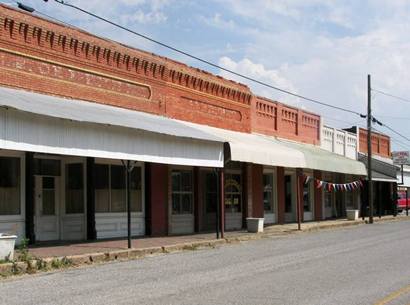
Main Street, at a four-way stop sign. To the left is the downtown
area, old buildings occupying both sides of the street. One structure
holds the proverbial town café, where the village intellectuals gather
to both discuss, and sometimes find answers for, the world’s pressing
issues. The café opens early, no doubt to give its denizens plenty
of time to exercise their problem-solving skills and plenty of coffee
to force them to stay awake while they do so. To the right of the
intersection are the tracks, and beyond these Highway 919 turns sharply
to the left followed almost immediately by a turn back to the right.
At this second turn stands an automobile dealership with its accompanying
garage and lots. The road now heads north where it rises gently to
cross some impressive and beautiful Texas hills.
Back at the junction Highway 193 continues west. There is a siding
on the Union Pacific, and frequently a boxcar is set out for a local
merchant. The railroad has been replacing its crossties for some time
now. Stacks of them occupy the area between the road and the tracks.
In no time I’m out of Gordon.
There is a peace associated with this little town: no traffic to speak
of, no loud noises, no apparent rude drivers, none of the harrowing
scenes I experience on the interstate. Some wit might be tempted to
quip that Gordon is a
place out of time, but this hypothetical snide thought sounds like
a compliment to me.
Beyond Gordon, trees
border the highway on the north and scrub brush on the south. A noticeable
hill stands up in one field, a marked contrast to the flat fields
surrounding it. The railroad is visible through the trees, and often
I see a train because this important route handles some twenty-five
consists per day. I observe no houses along this six-mile stretch.
Only as I approach Mingus
do any signs of civilization appear. |
|
|
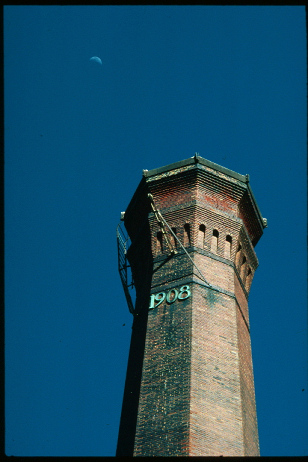
The
1908 smokestack in Thurber
Photo courtesy TXDoT |
| |
| Mingus
is a small village of less than 300. It was once much larger than
this due to the nearby abandoned town of Thurber.
Thurber,
for about thirty years between 1888 and 1927, was a coal mining nexus
that could boast of modern conveniences such as electric service and
brick streets. In fact, a brick factory supplied paving material for
several towns in the neighborhood. Thurber reached a population of
10,000 at its zenith, but the mines dried up, the people moved away,
and the town was totally razed in 1933. Today, few artifacts remain
of this previously booming metropolis: two restaurants – catering
mostly to tourists and hapless freeway travelers – an old train deport
that was actually moved in from Strawn,
a small city park, and a new museum built by Tarleton State University.
A branch line of the Texas and Pacific Railroad ran the four miles
from Mingus to Thurber.
As Highway 193 merges with Highway 108 at Mingus
and the road makes a sharp curve to the north, I can see the embankment
of this old spur line right before I cross the modern Union Pacific
tracks. Mingus looks
almost deserted. There is a small post office at the highway intersection,
a convenience store along Highway 108 – Main Street – and an old Opera
House, a relic from the nineteenth century, now gutted but with its
walls still standing on the corner of Main and Highway 193. Hopefully,
there are plans to restore this structure. I imagine many an interesting
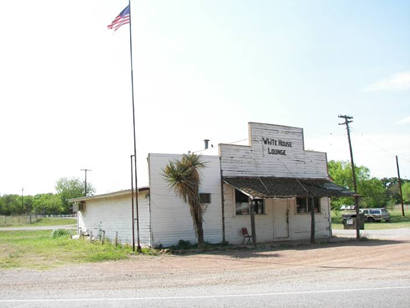
tale comes out if its history. The principle attraction of Mingus
today seems to be a honky tonk where the locals go to relieve their
frustrations after a week’s labor. |
 |
After
crossing the tracks on Highway 108, I take a quick left turn to the
west, pass an old boarded-up church, and then curve back to the right
on my way to Strawn.
For about two miles the road keeps to the north. It goes through a
densely wooded section, fords a creek, and breaks out into the sunshine,
where I can see several farms and ranches with some rolling hills
forming the background to this bucolic scene. The highway gradually
turns to the left, west, where it parallels both the interstate about
five miles to the south and the railroad tracks one mile distance.
I see neither from the road. The way into Strawn
is a gratifying drive. As I get closer to the town, I start to see
more houses. I pass a factory on the south which manufactures various
types of construction equipment and that must provide many country
residents with job opportunities. Farther down the road I see the
rare phenomenon of a candle plant. Actually, the alluring aroma attracts
me long before the physical plant comes into view. The candles are
sold throughout the nation, and they give Strawn
the small reputation on which the chamber of commerce can brag.
I am now at the city limits. Of the “tri-city” layout through which
I have passed, Strawn
is the largest town, but still with a population of less than 1000.
It has the appearance of having been larger at one time. I go by some
beautiful old homes before I reach the central business district.
A burned-out florist shop and the post office are next to each other
on the right. I see the community center on the left, then a row of
buildings, another of which has been the victim of fire. I reach the
end of Highway 108 as it junctures with the main north-south Highway
16. All the downtown streets are brick-paved, undoubtedly with the
bricks from the old Thurber
plant. When I turn left, south, I notice an old bank building on the
west side of what is now Central Street and some shops on both sides
that sell antiques and the local-made candles. There is a vacant lot
on the left where the Strawn Theater once stood. It too burned long
ago. Strawn seems to
have more than its share of fires. Highway 16 takes a ninety-degree
turn to the right, then immediately another one to the left to cross
over the railroad tracks. The roads in this part of the country have
so many right angle turns that I think of the term “orthogonal land”
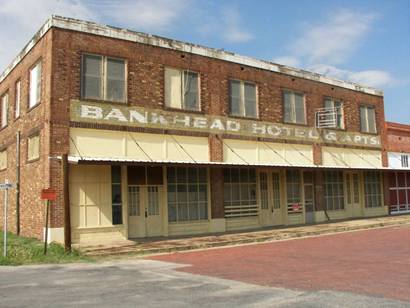
as an appropriate moniker for the landscape. Off to the right, before
I cross the tracks, sits the old Bankhead Hotel. It is empty now,
but its size leads me to think that in the past it was a haven for
weary travelers on their east-west journeys across America because
Strawn was on this old
route before the freeway was built. |
 |
| At the railroad
crossing a short spur siding branches off the mainline tracks. It
bends around toward the south. I have seen at times two dormitory
cars set out on this line to house railroad workers. Mostly, though,
the line stays empty. To the east of the highway stands the local
convenience store and gathering place for the “foolosophers.” A short
distance down the road stand two of the area’s popular restaurants:
Mary’s and Flossie’s. They are across the road from each other. In
addition to serving authentic Texas cuisine, they offer liquid spirits
– the only places for miles that do so – for many imbibers. Next,
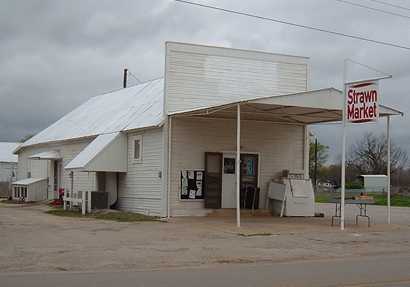
on the right, sits the Strawn
Market, a combination gas station-grocery store that still serves
the community after many years in business. I now head out of town
to rejoin the interstate. |
Strawn
Market -
"The store was originally named Lovera's. I purchased the store
2 years ago"
- Cathy Brown, June 30, 2008 |
|
It
is four miles to my personal Via Dolorosa, the last few miles
to the campus. Once there, I face four days that I can barely get
through. The school represents the way America appears to me today:
student attitudes indicate that our citizens think they deserve
certain rewards or gifts in life without working for them. Entitlement
reigns supreme, even in academia. I’ve just about had it. The road
has been long to my dubious destination. But the sixteen-mile delightful
detour reminds me that there once was another America, a wistful
place full of pleasant and pensive scenery, not a jungle of concrete
highways and twisted lives. For my own sanity, I now travel it every
week.
© Billy
B. Smith
"They
shoe horses, don't they?" November
17 , 2007 Guest Column
|
|
|
 HOME
HOME