|
Books
Excerpts from
2007 BOOK AWARD WINNER
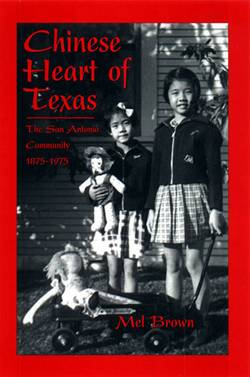
CHINESE HEART
OF TEXAS
The San Antonio Community
1875-1975
by Mel Brown |
|
|
To
order:
Contact Mr. Mel Brown at 512-288-7354
or email at melbjr@earthlink.net |
"JOHN CHINAMAN
IS HERE." A simple four word declaration heralds April 5th, 1875 as
that day on which the Chinese first came to the rustic and rowdy town
of San Antonio, Texas.
Did he remain there for a while, start a business or just look around
and leave? Why was he drawn to this oddly cosmopolitan frontier city
where so many strange languages were spoken around each corner and
in every shop? Ten years after the American Civil War, traveling there
from any other town in the state, like Dallas or Houston, required
a journey of several days by stage coach. The first railroad did not
reach San Antonio until 1877, so that meant a dusty, bone jarring
ride for seemingly endless hours and miles.
A few years later San Antonio became home to a number of other Chinese
men who had been brought to Texas to complete the Southern Pacific
railroad line that ran from Florida to California. When the railroad
project was finished, most Chinese migrated back to the West coast
and many returned home to Guangdong. Others decided to remain, so
San Antonio's small Asian population soon began to grow along with
the prosperous city. The Daily Express reported on March 2, 1883 that
"... a fresh delegation of washee-washee Chinese has just arrived."
Many of these men had skills learned while working on the great railway
but they opened hand laundries so as not to compete for jobs with
the local work force. By 1887, the number of Chinese laundries was
twenty-five as the colony had grown to over fifty men and one woman. |
Sue
Lee may have been San Antonio's first Chinese
female resident but that was a secret which she desperately wanted
to keep. This unusual oriental tale comes from an August, 1887 newspaper
story under the droll heading "IN BREECHES AND BOOTS". The colorful
account informed its curious readers that in a certain Chinese cafe
"very popular with the local Celestials, one of the waiters is certainly
a woman, dressed as a man." Loyal patrons of the "chop shop" on W.
Commerce St. near City Hall helped Sue Lee maintain her subterfuge.
Many of them adamantly swore that she was a "real man", in spite of
her obvious feminine features and girlish mannerisms. Maybe the poorly
fitting trousers and brogans gave her away. An apparently beguiled
newspaperman wrote that at times she affected "...a bewitching look
through the long black lashes of her almond eyes."
We trust that Sue Lee did not let her guard down as consequences could
be terrible. Readers were informed that this "celestial masquerade"
was necessary because Sue was a runaway slave. The article explained
that Cantonese girls were regularly indentured to rich Chinese masters
by a syndicate in San Francisco. This fugitive woman had escaped a
keeper who might have paid as much as $3,000 for her, depending upon
her age and physical appearance. " Poor Sue, doubtless to gain her
liberty, has broken away from her masters and in the garb of a man
is keeping her identity and whereabouts concealed from her owners."
The ardent reporter ended by adding that her charade might be undone
by the police, if they enforced a local ban on women appearing publicly
in men's garb. Sue Lee's uncertain fate remains concealed to those
of us looking back to her day; hopefully, she lived her life as a
free woman, one way or another. Thousands of long suffering Chinese
girls and women were exploited and abused during this period of legal
prostitution while many others died as a result of disease and neglect.
Sexual slavery was the frontier reality of nineteenth century America
due in part to the bigoted strictures on immigration of Chinese women."
|
It
was about this time that the U. S. Congress passed an "Exclusion
Law" promoted chiefly by organized labor and west coast politicians.
It specifically banned Chinese immigration into America beginning
in 1882. That in turn compelled the next generation of Cantonese laborers
and merchants to enter Mexico instead where they were at first welcomed
to help stimulate that nation's northern states economies. Like they
did everywhere else, the Chinese prospered by hard work and frugal
living. Within a mere twenty years they dominated local economies
as commercial farmers, merchants, laundry men and even in light manufacturing.
By the beginning of the 1910 Mexican Revolution, they were being scapegoated
to the point of social then legal persecution which eventually turned
violent.
"The worst incident occurred in the Chinatown of Torreón, Coahuila
in May of 1911. A violent rampaging throng of three to four thousand
Mexicans attacked the approximately 1,400 Chinese there. In a period
of four hours on May 15th, 1911 over 300 Chinese men, women and children
were murdered. Forty of their grocery stores were demolished, along
with five restaurants. Four hand laundries were ransacked as were
dozens of smaller shops. The productive commercial farms and gardens
nearby were also destroyed. As rioting raged, employees, wives or
children who got caught, were killed or beaten. Five Japanese residents,
mistaken for Chinese were also murdered. Dead were buried in a large
pit which was hastily prepared as a mass grave outside the municipal
cemetery."
A few years later in March 1916 the Mexican bandit-general Pancho
Villa attacked and pillaged Columbus, New Mexico killing several civilians
and a number of U.S. Army troops posted there. Gen. "Black Jack" Pershing
led a large American military force into Mexico known as the Punitive
Expedition to capture or kill Villa. He was unsuccessful and was recalled
in early 1917 to prepare the army for war in Europe. Because of the
ongoing persecution of Chinese in Mexico he was given permission to
bring over 500 of them to the U. S. who had aided the Expeditionary
force. Just over 400 of them ended up in San
Antonio at Fort Sam Houston and became known as the "Pershing
Chinese." Overnight that city's Chinese population jumped from
nearly 100 to nearly 500. Soon there were families with children born
as Texans as the Alamo City became home to the largest Asian population
in the state. |
|
|
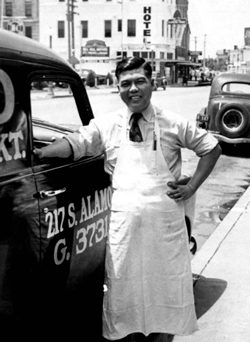
Fred
Wu stands by his delivery truck, in front of Alamo Grocery at 217
S. Alamo about 1946. Fred bough the successful market from his uncle,
Ted Wu, then ran it until 1964 when he relocated due to HEMISFAIR
in 1968. Fred became a founding member and first president of the
Chinese American Optimists Club of San Antonio in 1953.
Photo courtesy Virginia Wong |
The
1920s and '30s were the Golden Age for San Antonio's Chinese community
when more families settled down there, raised kids and established
businesses. The majority of them owned and operated "mom & pop" grocery
stores that were scattered in and around the downtown area. There
was never a Chinatown as such in SATX because the market families
assimilated fairly quickly into the already remarkably diverse ethnic
patchwork that San Antonio had been since the 1850s. Germans, Irish,
Jews, Italians, French, Black, English and of course Mexican populations
had been living together for years by the time the Chinese arrived.
For various historical reason, the majority of the Chinese coming
to America from the 1870s onward came from Kwangtung, now Guangdong
province near Canton. As a result of this trend the original American
Chinese were a mostly homogenous group in terms of dialect, tradition,
attitude and behavior. This was equally true of those coming into
San Antonio's multicultural milieu.
So the Chinese entered into the midst of this colorful quilt as neither
white nor black. This enabled them to live wherever they chose, have
businesses in any sector and send their kids to the nearest school
regardless of its racial makeup. Their many, family run markets and
numerous cafes became familiar sights nearly everywhere in town. ABCs
or American Born Chinese were growing up as Texans and along with
their "paper son" siblings were also building the homogenous community.
Paper sons were those young men born to American fathers who visited
wives in China who could not immigrate because of the Exclusion Laws.
|
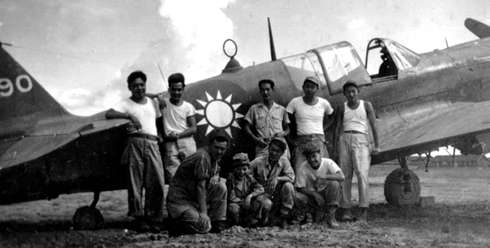 |
| The All-Chinese
American 555th Air Service Squadron members pose next to one of the
P-40s belonging to the Chinese American Composite Wing of the 14th
Air Force under Gen. Claire Chennault. Their mascot Stevie(an orphan)
kneels next to San Antonian Sgt. John Leung during a lull in activity.
Photo courtesy Dora Leung |
Finally
the old Exclusion Laws were undone in 1943 as WW II raged across Asia
and thousands of Chinese Americans joined the U. S. armed forces.
A number of San Antonio's ABC's and those so called "paper sons" also
enlisted. Along with Generalissimo Chiang Kai-shek, Gen. Claire Chennault
requested that an Army unit be established entirely of Chinese Americans
to be sent to China for the war effort. The 14th Air Service Group
was formed and arrived there in late summer 1944 then got busy using
their training in different ways to ensure that the American and Chinese
air forces were as effective as possible against the large and powerful
Japanese army. - "The 14th Air Service Group was made up of nine technical
support units. Each of these performed some specialty such as the
various quartermaster functions as well as transportation and communications,
etc. They were responsible for supplying everything from tooth paste
and fresh uniforms to the fuel, spare parts, ammunition and bombs
needed for air operations. The 14th also managed level three of aircraft
maintenance and repair. Keeping aircraft operational was the 14th
ASG's most important task and was provided by the well trained 407th
Squadron mechanics and technicians."
They did everything from day to day maintenance to recovery and repair
of crashed airplanes. Salvage of unrepairable aircraft was another
of their jobs; it meant removal of all reusable parts or components.
That included everything from radios, to tires, instruments, wings,
and armament which could be reused on other aircraft. This duty and
service would prove, in the long run, quite beneficial to the men
themselves as they later would use Veteran's benefits to buy homes
or start businesses back in Texas. At the war's end, many of these
men were allowed time to return to their ancestral villages and areas
to look for wives. It proved to be a good policy as many of them eventually
brought women to the States for marriage and to begin families.
"Many
other Chinese American citizens served their nation in World War II.
Just over 13,000 of them enlisted or were drafted into the various
branches of the Army and Navy after Pearl Harbor was attacked. Added
to the number of those already in military service since 1940, that
number climbs closer to 16,000. They saw duty in overseas areas including
almost all of Europe, plus North Africa and the Mediterranean. Many
thousands more served in the Merchant Marine throughout the vast conflict.
During WW II, 214 Chinese Americans died while serving in all the
branches of the U.S. Armed Forces, either in combat, in accidents
or from illness." |
|
|
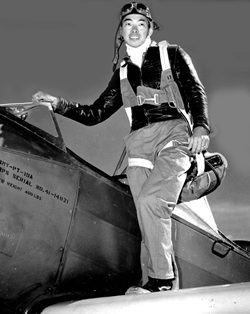
"Civilian
Pilot Training instructor Frank Eng awaits his next student on the
wing of a Fairchild PT-19A at a base near Ballantine in East Texas.
The Army paid private contractors all over Texas to teach basic flite
skills to thousands of young recruits during WW II because of the
shortage of military instructors."
Photo courtesy Virginia Wong |
"As
the 1950s began though, another challenge to full acceptance of Chinese
Americans as "real Americans" emerged. A new wave of racism arose
in the country which was fed as much by fear of communism as it was
by xenophobia. From June, 1950 the United States' dominant role during
the Korean conflict meant, in effect, an undeclared war with China.
That was due to Beijing's alliance with North Korea's marxist regime.
This produced much suspicion in America as to the loyalties of its
Chinese citizens. It came at the time when many Chinese Americans
were finally beginning to overcome old prejudices and fears in their
hometowns."
"Complicating matters, the FBI began covert surveillance and intelligence
gathering programs in many cities. Those programs had larger Chinatowns
pitting their citizens against each other over issues of loyalty.
The sadly contentious period passed but left many victims in its wake
as personal and political vendettas surfaced, leaving communities
with permanent scars. For the most part, these differences never became
disruptive for San Antonio's modest Chinese American community, long
noted for its conservatism and loyalty."
"However,
for one particular family this was indeed an issue and one which permanently
affected its children. By the mid-1950s, Mr. Hong Fat Lee became
known in town as being sympathetic toward Chairman Mao's mainland
or "Red" China regime. His views ran contrary to the convictions of
most San Antonio Chinese at the time who favored the Taiwan based
Nationalist government of the Kuomintang's Chiang Kai-shek. Beyond
the day to day friction it caused him within the community, it also
made the grocery man suspect to the authorities as well. A good American
and staunch believer in personal freedoms, the well read Mr. Lee was
also somewhat outspoken in his political opinions. This eventually
led to disruptive visits from the FBI which was then known to harass
citizens it perceived as disloyal to America."
"So it was that late one night twelve year old Tom Lee was
awakened by loud knocking on the front door of the family home on
Texas Street. Opening the door, he was confronted by a G-man who demanded
to speak with his father immediately. Sleepy and now grumpy, Tom told
the agent that his parents had already retired after a long day of
work at the family store. He added that if the man wanted to discuss
something with Mr. Lee, he could find him any day of the week at the
nearby HONG LEE Market. Tom then slammed the door in the agent's face
and went back to bed."
"Tom could also have told the FBI man that his father was a strong
supporter of Congressman Henry B. Gonzales (Texas' first Hispanic
U. S. representative), always voted Democratic and instructed the
Lee children in the particulars of the U. S. Constitution. That young
Tom Lee would eventually become a political activist who participated
in early and very unpopular civil rights demonstrations while attending
The University of Texas at Austin. It was there on campus in 1961
that he shook hands with Dr. Martin Luther King. In doing so, Tom
expressed his own heartfelt beliefs and honored his dad's unique style
of Americanism." |
Mary
Eng or "Auntie Mary" to hundreds of family and friends, is one
of the most remarkable citizens San Antonio has ever known. She was
born in Shreveport, Louisiana where her father operated one of the
largest laundry businesses in that state. Mary lived in China for
three years, receiving the traditional education which her father
required, and graduated from high school there. She later married
a San Antonio merchant named Joseph Eng, raised four children, organized
youth clubs, led China Relief drives, worked in the family's markets,
taught English to war brides, was a Civil Defense worker, captained
a women's bowling team, baked countless almond cookies and made egg
rolls for annual charity functions in her spare time.
"Perhaps the most colorful media account regarding Mary Eng was the
result of a notorious robbery at JOSEPH's Foodliner in the spring
of 1973. Two bad guys named Jones and Perez entered the market with
larceny in their hearts. This was their second holdup of the afternoon,
as Mr. Jones cornered Joseph and Mr. Perez concentrated on Mrs. Eng.
Short little Mary saw a pistol pointed at her and emptied the cash
register as instructed. That set off an automatic alarm, which spooked
the two desperadoes who fled with $1700 of hard earned Eng cash in
a stolen 1967 Mustang. The two might have gotten away if they hadn't
run a stop sign in front of a police car just a few blocks away."
"Thereon followed a 100 mile per hour running gun battle up I-35 to
New
Braunfels. The chase involved forty police, sheriff and constable's
cars, a helicopter and a TV news crew who happened to be nearby. After
running two roadblocks, the desperate duo was stopped in a lethal
hail of gunfire from peace officers. Both outlaws died and JOSEPH's
Foodliner was open for business the next day. Mary Eng was at the
cash register as usual, though still a bit shaky but planning her
next club committee meeting."
Now at age 90, Aunty Mary Eng epitomizes the historic San Antonio
Chinese community and embodies its spirit of the American "can do"
attitude and a Texan's love of place. The old Alamo City turned put
to be the perfect choice of a home that early Chinese pioneers could
have made to live in a hundred and thirty odd years ago. Modern immigration
into the bustling city of Saint Anthony has widened to include many
others from the wider Asian continent and Pacific Rim nations now
as history continues to be made there. Chinese Heart of Texas is only
the beginning of a history long overdue in the telling and hopefully
much appreciated for its ongoing chapters now in the making.
© Mel
Brown |
|
|
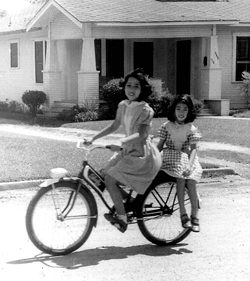
"Wan
Lee and her sister Shirley sharing a summertime bike ride past their
home on Texas Ave. about 1950. The two Lee girls along with their
seven siblings grew up helping in their parent's store the Kong Lee
Market on nearby Zarzamora Street."
Photo courtesy Dr. Washington Tom Lee |
|
|
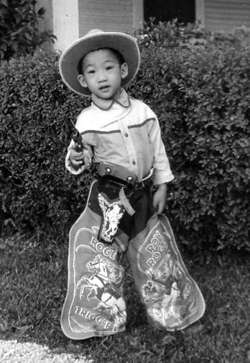
Five
year old Washington Tom Lee shows off his official Roy Rogers cowboy
outfit and six-shooter cap pistol at his Texas Avenue home in San
Antonio about 1952. This youngster has become one of the city's most
respected physicians while his brother and a sister are also MDs,
one in Cal. the other in NYC.
Photo courtesy Dr. Washington Tom Lee |
Order
Information:
Order "Chinese Heart of Texas" and his other books by contacting
Mr. Mel Brown directly at 512-288-7354 or by email at melbjr@earthlink.net
Books ordered from Mr. Mel Brown are autographed and may have a personalized
dedication added upon request
|
| San
Antonio in Vintage Postcards |
|
|
|
|
 HOME
HOME