|
New Braunfels
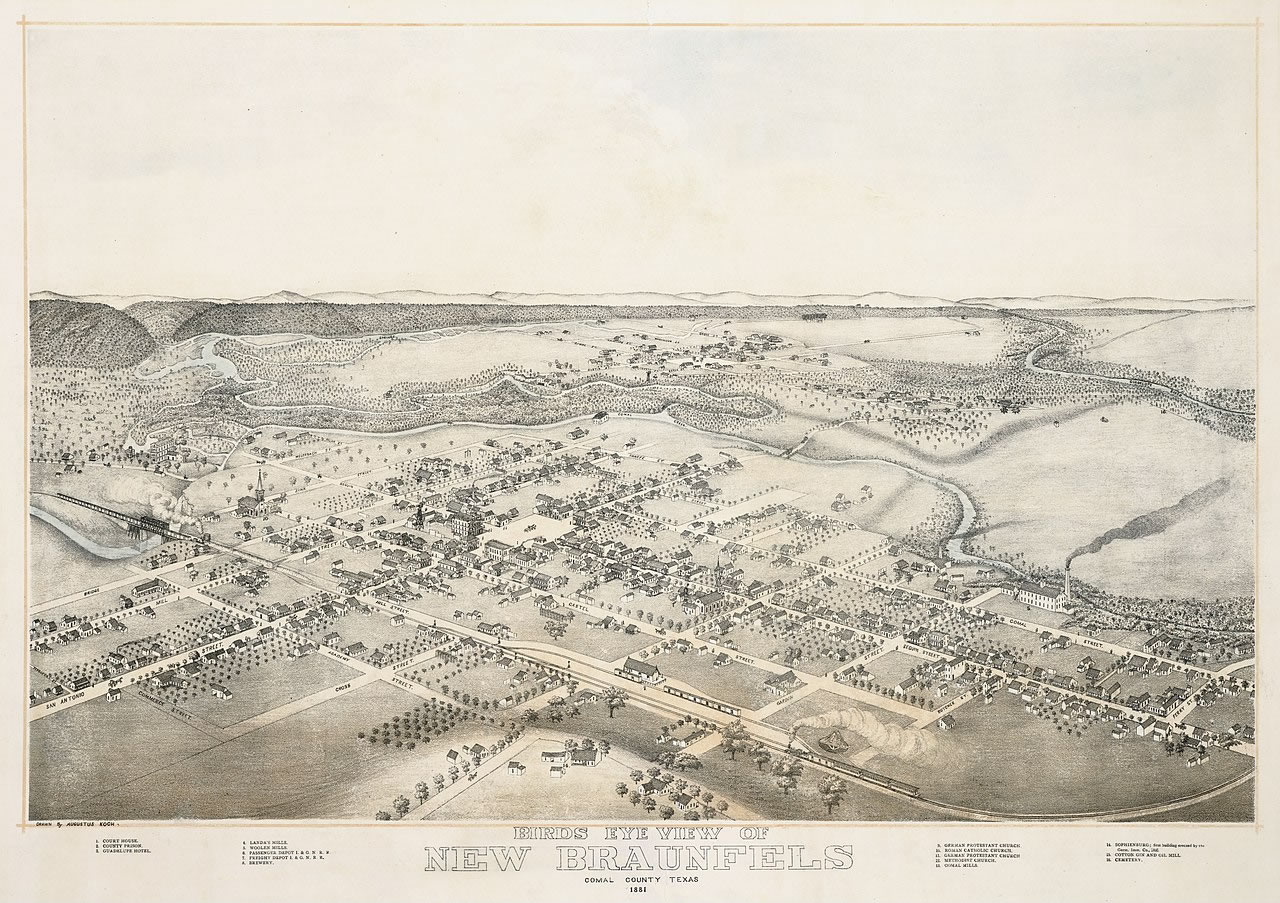
1881 Birds Eye View
by August Koch, Amon Carter Museum |
New Braunfels,
Texas History
The
Story of our Texas' German Pilgrims: or Death March to Comal County
by W. T. Block Jr.
"...Of the first German Pilgrims to Texas in 1845... only one
in four survived the walk from Indianola to New Braunfels..."
more
New
Braunfels, Texas: Pearl of the Comal-Guadalupe Valley by W.
T. Block Jr.
"Perhaps New Braunfels was to play a role in frontier Texas
history only because of the reactionary conditions that existed
in post-Napoleonic Europe... In the late winter of 1845, the story
of the first 6,000 immigrants to land at Carlshafen, which was still
a prairie, makes the first year's History of the Plymouth Pilgrims
mild by comparison..." more
History in a Pecan Shell
Prince Carl of Solms-Braunfels and other semi-nobles from Germany
had contracted to settle the "western lands" of the New Republic
of Texas. The land grants were to be between the Upper Colorado
and the Llano Rivers. New Braunfels and Fredericksburg
were originally meant only to be way stations.
Carl only spent a short time in the town that continues to wear
his name. He returned to Europe in 1845 to marry and never returned.
Meanwhile, the society that was to aid the immigrants went broke.
By the time the bulk of the immigrants arrived they were stranded
(in the truest sense of the word) at Indianola.
Hundreds died on the beach and many attempted to walk across a land
very different from Germany. Recent arrivals infected the settled
Germans with Yellow Fever and hundreds more died. About the only
benefit to come from the trek was the settlement of many towns in
Victoria,
DeWitt and
Lavaca Counties.
|
|
|
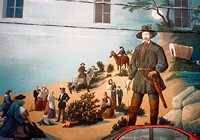
Prince
Carl of Solms-Braunfels mural
TE photo |
The
mural fails to convey any sense of desperation.
Prince Carl planned on governing "his" town from the high ground where
the Sophienburg Museum is today (401 Coll Street).
Arriving about the time Texas was
annexed to the U.S., the Germans found themselves in a land at war
with neighboring Mexico. Between the Mexican War and the Civil War
New Braunfels was the 4th largest city in Texas.
They managed to avoid participating in the war with Mexico, but weren't
so lucky when the Civil War broke out a few years later.
New Braunfels grew steadily. A period of prosperity in the late 1800s
built the courthouse
and many elaborate Victorian homes and buildings
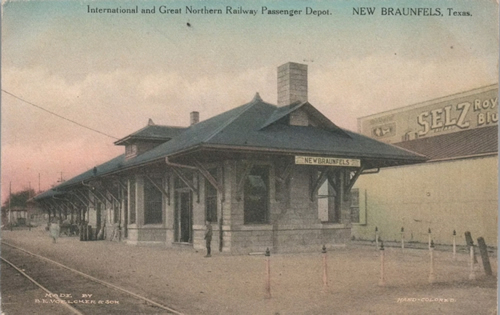
The International and Great Northern Railroad came to
town, followed by the Missouri, Kansas City and Texas. Railroad
spurs laid to Landa
Park began New Braunfel's tourism industry with excursion trains
from towns as far away as Taylor
and Elgin. |
 |
|
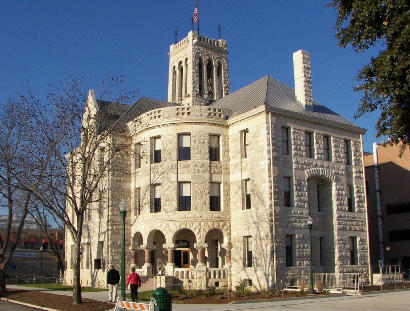
The
Comal County Courthouse ›
An 1898 design by J. Reily Gordon. It is nearly identical to Gordon's
Lee County Courthouse (1897) in Giddings.
The New Braunfels Square
An unusual design, but practical. Traffic circles are terrors to
those unaccustomed to them, but the corners provide a safe harbor.
Reaching the fountain in the center of the island gives one a feeling
of accomplishment for having reached it in one piece - the pedestrian
can then rest while they consider a plan for re-crossing.
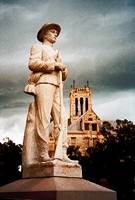
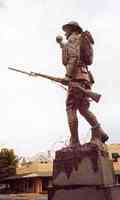
The two statues - one Confederate and one "Doughboy" were
donated years apart - but both were donated by Mr. and Mrs. E.A.
Clousnitzer.
|
|
|
|
Confederate
soldier
and courthouse
TE photo |
The Doughboy
Statue
(dedicated November 11, 1937)
TE photo
|
| There
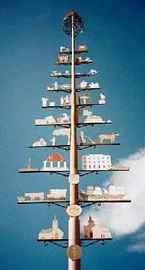
is also a beautiful fountain and a Friendship Tree -
symbolizing some sort of bond between New Braunfels and "Old" Braunfels
- back in Germany. |
New Braunfels,
Texas
Landmarks/Attractions
|
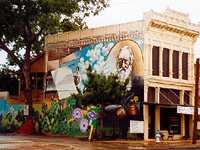
A
mural just off the square shows landscapes, flora, fauna and indigenous
peoples of the region. There's also an 20-foot image of Ferdinand
Jakob Lindheimer - the botanist who spent a good part of his life
classifying Texas flora.
TE Photo |
 |
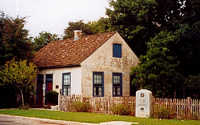
The
Lindheimer Home
(c. 1852) is included on the city's driving tour. Many of the plants
named by Lindheimer
are growing today on the grounds of his former property.
491 Comal St. Admission.
TE Photo |
|
The Children's
Museum - 386 W. San Antonio. Admissions
Clear Springs
Aviaries and Zoological Gardens -
35-acre park home to over 200 species of exotic birds and animals,
2000 species of exotic plants. I-35 South, Exit 182. 830-606-6029.
Admission.
Conservation
Plaza - Showcasing preserved buildings owned by the New Braunfels
Conservation Society. 1300 Church Hill Dr. Admission
Dry Comal
Creek Vineyards - 6 miles West of New Braunfels. On Hervelin
Road off Hwy 46 West. 830-885-4121
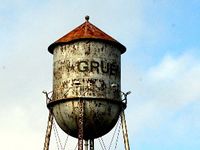
Gruene
Historic Distict - In the New Braunfels City Limits
A village established by German immigrants before 1850. Today a
popular tourists destination. Includes old homes, stores, galleries,
beer hall, and inns. Designated a Historic Town by the State of
Texas.
Old Gruene Market Days - the third weekend from February
through November, and the first weekend in December.
The Henne
Hardware Company (c.1893) - 246 W. San Antonio Street
Lake
- Canyon Lake
Landa
Park/ Comal
Springs - Scenic city parknear downtown.
196 acres. Site of the annual Wurstfest.
New Braunfels has Texas' shortest river - the 2.6 mile long Comal
River, whose source and confluence (with the Guadalupe)
are within the city limits.
Museum of
Texas Handmade Furniture - In the historic Andreas Breustedt
home, circa 1858. 1370 Church Hill Dr. Admission
New Braunfel's
Fire Museum - Fire Station One - First block of Hill Street
New Braunfels
Museum of Art and Music - 800-456-4866
Smithsonian-affiliated museum.
1257 Gruene Road in Gruene Historic District. Admission.
Railroad
Museum - 102 N. Hill Street in the Old New Braunfels Depot (c.1891)
Schlitterbahn
- 400 N. Liberty St. 830-625-2351. Admission.
Snake Farm
- I-35 South, Exit 182. 830-608-9270
Sophienburg
Museum - 401 W. Coll St. at Academy Ave. Admission
Wagenfuehr
Home and Buckhorn Barbershop Museum -
521 West San Antonio St. Admission
|
 |
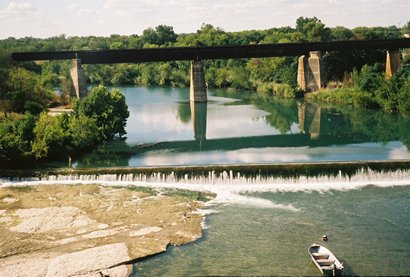
Faust Street
Bridge
Photo courtesy Chia-Wei Wang, August 2006 |
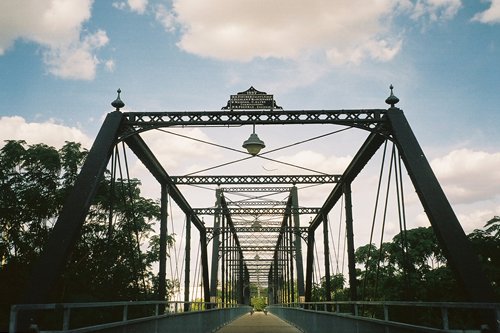
Faust
Street Bridge c.1887
One of the more interesting bridges in this part of Texas is the old
Faust Street Bridge c.1887 over the Guadalupe
River. The water is usually clear and the fish can be clearly
seen.
The bridge just underwent a restoration in 1998 and benches have been
provided for fish watching. |
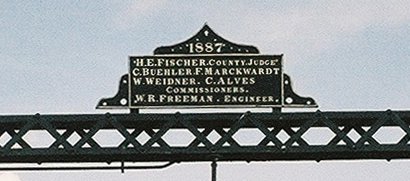
1887 Faust Street
Bridge plate
Photo courtesy Chia-Wei Wang, August 2006 |
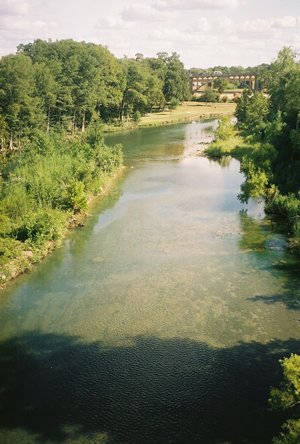
View of the railroad
bridge over the Guadalupe
River
Photo courtesy Chia-Wei Wang, August 2006 |
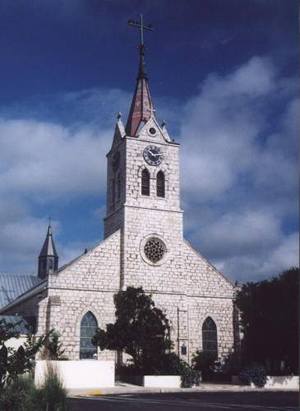
Sts. Peter &
Paul Catholic Church
Photo courtesy Barclay Gibson, April 2005 |
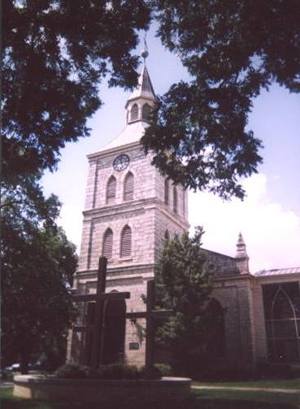
New
Braunfels Prostestant Church
Photo courtesy Barclay
Gibson, June 2003 |
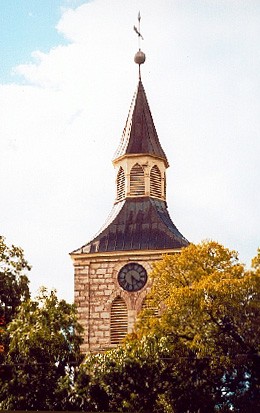
New Braunfels
Prostestant Church tower
TE photo,
2004
More Texas Churches |
|
|
|
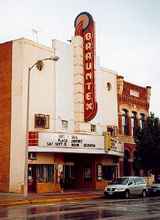
The
Brauntex Theater
TE photo |
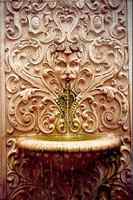
Faust fountain,
historic Faust Hotel
TE photo
|
SCENIC DRIVES -
RR
32. The road runs the crest of the ridge called the "Devil's
Backbone".
River
Road - Along the Guadalupe River
10.6-mile scenic drive between Loop 337 in New Braunfels and Canyon
Lake Dam which crosses the Guadalupe River four times
Book Hotel Here › New
Braunfels Hotels
|
New Braunfels,
Texas Chronicles
Lincoln
Slept Here? by Mike Cox
“Hotel Where Lincoln Stayed Still Operating,” reads the headline
on the yellowed 1950 newspaper clipping. That a hotel might be in
business nearly a century after Abraham Lincoln spent the night
in one of its rooms would not be particularly remarkable in Illinois
– say Springfield – or Washington. But the “Lincoln slept here”
assertion appeared in a Texas newspaper and referred to a historic
hostelry in New Braunfels... more
Skat
by Michael Barr
Skat was once a popular card game in the German Hill Country...
The game of skat (pronounced 'scot') originated in Altenberg, Germany
in the early 19th century when members of the local card players'
club combined elements of a popular Italian game called Tarock with
another game called Schafkopf (sheep's head)...
There are still skat tournaments in Seguin and New Braunfels, but
not so much in Fredericksburg anymore. Skat has gone the way of
9-pin bowling and cursive writing.... more
|
 |
New
Braunfels Tourist Information
Vistior Center - I-35 and Post Road. North of New Braunfels.
Open daily. 800-572-2626
New Braunfels Chamber of Commerce -
390 E. Seguin 1-800-572-2626
Website: www.nbcham.org
City of New Braunfels - 424 South Castell Avenue -
PO Box 311747 New Braunfels, Texas 78131-1747
Phone: (830) 608-2100
http://www.ci.new-braunfels.tx.us/
New Braunfels City Hall - (830)-625-6200. |
| Texas
Escapes, in its purpose to preserve historic, endangered and vanishing
Texas, asks that anyone wishing to share their local history, stories,
landmarks and recent or vintage photos, please contact
us. |
|
|
 HOME
HOME