|
|
 |
From "Eighteen
Ghost Towns of Runnels County" by Alton O'Neil Jr.
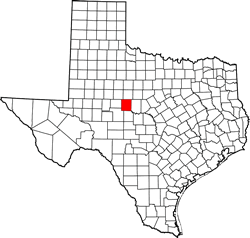
Olfen, ten miles north of the confluence of the Colorado and Concho
rivers in Runnels County,
is a German Catholic community. In the early 1890s German Catholics
who had immigrated to Colorado,
Fayette, and other
counties in Southeast Texas from 1846 to 1890 looked toward West Texas
for farmland, a healthy climate, and a place to establish a Catholic
environment. By the 1890s the railroad had built as far as Ballinger
on the Colorado River.
Bernard Matthiesen, from Ellinger
in Fayette County,
went by train to Ballinger
in June 1891 and again in October 1891 by horse and wagon to look
for farmland. In 1893 he bought land and moved his wife Elizabeth
(Hoelscher) and family to what is now Olfen. In 1901 Matthiesen and
Willy Glass wrote to Bishop John Anthony Forest in San
Antonio and obtained permission to build a school, to be used
also as a church. Father Frank Maas was the first pastor.
The community was first called Fussy Creek, then Maas,
and finally Olfen, after Olfen in Westphalia. The first mass
in the church-school was the wedding mass of Bernard Niehues and Amalia
Matthiesen. The new bride, given the privilege of naming the church,
chose the name St. Boniface, for a popular German saint. The
community grew quickly. In 1909 Father Frank Garmann, who had succeeded
Father Maas, built a new church. In 1921 a group of men from outside
Olfen, whipped up by the anti-German sentiment during and after World
War I, took Father Joseph Meiser from the rectory, intending to
tar and feather him. Unknown to them the housekeeper, who had managed
to conceal herself, telephoned parishioners, and within minutes a
caravan of cars was in pursuit. The men, seeing them, pounded on Father
Meiser and shoved him out of the car, giving up the plan to tar and
feather him. The 1909 church burned to the ground on January 15, 1922.
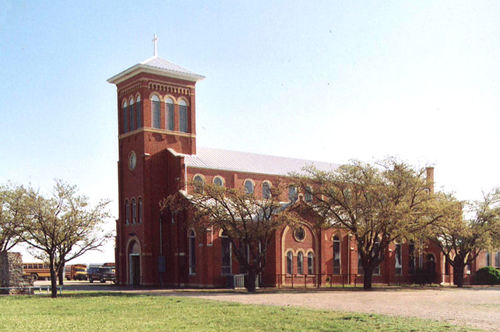
The people immediately got to work and in ten months built a large
and beautiful Romanesque church, dedicated on November 16, 1922. The
community was still listed in 1990. |
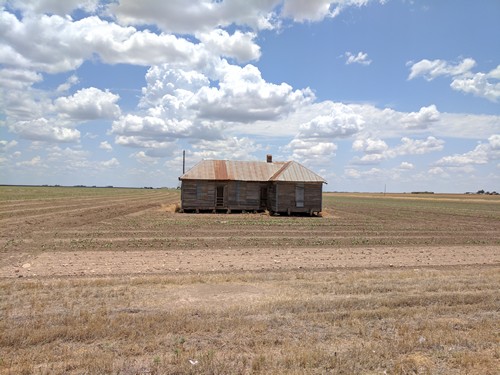 |
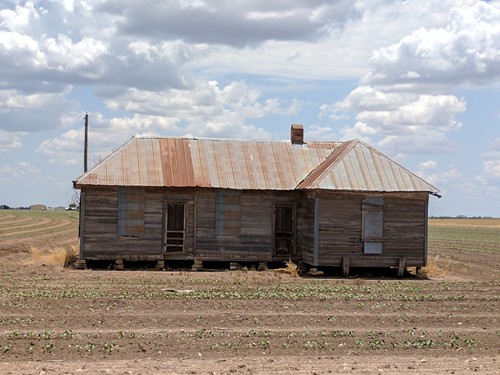
| Photo
courtesy MF Peck, July 2017 |
| Photo
courtesy MF Peck, July 2017 |
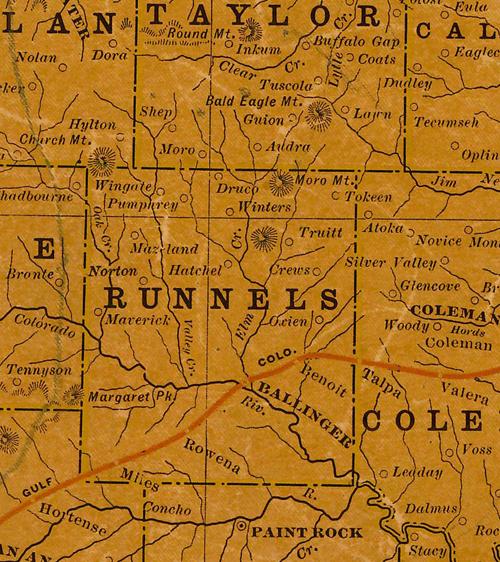
Runnels
County 1906 Railroad map showing the confluence of the Colorado
and Concho rivers
From Texas state map #10748
Courtesy
Texas General Land Office |
| Texas
Escapes, in its purpose to preserve historic, endangered and vanishing
Texas, asks that anyone wishing to share their local history, stories,
landmarks and recent or vintage photos, please contact
us. |
|
|
 HOME
HOME

 Texas
Gulf Coast
Texas
Gulf Coast East
Texas
East
Texas Central
Texas North
Central
Texas North Central
Texas South
Central
Texas South Texas
Panhandle
Texas
Panhandle South
Texas
South
Texas Texas
Hill Country
Texas
Hill Country West
Texas
West
Texas Texas
Ghost Towns
Texas
Ghost Towns Texas
Counties
Texas
Counties