|
 |
History in
a Pecan Shell
Whiteflat was originally
a Matador
Ranch line camp. Either Bill Tilson or Mrs. H. H. Campbell named
the town in 1899 for the abundant white needlegrass.The town was established
between the geographic features of Willow Creek and Tom Ball Canyon.
By 1910 Whiteflat had a school and the population reportedly reached
several hundred.
The high school dates from the 1920s when the town also had a cotton
gin and post office.
According to the Handbook of Texas, "early families included the Tilsons,
Bloodworths, Wilkinsons, Morrisses, and Kimbells."
The population was a mere 50 in the late 1940s - the period of increased
mobility and school consolidations. The proximity of Matador
was the biggest contributor to Whiteflat's decline. In 1980 the population
was down to only 20 and the Texas highway map of 2000 shows an estimated
population of three people.
The post office and all businesses have long been closed. |
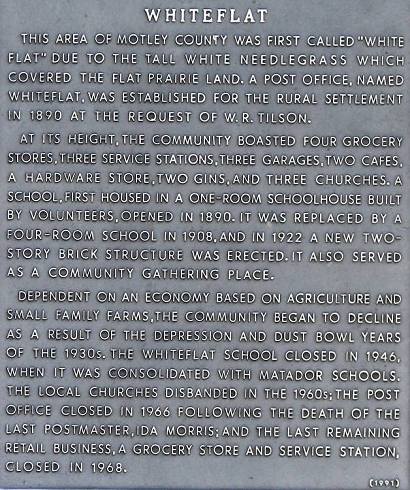 |
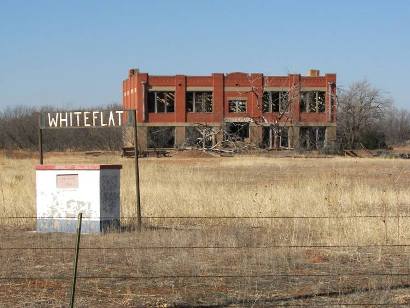
Whiteflat
Historical Marker (On Hwy 70)
Photo courtesy Barclay
Gibson, 2007 |
Historical Marker:
WHITEFLAT
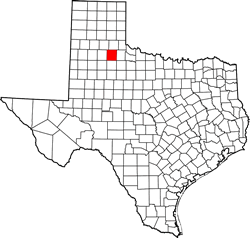
This area of Motley
County was first called "White Flat" due to the tall white needlegrass
which covered the flat prairie land. A post office, named Whiteflat,
was established for the rural settlement in 1890 at the request of
W.R. Tilson.
At its height, the community boasted four grocery stores, three service
stations, three garages, two cafes, a hardware store, two gins, and
three churches. A school, first housed in a one-room schoolhouse built
by volunteers, opened in 1890. It was replaced by a four-room school
in 1908, and in 1922 a new two-story brick structure was erected.
It also served as a community gathering place.
Dependent on an economy based on agriculture and small family farms,
the community began to decline as a result of the depression and dust
bowl years of the 1930s. The Whiteflat school closed in 1946, when
it was consolidated with Matador
schools. The local churches disbanded in the 1960s; the post office
closed in 1966 following the death of the last postmaster, Ida Morris;
and the last remaining retail business, a grocery store and service
station closed in 1968. |
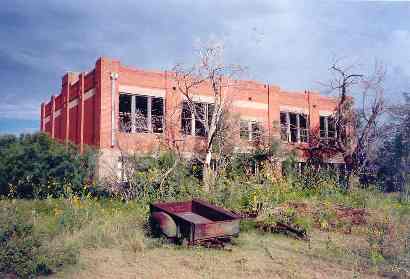 |
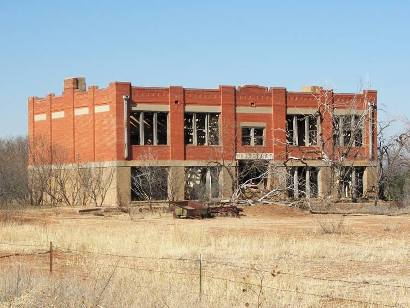
The old Whiteflat
school. "It's now overgrown and horses are kept on the land behind
the school building."
- Jon M. Hager, 9-04 photo |
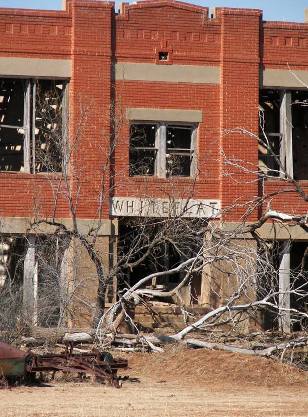
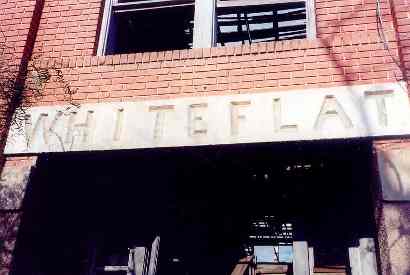
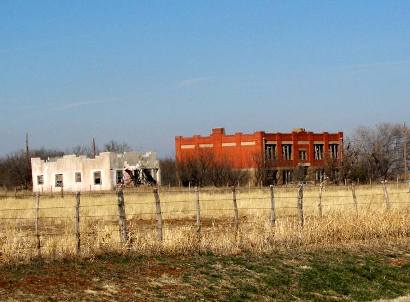
Close
up view of Whiteflat school
Photo courtesy Jon M. Hager, 9-04 |
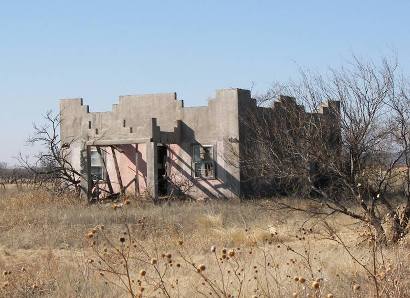
The parsonage
for the Methodist Church
Photo
courtesy Barclay
Gibson, 2007 |
PHOTOGRAPHER'S
NOTE:
I happened across Whiteflat while driving back from a hiking trip
with my son Erich (Labor Day weekend). Whiteflat is in the panhandle
(Motley County)
on highway 70 between Turkey
and Matador.
The current local population can't be more than a handful as I saw
only one home that looked as if it might be occupied (though we did
not explore the area very long).
I've provided copies of three of the photos I took during our visit.
- Jon M. Hager, Grand
Prairie, Texas, September 12, 2004 |
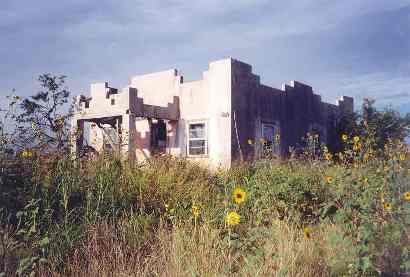
The parsonage
for the Methodist Church
Photo courtesy Jon M. Hager, 9-04 |
Whiteflat,
Texas Forum
Subject:
Whiteflat Methodist Church
My wife and I were married in the Whiteflat Methodist Church in
1961. Her mother was the pastor at the time, but my wife's older
brother performed the ceremony. We heard that the church building
had been moved to another community. Can someone verify that? -
Lamar Taylor, March 21, 2020
Three Things
about Whiteflat
My grandfather, William W. Pierce, rented a farm near White Flat
sometime between 1918 and 1925. He and his older sons, my uncles,
raised cotton until a barn fire destroyed the harvest they were
storing there, waiting for better prices. They later moved to Floydada,
where my mother met my father in 1929. My aunt, Mae (Pierce) Griggs,
who died in January of 2005 at the age of 97, told me three things
about those times at White Flat:
1. The school hired some local boys to drive to the surrounding
farms in a covered wagon to bring the children to school.
2. The school did not have a storm shelter. Instead there was a
large ditch next to the building. If a tornado was sighted the students
and teachers would lie down in the ditch.
3. Airplanes were extremely rare in this region at the time. One
day one flew over the school. The teachers allowed all the students
to run outside to see it. - Thomas Maddux, September 23, 2006
The Buildings
in Whiteflat, Texas
I grew up in Whiteflat and the white building was the parsonage
for the Methodist Church which I attended in the 1950 until it closed
in the 1960.
The old school building was used in the 50's and 60's to hold elections
and I can remember attending a Halloween haunted house there put
on by the Home Demonstration Club.
The Baptist Church was behind the school building. If you go west
on the dirt road, you will come to the Whitflat Cemetery. - S. Alexander,
June 10, 2005
Subject:
White Building
Perhaps this building was a business or government building before
mid 1930, but I really believe it was the parsonage for the Methodist
Church. I have been inside the house and cannot imagine it serving
any purpose other than a residence. - Earle Price, May 22, 2005
|
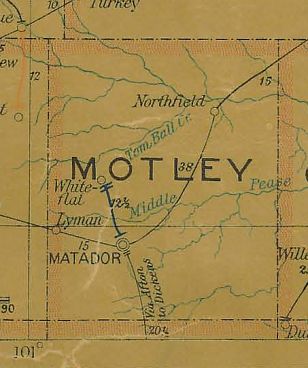 |
1907 Motley
County postal map showing Whiteflat
From Texas state map #2090
Courtesy Texas General Land Office |
| Texas
Escapes, in its purpose to preserve historic, endangered and vanishing
Texas, asks that anyone wishing to share their local history, stories,
landmarks and recent or vintage photos, please contact
us. |
|
|
 HOME
HOME