|
|
ALIEF, TEXAS
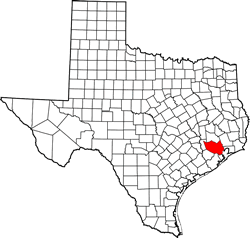
Harris
County, Texas
Gulf Coast
29° 42' 40" N, 95° 35' 47" W (29.711111, -95.596389)
SW Houston
between Bellaire Blvd and Westheimer and
State
Hwy 6 and the Sam Houston Tollway
Population: 1,400 (1990, 2000)
Book Hotel Here › Houston
Hotels
|
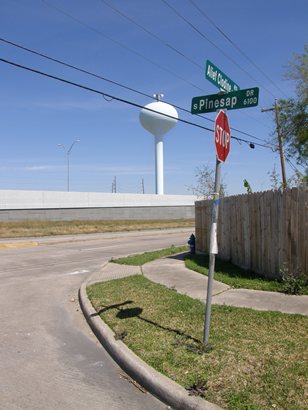
Alief Water Tower
TE photo, March 2009 |
History in
a Pecan Shell
Alief was first settled around the time of the Civil War. A man with
the redundant name of Reynolds Reynolds owned 1,250 acres of land
here along the bayou. Reynolds sold out in 1888 and the buyer, Jacamiah
Daugherty, granted a right-of-way to the approaching San Antonio and
Aransas Pass Railroad the following year.
Francis I. Meston purchased the land in 1893 and the following year
Harris County surveyors
listed the community as Diary, Texas. When the town received
its first post office the name officially became Alief after Alief
Ozella Magee, the first postmistress.--- The population was a mere
25 people in the mid 1890s. Alief suffered a flood in 1899 and the
Galveston
Storm hit the following year. Prone to frequent flooding, Alief’s
prairies were perfect for rice farming and from 1900 through 1915
rice became the predominant crop.
In 1901 Alief received an influx of German immigrants. A few years
later many who had fled after the 1900
storm returned to bolster the community and the railroad invested
in passenger and freight depots.
An irrigation system reached Alief in the 1930s and reestablished
rice farming. The Great Depression reduced Alief’s population from
112 to a mere 35.----But it rose to 200 by 1942 only to decline again
after the war.
The Alief ISD (established in 1911) is the most noticeable entity
in town with several large schools and a 10 acre maintenance facility
for the district’s school buses.
By the 1970s much of Alief had been annexed by Houston.
The population has been given as 1,400 from the early 1960s through
2000. Alief-Clodine Road now parallels the Westpark Toll Road and
it’s hard to tell where Houston leaves off and Alief begins due to
Houston’s ever-expanding
Chinatown. |
| Texas
Escapes, in its purpose to preserve historic, endangered and vanishing
Texas, asks that anyone wishing to share their local history, stories,
landmarks and vintage/historic photos, please contact
us. |
|
|
 HOME
HOME

 Texas
Gulf Coast
Texas
Gulf Coast East
Texas
East
Texas Central
Texas North
Central
Texas North Central
Texas South
Central
Texas South Texas
Panhandle
Texas
Panhandle South
Texas
South
Texas Texas
Hill Country
Texas
Hill Country West
Texas
West
Texas Texas
Ghost Towns
Texas
Ghost Towns Texas
Counties
Texas
Counties