|
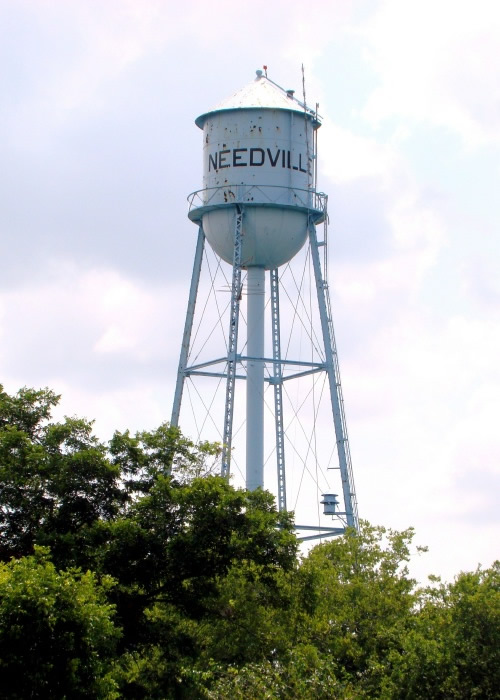
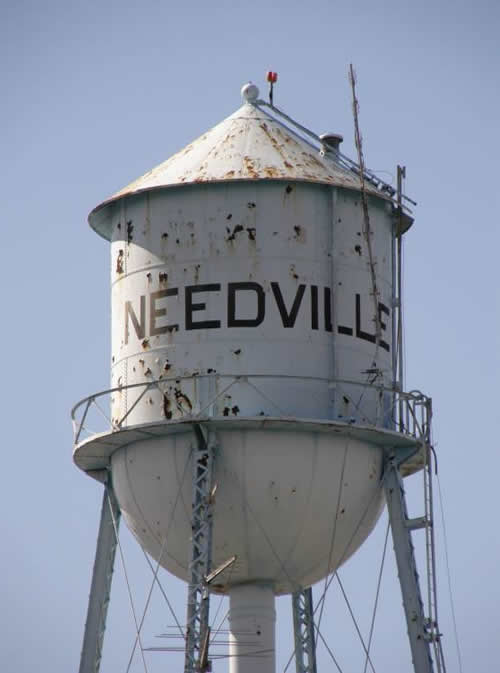
Needville water
tower
Photo courtesy Ken
Rudine, July 2007 |
History in
a Pecan Shell
First named Schendelville
after store and gin owner August Schendel, the town began in the early
1890s. When August made an application for a post office (1894) he
jokingly asked that it be called Needmore, but some postmaster in
West Texas had beat him
to it, so the authorities took the liberty of altering it to Needville.
A school opened in the late 1890s about the time the town was platted
and lots sold. The population was 100 in 1914 and the town received
a phone connection two years later. The Galveston, Harrisburg and
San Antonio Railway arrived in 1918. The population had increased
to 500 by the 1920s and Needville had its own electric generating
plant. In 1932 Highway 36 was constructed, giving the town it's first
all-weather road connecting it to other towns.
Needville students were bussed to Richmond
and Rosenberg until the late 1940s
when Needville formed its own ISD. The high school opened in 1948,
and the elementary school in 1960. The high school suffered an arson
fire in 2007, which destroyed much of the original building.
The N. A. Allen Elementary School was constructed for Black students
in 1960 and integrated six years later. The town got its first library
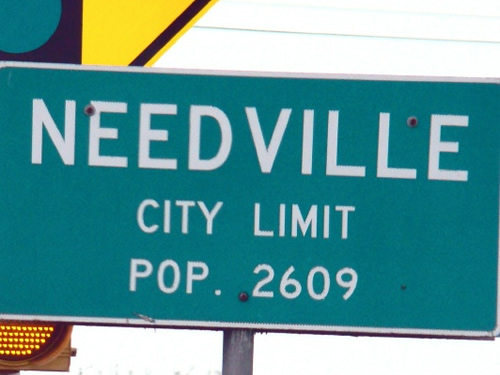
in 1974. The 1950 population was just over 600. It grew to 2,199 by
1990 and 2,609 for the 2000 census. |
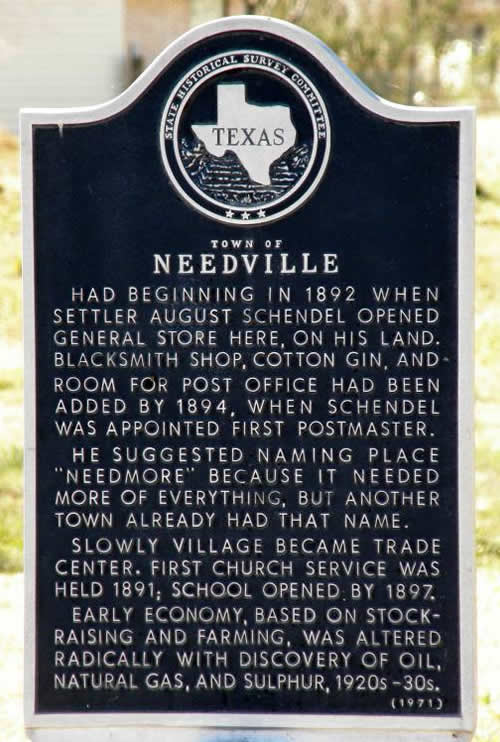 |
Needville Historical
Marker
Photo courtesy Barclay
Gibson, February 2009 |
Historical Marker:
Town of Needville
Had beginning in
1892 when settler August Schendel opened general store, here, on his
land. Blacksmith shop, cotton gin, and room for post office had been
added by 1894, when Schendel was appointed first postmaster.
He suggested naming place "Needmore" because it needed more of everything,
but another town already had that name.
Slowly village became trade center. First church service was held
1891; school opened by 1897.
Early economy, based on stockraising and farming, was altered radically
with discovery of oil, natural gas, and sulphur, 1920s-30s. |
Needville City
Limit sign
POP. 2609
Photo courtesy Ken
Rudine, July 2007 |
| Texas
Escapes, in its purpose to preserve historic, endangered and vanishing
Texas, asks that anyone wishing to share their local history, stories,
landmarks and recent or vintage photos, please contact
us. |
|
|
 HOME
HOME