|
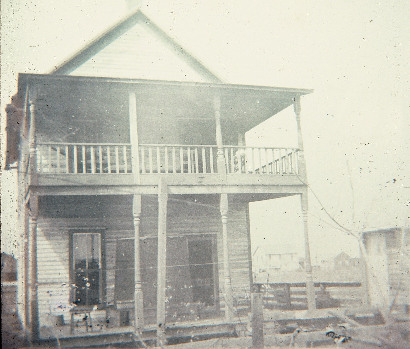
Pearland home
and post office in 1890's
Vintage
photo courtesy Pearland Historical Society
More Texas Post
Offices |
History of
Pearland, Texas
The original townsite
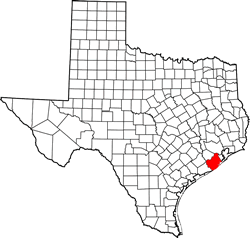
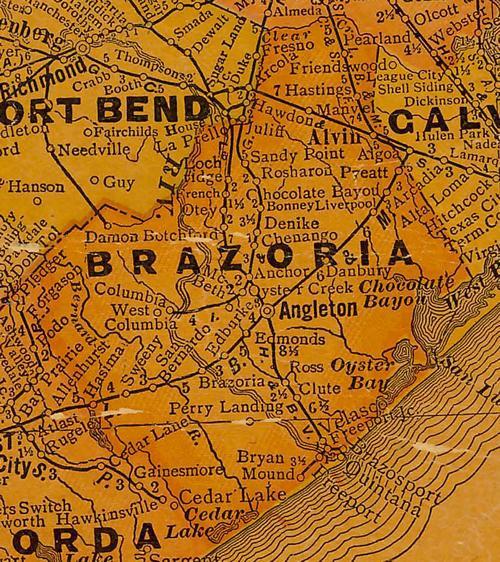
of Pearland is on State Highway 35 in Brazoria County approximately
37 miles north of Angleton, the county
seat. In 1882 the area became a siding switch for the Gulf, Colorado
and Santa Fe railroad on its route from Galveston
to Houston. The original
settlement was called “Mark Belt” when a post office was established
in the community in 1893. |
|
|
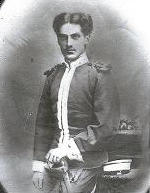
Witold
von Zychlinski - Polish nobleman who founded Pearland in 1894
Vintage
photo courtesy Pearland Historical Society |
| In 1892 Witold
von Zychlinski, a man who was purported to be a Polish nobleman, purchased
2500 acres of land adjacent to the railroad. Zychlinski reportedly
toured the area in a fancy buggy pulled by two shiny, high stepping
horses. An agent by the name of J.R. Jeter was hired to plant pear
trees and other fruit trees to spruce up the coastal prairie land.
On Sept. 26, 1894 Zychlinski filed the plat for the townsite of Pear
Land. Although the original plat read “Pear Land”, there is
no evidence it was anything but Pearland (one word) thereafter. Within
a year Zychlinski left for parts unknown and was never heard from
again. Many
thought Zychlinski was not really of Polish nobility; but just another
land speculator with a gimmick. However, in 2006 a member of the Pearland
Historical Society living in Denver, Colorado found a man in Chicago
by the name of William Willoughby who is the great grandson of Witold
von Zychlinski. Willoughby is a retired Major General of the U. S.
Air Force. General Willoughby was doing research on the Zychlinski
family and was in the process of writing a book on the family. He
verified that Witold von Zychlinski was a Polish Count who had married
a relative of President Zachary Taylor while she was in Poland at
a finishing school. General Willoughby also furnished the first picture
of Zychlinski anyone in Pearland had ever seen. Zychlinski and his
bride came to New York where he went bankrupt in a coal business.
He then left his wife and two sons to pursue business activities in
the south. His great grandson reported the family never heard from
him after that and he was unaware of his activities in Pearland. The
trail of Witold von Zychlinski ends the day he left Pearland. He has
never been heard of since and remains a man of mystery; but he is
the founder of Pearland and the man who ordered the planting of the
beautiful pear trees from whence came the name “Pearland”. |
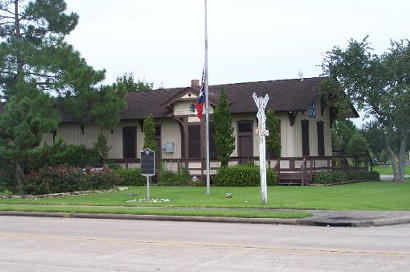 |
Original Pearland
depot built in 1890's.
Now moved to next to City Hall and a Texas Historical Building
Photo
courtesy Pearland Historical Society
More Texas Railroad
Depots |
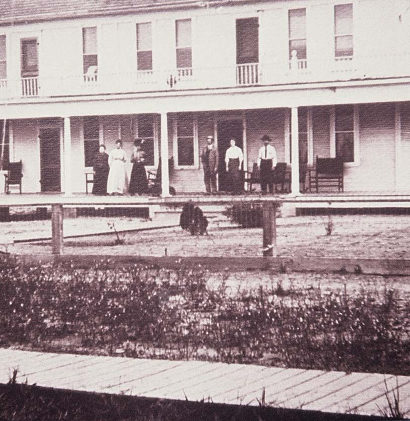
Suburban Gardens
Hotel approx. 1904
Vintage
photo courtesy Pearland Historical Society
More Rooms
with a Past |
| An advertising
campaign to attract buyers from the cold snowbound Midwestern states
promised buyers a virtual Garden Eden with beautiful flowering pear
trees, strawberry fields and orange orchards with a mild climate and
plenty of water. In 1894 a railroad station was built with labor furnished
by local settlers. The station today has been moved next door to Pearland
City Hall and is the oldest building in Pearland. From 1894 until
1900 many settlers came to Pearland attracted by the mild climate
and cheap land and the promise of pears, strawberries and oranges.
By 1900 there were 5 stores, a newspaper and a school with about 100
students. On Sept. 8, 1900
a devastating hurricane hit Galveston
killing some 8000 persons and virtually wiping up the little village
of Pearland. Many families abandoned their homes and farms and returned
to the Midwest. Over the next few years the pear trees died from the
blight, the strawberry patches were abandoned because of too much
rain; and most of the remaining settlers made their livings by baling
hay or raising cattle. Still the advertisements in the mid-west drew
new settlers who had their rail fares paid to visit “The Paradise
Garden”. A hotel called the “Suburban Gardens” was built across the
tracks from the depot to accommodate the prospective buyers. Once
more the Pearland had a mini-boom. Once again farmers were raising
oranges and vegetables and a great freeze struck and destroyed orchards
and vegetable farms and once again many settlers returned to the mid-west.
Still people came and in 1912 built a two story brick school. In 1915
once more disaster struck in the form of another terrible hurricane
which many old timers said was worse than the 1900
storm. The storm destroyed the new school and for the next 22
years Pearland high school age children were bused to Webster High
School. |
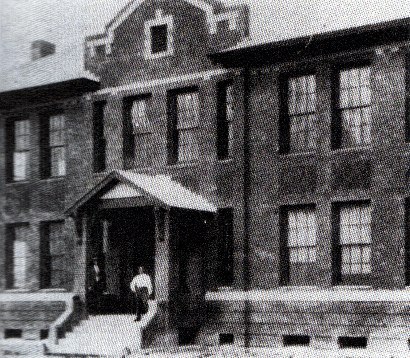 |
Pearland High
school built in 1912
- destroyed by storm of 1915
Vintage
photo courtesy Pearland Historical Society
More Texas
Schoolhouses |
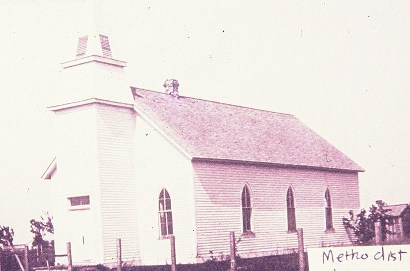
Pearland's Original
Methodist Church circa 1915
Vintage
photo courtesy Pearland Historical Society
More Texas Churches |
After the orange
orchards disaster, Pearland experienced another boom with the growing
of figs. A commercial fig canning plant in Pearland was a boon to
the economy. However overproduction virtually killed the fig industry
and from the period of around 1917 to the 30’s hay farming, cattle
farming and dairy farming were the means of livelihood for most families.
In the 30’s after discovery of oil at nearby Hastings and Manvel,
Pearland became a mini-boom town with dance halls and beer joints
flourishing. Most of the streets and roads in the area at that time
were oyster shell. A concrete highway connecting Pearland with nearby
Houston (Highway 35) was completed in 1936 giving Pearland citizens
a quicker access to the large city. Also a concrete road (Highway
518) to Manvel to the west of Pearland was completed in 1938. During
the oil boom years, the Pearland area also became a large rice growing
area with thousands of acres west of the city being cultivated for
rice. In those boom days Pearland also became known as a sort of “honky
tonk” heaven where oil field roughnecks, farm hands, and construction
crews came from all around the Houston
area to enjoy the numerous dance halls and beer joints. Also in 1937
a new school was constructed giving local high school students a first
class facility once again.
As Houston expanded, Pearland
grew also. In 1949 a Water Control and Improvement District was approved
by voters with basically the boundaries being the “old townsite” as
platted by Witold von Zychlinski. The City incorporated in 1959 and
the 1960 census listed Pearland’s population as 1497. During the past
5 decades the Pearland area has seen tremendous growth. Today the
population is over 90,000 with new sub-divisions and shopping centers
springing up on the western side of town. Although it is no longer
a small town, citizens are attracted to Pearland because of the still
small town atmosphere and especially to the excellent school district.
For more information about the history of Pearland see the Pearland
Historical Society website at www.PearlandHistoricalSociety.org
|
 |
| Texas
Escapes, in its purpose to preserve historic, endangered and vanishing
Texas, asks that anyone wishing to share their local history, stories,
landmarks and recent or vintage photos, please contact
us. |
|
|
 HOME
HOME