|
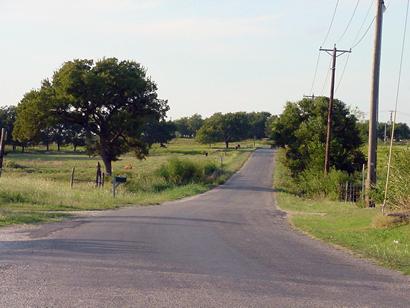
The road to Corn
Hill
Not to be confused with New
Corn Hill
TE
Photo, 9-04 |
History in
a Pecan Shell
>In
1855 a Judge named John E. King built his residence atop a topographical
feature called Corn Hill. The house served as a stop for the stage
line connecting Georgetown and Fort
Gates and a post office was granted the same year of 1855.
The town had an uneventful history until the 1870s and 1880s. The
first store was opened in 1869 and a gin two years later. In 1884
Corn Hill the town had 250 people with two mills, a Masonic lodge,
three gins, a newspaper, and the Corn Hill Academy.
By 1896 the population was 350 in 1896 and the town's high-water mark
came around 1910 when an estimated 500 people lived here.
The Bartlett and Western Railway
bypassed Corn Hill, and the town of Jarrell
was established alongside the rails. Corn Hill received a death blow
during the period 1910 to 1920 when all the people and most of the
buildings (including the post office) moved to Jarrell.
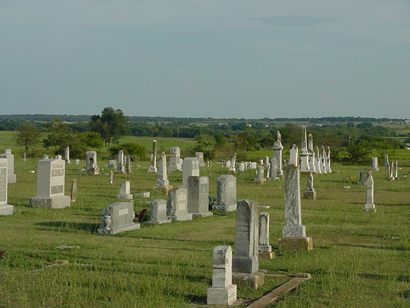
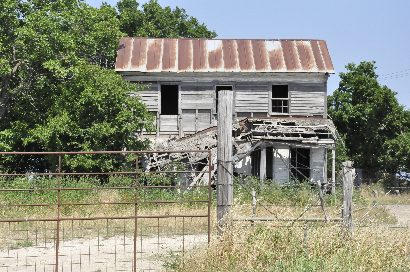
Today only a few buildings still stand. The old
city cemetery is less than a mile east of what had been the town.
It offers a sweeping view of the countryside and a distant view of
the church at New Corn Hill.
See 1907 Postal Map |
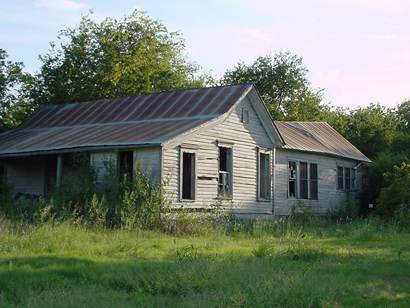 |
One of a few
remaining buildings in Corn Hill
TE Photo, 9-04 |
Historical
Marker
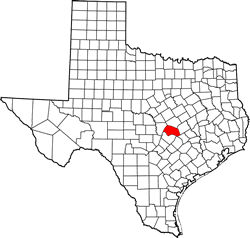
: 2 miles S of Jarrell on northbound
access road
Corn Hill Community
Settled primarily
by settlers from Texas and southern states, Corn Hill was one of the
earliest communities in Williamson
County. John E. King, county judge from 1858 to 1860, named it
for the home he built on a hill and nearby cornfield in 1852. The
dispersed agricultural community was the first stop on the stage line
running from Georgetown to Fort
Gates (Coryell
County).
A post office opened in 1855 and by the 1860s, an influx of new residents
settled here. In 1878, George G. Grant established corn Hill Academy
Male and Female School, built on land donated by Judge King. It thrived
and in 1886 moved to a new two-story building with four classrooms,
a bell tower and an auditorium, which provided meeting space for local
church services. By 1893, a public school opened as part of Corn Hill
Independent School District.
By the end of the 19th century, Corn Hill had a saddle club, several
churches, two locl cotton gins, Corn Hill College, fraternal lodges
and school organizations. By the early 1900s, community residents
became active in Populist politics and in the Farmers’ Union. Industrial
activity of the early 1900s included the Corn Hill and Gravis Telephone
Company and a waterworks; a planned interurban to Bartlett
never materialized.
The settlement began to decline in 1909 when the Bartlett Western
Railway bypassed two miles to the north, establishing the town of
Jarrell. Steam engines helped move
homes and businesses to the new townsite, and other moved to the village
of New Corn Hill, but many residents
chose to remain here. Today, the dispersed Corn Hill settlement survives
as a reminder of the area’s early agrarian heritage.
(2007) |
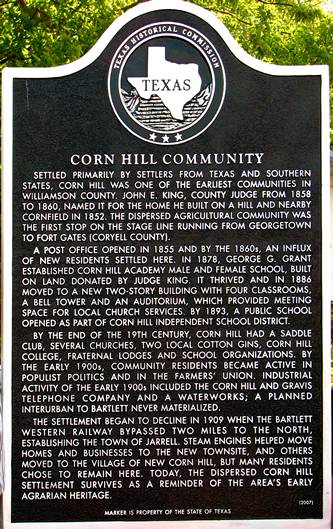 |
Corn Hill Community
historical marker
Photo courtesy Wayne Ware |
Corn Hill Cemetery
with a
distant view of the church at New
Corn Hill
TE Photo, 9-04 |
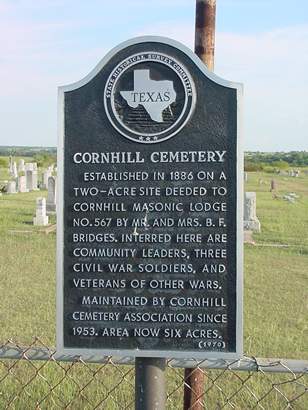
Historical Marker:
CR 313
Cornhill Cemetery
Established in
1886 on a two-acre site deeded to Cornhill Masonic Lodge No. 567 by
Mr. and Mrs. B. F. Bridges. Interred here are community leaders, three
Civil War soldiers, and veterans of other wars. Maintained by Cornhill
Cemetery Association since 1953. Area now six acres.
(1970) |
No more rooms
for rent
John Shaver home/hotel
Photo
courtesy James E Bridges, May 2010
More Rooms
with a Past |
Good
old New Corn Hill
by Clay Coppedge
Maybe you have been to New Corn
Hill and thought you were in Corn Hill, or Cornhill depending
on your spelling preference and which map you're using. What some
people think of as Corn Hill is really New
Corn Hill, the place on FM 1105 where rolling pasture and prairie
converge at the beautiful and historic Holy Trinity Catholic Church...
Read full article |
Corn Hill,
Texas Forum
Subject:
Descendant of John Shaver
As a direct descendant of John Shaver, I have also photographed
the deteriorating Shaver home/hotel (in the photo provided by James
Bridges) through the years. I am always relieved to find it still
standing on each return visit! My Corn Hill families (Shaver, Biles,
Haralson, Buchanan, Robbins and Frasier) all eventually lived in
Jarrell and Georgetown.
I have visited the old Corn Hill cemetery at least twice a year
my entire life, and am glad to see that it is still well maintained.
I would very much like to see more stories and photos from those
with Corn Hill connections or interest. - Linda Petty, May 19, 2011
Subject:
Corn Hill Cemetery
Just bit of additional information: B
F Bridges is my gGrandfather. B F is Benjamin Franklin. He was
a confederate soldier from Missouri, serving as a teamster and was
captured and interned in Arkansas. He moved to Texas and married
Penelope Ake. The Akes lived in Willis Creek, exact location
unknown. I cannot find any records of a community by that name although
the creek obviously exists in the Corn Hill area. I know very little
about the old family as that was well before my time and I cannot
remember any conversations about those times. There is a small Ake
Cemetery nearby that I have not yet located. - James E Bridges
Lt Col USAF (ret), Austin, Texas, November 06, 2010
Subject:
Growing up in Corn Hill
Recently I was given a printout from your article relating to the
Corn Hill area of Central Texas. I am writing today, as after viewing
some of the pictures you provided, it brought back memories of my
early days.
You see, I along with my sisters were reared in that Catholic Community,
attended parochial school there, as well as some of us married in
the large Church that still stands today, as well our Grandparents,
Aunts and Uncles as well as many other members of the family and
friends, that now, lie buried in the very same Cemetery you show
in the pictures. I still have one surviving Uncle that lives to
this day, directly across from the large Catholic Church and would
be directly across from the few remaining buildings that you once
again featured in your article.
Oh yes, many memories, of the first Grocery Store that was just
off the road, where I watched my first "World Series game between
the Dodgers and Yankees. That would have had to be somewhere around
1950's. I also remember going to the Church activities as well as
annual celebrations just below the hill at a place called "Moravian
Hall". It was a two story structure, with a stairway leading upstairs
to a wooden dance floor. Downstairs was reserved for Bohemian Taroks,
Dominoes as well as refresments and delicious cakes pies kolaches
sauage barbecue beer and much much more. Wonderful times, those
ole days, and miss the greatly. My sisters as well as myslef still
make our trips to that erea as often as we can, as most of our classmates
and friends reside either in that area still, or the Austin, Texas
area. My Mother and Father were buried there on top of the hill
under the large oak trees just south of what use to be a ballpark.
I playd ball there when I was in school, but my Father also spoke
of the "big games" they had in a ballfield a bit farther down to
the right. The school and most all, as you mention, are almost all
gone, but the memories of the Catholic Nuns that gave us our early
education and Christian way of life, still remains with us to this
day. I will attempt to visit my Uncle within the next couple of
weeks, as he will be celebrating his 103rd or 104th Birthday this
year.. He has great knowledge of that entire area and lives alone,
with the help of his Son.
I hope to share some other things, now that I know how to locate
you, and thanks for the great work you are doing to preserve all
that is so precious to all of us, as we age along with everyone
else. Oh by the way, my one sister lives in Temple,
Texas, while the other lives in Houston,
Texas. Thanks again. - William (Bill) Knapek, Houston, Texas
77040, Age 63, May 02, 2006
|
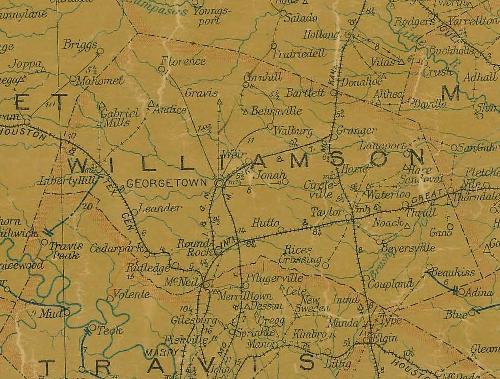 |
1907 Williamson
County postal map showing Corn Hill
(West of Bartlett in northern Williamson
County,
near Bell County line)
From Texas state map #2090
Courtesy
Texas General Land Office |
| Texas
Escapes, in its purpose to preserve historic, endangered and vanishing
Texas, asks that anyone wishing to share their local history, stories,
landmarks and recent or vintage photos, please contact
us. |
|
|
 HOME
HOME