|
|
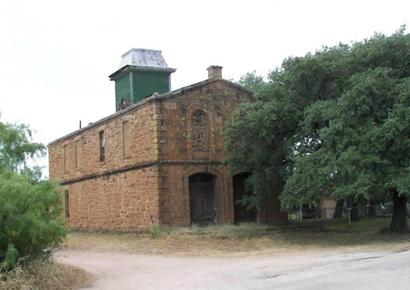
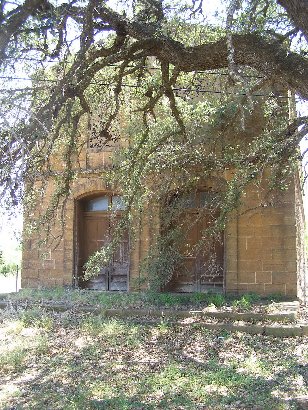
The former Koock
Store and Community Building
Photo courtesy Barclay
Gibson, August 2006 |
History in
a Pecan Shell
German settlers transmigrating from Fredericksburg
began arriving in the early 1850s. These were joined by Irish immigrants
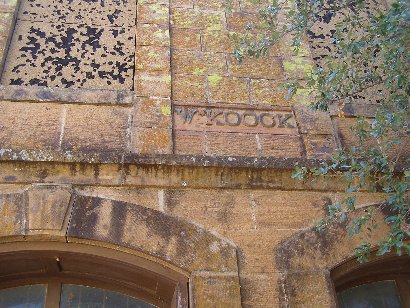
in the middle of that decade. The towns namesake(s) were William and
Minna Koock who opened a store in their log house just after the Civil
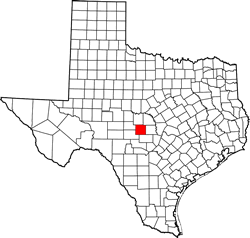
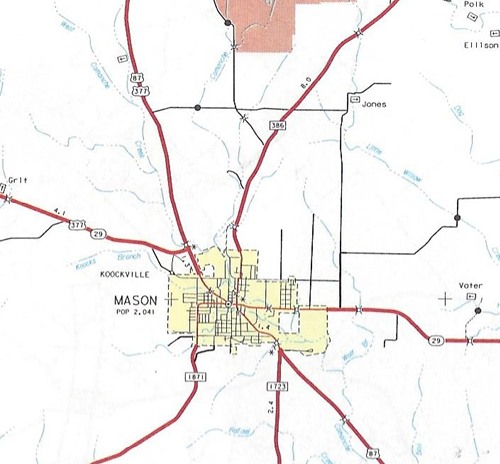
War. Due to its proximity to Mason,
the Koocks never saw the need to apply for a post office.
Koock's store became a stop for cattle buyers from more western counties.
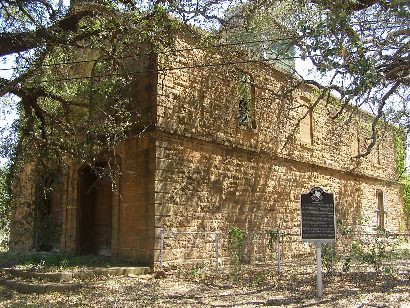
The log store/ residence was rebuilt as a large stone structure in
1883. The building's second floor served as a community center and
a place to hold civic meetings. The town thrived after the Civil War
and the new prosperity made Koock a banker as well as a storekeeper.
Koock later built a large flour mill and gin on his property but it
was torn down and the stone cannibalized to build the VFD building
in Mason. Koockville did have
its own school at one point.
A decline in cattle and sheep prices sent the town into a slump, but
when William Koock was killed in a riding accident (1890) his family
moved into Mason and eventually
sold the businesses (1899). Without the driving force of William Koock,
the town would have disappeared, but it's nearness to Mason
has caused it to evolve into part of that city. |
 |
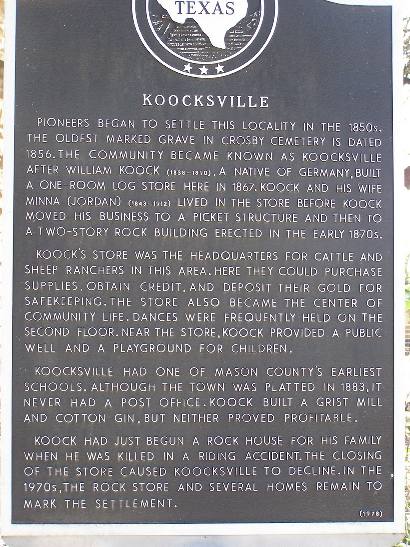
Historical
Marker:
Koocksville
Pioneers began
to settle this locality in the 1850s. The oldest marked grave in Crosby
Cemetery is dated 1856. The community became known as Koocksville
after William Koock (1838-1890), a native of Germany, built a one-room
log store here in 1867. Koock and his wife Minna (Jordan) (1843-1912)
lived in the store before Koock moved his business to a picket structure
and then to a two-story rock building erected in the early 1870s.
Koock's store was the headquarters for cattle and sheep ranchers in
this area. Here they could purchase supplies, obtain credit, and deposit
their gold for safekeeping. The store also became the center of community
life. Dances were frequently held on the second floor. Near the store,
Koock provided a public well and a playground for children.
Koocksville had one of Mason
County's earliest schools. Although the town was platted in 1883,
it never had a post office. Koock built a grist mill and cotton gin,
but neither proved profitable.
Koock had just begun a rock house for his family when he was killed
in a riding accident. The closing of the store caused Koocksville
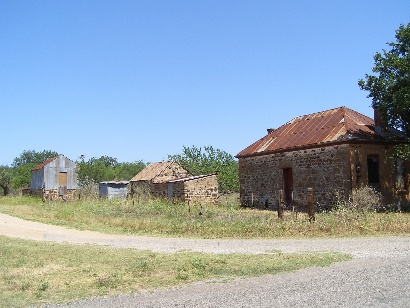
to decline. In the 1970s, the rock store and several homes remain
to mark the settlement.
(1978) |
 |
| Texas
Escapes, in its purpose to preserve historic, endangered and vanishing
Texas, asks that anyone wishing to share their local history, stories,
landmarks and recent or vintage photos, please contact
us. |
|
|
 HOME
HOME

 Texas
Gulf Coast
Texas
Gulf Coast East
Texas
East
Texas Central
Texas North
Central
Texas North Central
Texas South
Central
Texas South Texas
Panhandle
Texas
Panhandle South
Texas
South
Texas Texas
Hill Country
Texas
Hill Country West
Texas
West
Texas Texas
Ghost Towns
Texas
Ghost Towns Texas
Counties
Texas
Counties