|
ROARING SPRINGS,
TEXAS
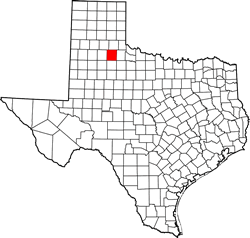
Motley County,
Texas Panhandle
33°54'3"N 100°51'28"W (33.9007, -100.8576)
State Hwy 70 and FM 684
8 miles S of Matador the county
seat
85 miles NE of Lubbock
ZIP code 79256
Area code 806
Population: 231 Est. (2019)
265 (2000) 264 (1990)
Roaring Springs Area Hotels › Lubbock
Hotels |
History in
a Pecan Shell
Roaring Springs
was once a part of the Matador Ranch. In anticipation of the
railroad coming through, they platted a town in 1912 and called it
Ragtown. It seemed like a good idea at the time. When they
got their post office in 1913 they were told to get serious and they
came up with Roaring Springs - named after a point on Dutchman
Creek.
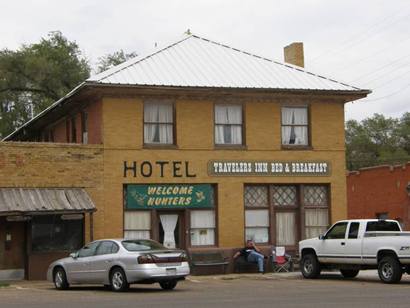
The Travelers Hotel (c.1914) in downtown Roaring Springs is
on the Texas Historical Commission's endangered buildings list.
The Quanah, Acme and Pacific Railroad operated from 1913 to 1971.
The high population of Roaring Springs was 514 people - reached in
the 1940s. |
Roaring Springs,
Texas
Landmarks & Attractions
|
| Historical Marker
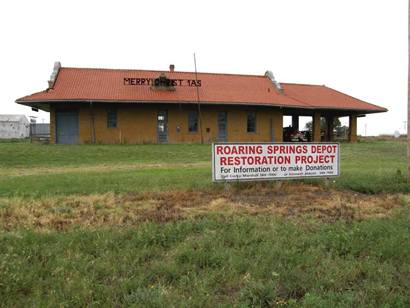
Under the leadership
of Samuel Lazarus (1855-1926), the Quanah, Acme & Pacific Railroad
contributed much to Motley County's economic development. One of the
townsites along the line, Roaring Springs was platted in 1912, one
year before the tracks reached this point. This brick mission revival
style depot was completed within a year, and handled passenger and
freight traffic until 1971. Roaring Springs' oldest structure, it
was purchased by the city in 1972. |
 |
 |
 |
 |
 |
 |
 |
 |
 |
 |
 |
 |
Roaring Springs,
Texas Forum
Witching
Water in Roaring Springs
My grandfather, Rolla Chester "R.C" Ireton and his wife Lillie lived
in Roaring Springs from 1920 to 1925. Son Merion Frank was born
February 16, 1922. Rolla operated the blacksmith shop, garage and
light plant furnishing power to the barbershop, general store run
by his father, Frank Austin Ireton, and the hotel and a few other
business places. The light plant consisted of a Model "T" Ford engine
and generator in the garage and blacksmith shop which ran the machinery
during and the electric generator at night until about ten o'clock.
Rolla was a dowser being able to find water with a willow branch
and in 1924 a rancher who could not find water on his ranch offered
him five hundred dollars to dig a well on his place he accepted
and took another man out and located place to dig and about twenty
five feet down where they found a nice stream of good water and
was producing water fifty years later. In 1925 they moved to Whitedeer.
- Mark William Ireton, Portland Oregon, August 11, 2007
Roaring Springs
will always hold a special place in my heart. My grandmother and
grandfather moved their ten children to Roaring Springs sometime
in the 1940's. All of their grandchildren loved Roaring Springs.
I was born in 1973 and as a child, I remember visiting my grandmother
on holidays and summers. We had freedom, we could walk downtown
to the store by ourselves and we played outside all day. Occasionally
we were able to go the Springs and swim. The people were always
friendly, they would wave as they drove by. My grandmother finally
moved from Roaring Springs about 5 years ago.
My mom told me about all of the people that used to live in Roaring
Springs and many of my fondest memories happened there. It was a
place that represented family and values. I couldn't believe people
actually left their doors unlocked. It is a really special place
to me. - Angela J., Granddaughter of Ossie "Shine" Brown, Las Vegas,
Nevada, July 27, 2005
My grandfather
worked for the Matador Ranch at one point, and they lived near Roaring
Springs in an old boxcar. He and my father broke saddle horses for
them for a while. They were working a bunch of cattle and my grandfather
was off his horse for some reason when a bull gored him badly. This
happened somewhere around 1915 or so. It took two years to heal,
and when he died in 1959, the scars on his abdomen were terrible
to see.
His name was J.O. CHESTER, born about 1867, married to Katie Leona
BAMFORD AUSTIN . The Children that were with them were Mae Austin,
John Felix Austin age about 15, and Thomas A. Chester age 5 or 6.
Thanks, Leona Guthrie
|
| Texas
Escapes, in its purpose to preserve historic, endangered and vanishing
Texas, asks that anyone wishing to share their local history, stories,
landmarks and recent or vintage photos, please contact
us. |
|
|
 HOME
HOME