|
Texas
| People
COMBAT OVER
TEXAS
America’s First Combat Sortie
Took Place April 20, 1915,
in Brownsville,
Texas
Aviation Pioneers
Byron Q. Jones
& Lt. Thomas D. Milling
by Dan Heaton |
|
|
Kitty
Hawk, North Carolina. Dayton, Ohio. North Island Naval Station in
San Diego. And Brownsville,
Texas.
No listing of the key locations in the early days of flight – particularly
the development of military air power – would be complete without
a reference to the southern Texas city of Brownsville.
It was from there that America’s first combat mission was flown,
way back in 1915.
The Army had
created the 1st Aero Squadron about two years earlier, but in 1915,
the terms ‘military’ and ‘air power’ were like a couple of shy kids
on opposite sides of the gym at the 8th grade dance.
Jones was at the controls of a flight in a fragile aircraft that
took off from Fort Brown on April 20, 1915, in an effort to determine
where the revolutionary forces of Francisco “Pancho” Villa were
staging in the Mexican city of Matamoros. With Jones was another
aviation pioneer, Lt. Thomas D. Milling, who was holding a map and
a pencil during the flight, in the hopes that he could sketch in
where the Mexican troops were that day.
|
|
|
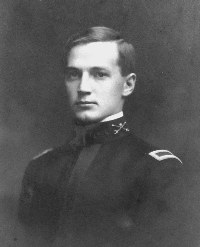
Byron Q. Jones
shortly after he graduated from West Point in 1912.
U.S. Army photo
|
|
|
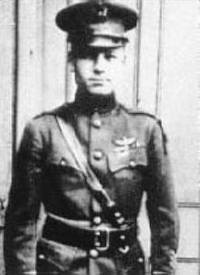
Lt.
Thomas DeWitt Milling
U.S. Army photo
|
| Following a course
of instruction at the Wright Bros. Flying school in 1911, Milling
helped organize Army aviation schools at College Park, Md., and Augusta,
Ga. From 1917 to 1919, Milling was in charge of air service training
in Europe, and also was chief of staff of the air service of the 1st
Army with the American Expeditionary Force. He retired in 1933, but
was recalled to active duty in 1942 during World War II. He died in
1961 and is buried at Arlington National Cemetery. |
The
1915 flight was far from the first time that Brownsville
and Fort Brown were on the front lines of combat. Several battles
had been fought in and around the area in the 1800s during the Texas
Revolution, the Mexican-American War and the U.S. Civil War. (Fort
Brown was the site of the controversial “Brownsville Raid” in which
it was alleged that black soldiers from the fort had raided the town
one night. As a result, 168 black soldiers were discharged from the
Army “without honor.” A subsequent Army review of the event in the
1960s – after all but two of the 168 former soldiers were deceased
– overturned that decision and restored the “honor” of the soldiers
in question.)
In 1915, the Texas region was under the command of Major
Gen. Frederick Funston. Already a Medal of Honor holder from actions
in the Philippines in 1899, Funston
had also won accolades and national esteem for his command of Army
forces in San Francisco when the famed 1906 earthquake rocked that
city. Had it not been for a fatal heart attack in early 1917, many
at the time believed that it would have been Funston,
not John J. Pershing, who would have commanded U.S. forces in World
War I. |
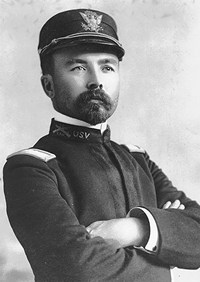
| Major General
Frederick Funston had won the Medal of Honor for his actions while
engaged in the Philippines with the U.S. Army in 1899. In 1906, he
had been in command of the Presidio in San Francisco and essentially
took command of that city after the famous earthquake, though martial
law was never declared. Funston was considered by many to be the most
likely candidate to take command of the American Expeditionary Force,
later commanded by Pershing, in World
War I. Funston suffered a fatal heart attack in January 1917,
a few months before the U.S. declared war and entered World
War I. His body would lie in state at the San Francisco City Hall
and he was then buried at Arlington National Cemetery. |
Funston
ordered the 1st Aero Squadron at Brownsville
to perform reconnaissance along the Rio Grande and report back to
him. After arriving at the base, uncrating and assembling their
aircraft, the men of the 1st were ready.
On the morning of April 20, Jones flew the unit’s first mission
from Fort Brown, taking off from the west end of the Cavalry parade
& training grounds at the fort. His first mission was uneventful
and after he landed, a second mission was planned for the afternoon.
That both the
morning and the afternoon missions both got off the ground at all
was somewhat remarkable in itself. In those days, the Army had about
a 50 percent success rate of actually launching planes, given the
fragile and unreliable nature of the early machines.
|
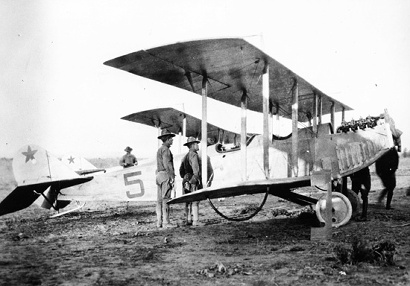 |
| A Curtiss JN-3
in Mexico with the 1st Aero Squadron. The date is unknown, as are
the individuals in the photo. The aircraft Jones and Milling were
flying along the border in 1915 was a Martin body with a Curtiss engine.
At that time, aircraft were not the standardized pieces of equipment
they are in today’s military. U.S.
Air Force photo |
Jones and Milling
clearly were the right men for the job. Earlier in 1915, Jones, a
West Point graduate, had set endurance records as a solo pilot and
as a pilot with passengers. Later that year he would successfully
(and intentionally) perform the first aerial loop and become the first
pilot to intentionally stall his aircraft and put the aircraft in
a tail spin – and live to tell about it. Milling was one of the most
experienced air men in the Army. He had been sent to the Wright Brothers
flying school in Dayton in 1911 and had been the first man to receive
a Military Aviator Certificate from the Army. He held the 30th pilot
license issued in the world.
Jones and Milling climbed aboard their Martin aircraft with a Curtiss
“pusher” engine (the propeller was in the rear and “pushed” the aircraft),
and the two men began to determine the where-abouts of Villa’s forces.
|
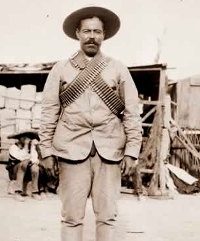
| Pancho
Villa was a Mexican revolutionary, who eventually took over the
state of Chihuahua in Mexico. Given that Chihuahua bordered the U.S.,
conflict was inevitable. In his early years, he was supported by the
U.S. government, even invited to meet with Gen. Pershing at Fort Bliss
in Texas. That relationship eventually soured and the U.S. launched
an expedition into Mexico in 1916 to eliminate Villa’s army. Many
of his senior leaders were killed during the 1916 campaign and his
army was scattered. Villa survived and remained an active player in
Mexico, until he was assassinated in 1923. His legal name was José
Doroteo Arango Arámbula. |
|
About 15 minutes
into the flight, the U.S. aircraft drew the attention of Villa’s
forces, who opened fire with at least one machine gun, as well as
small arms. Jones was able to maintain his composure under fire.
He opened the throttle and nosed up, climbing to 2,600 feet to avoid
the gunfire. He maneuvered away from the river and was able to return
safely to Fort Brown.
Jones’ official Army biography sums up the combat adventure succinctly:
“He was the first American pilot fired upon, flying over the river
at Brownsville,
Texas, by Mexicans using machine guns on the Mexican side of
the river.” A Texas state historical marker at Fort Brown also memorializes
the event.
A couple of
weeks after the historic flight by Jones and Milling, the detachment
of airmen were returned to San Diego for more training. Later, during
the 1916 expedition into Mexico, the 1st Aero Squadron returned
to Texas and moved into Mexico. There,
still hampered by the aircraft of the day, their primary value was
in speeding communications between Pershing in the field and his
headquarters back in Colombia, N.M.
Milling participated
in the Mexican Expedition as part of the 1st, but Jones received
different orders. With the Army still trying to figure out how to
get the most out of its aviation assets, Jones was assigned to the
Massachusetts Institute of Technology as a student, where he earned
a graduate certificate in aeronautics.
Milling retired from the Army in 1933, but was recalled to active
duty during World
War II. Following the war, he retired as a colonel. After his
retirement, he was retroactively promoted to the grade of brigadier
general.
Jones remained on active duty through 1944. In the late 1930s, he
transferred out of the Air Corps and back into the Cavalry branch
of the Army. He retired as a colonel. He is buried in Arlington
National Cemetery.
|
|
Forgotten Aviator:
The Byron Q. Jones Story
Order Here |
|
 HOME
HOME