|
Hope May Float
but Bolts Fly
This article begins with a letter from Clinton, Indiana which the
author states is "an old coal mining community."
Dear Texas Escapes,
I am sending some pictures from a magazine I own. It is the March
28, 1911 edition of "Power", published by Hill Publishing Company.
The article describes a locomotive boiler explosion that claimed nine
lives and injured 12 in Smithville
on Feb. 8, 1911. There are some very good photos with the article.
Is this accident known locally? I hope you are able to use this information.
Ed Maher, Clinton Indiana (Little Italy) |
| Photo
courtesy Smithville Chamber of Commerce |
|
The Article:
Reprinted from POWER Magazine - March 28, 1911
Locomotive
Boiler Explosion
by C. L. Greer
|
An
awful example of the destructive force of an exploding steam boiler
was recently had in the explosion of a Missouri, Kansas & Texas locomotive
boiler in the little town of Smithville
on the Colorado River in Texas.
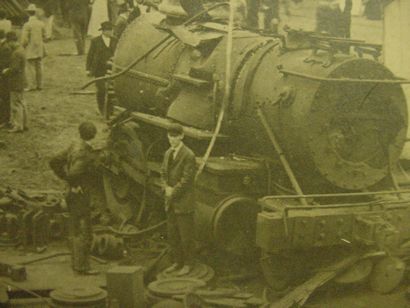
On February 8, a switch engine was brought from the shop after being
thoroughly overhauled. While steaming up preparatory to run to another
town, the boiler let go in one of the most disastrous explosions ever
known. |
| The
wreck was so complete that it could not be ascertained at just which
point the rupture first occurred. The whole firebox end of the engine
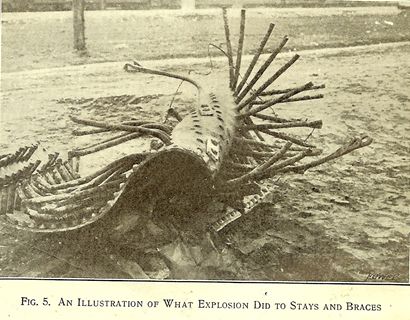
was blown to pieces and the cab to splinters. A portion of the roof
sheet of the firebox was hurled a distance of three blocks, landing
on the street, while smaller pieces flew twice as far. This portion
is shown in Fig. 5. One large piece crashed through the roof of a
business house several blocks away. At some places the rivets were
sheared completely while at others the sheets, 1/2 inch thick, were
torn like paper. |
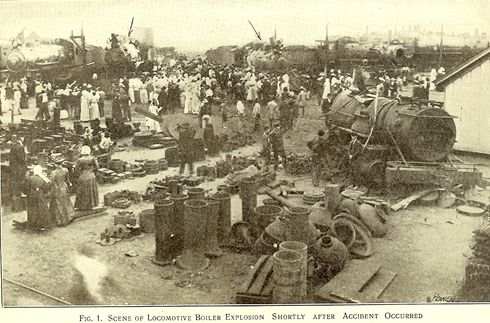 |
Figure 1 shows
a general view of the wreck. The wrecked engine, before the explosion
stood between the two engines indicated by the arrows.
When the explosion came, the tender was thrown back into the turntable
pit and the front part of the boiler was shoved a distance of about
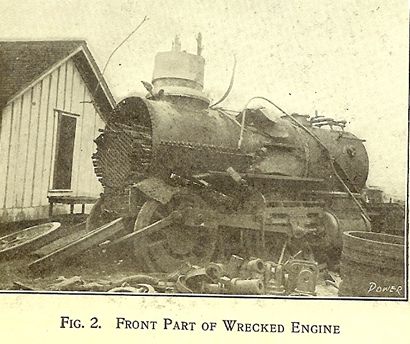
100 feet, with the drivers plowing in the ground. The rear pair of
drivers were shoved completely off their axle, as shown in Fig. 2,
and were dragged along by the connecting rods while the axle was bent
to the arc of a circle. These wheels are pressed on their axle under
a pressure of 90 tons. |
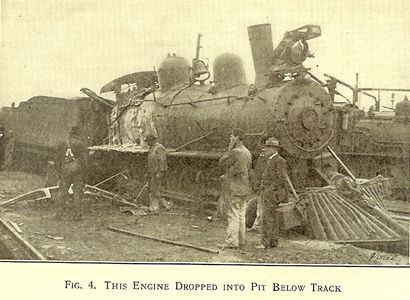
The two engines
in Figs. 3 and 4 which stood on each side were badly damaged, the
cabs being almost entirely blown away.
The engine shown in Fig. 4 was shoved off the track and dropped into
the pit below while the rail on the far side was broken by the driving-wheel
flange.
Fig. 5 shows the braces and stay bolts were broken and twisted from
the sheets. |
 |
In
Fig. 2 may be seen some of the sheared rivets still in the holes.
Four men lost their lives and twelve were injured. Two men in the
cab and one on top of the boiler were blown to atoms, being identified
only by hands, feet and bits of clothing.
It is the general opinion that the cause of the explosion was a defective
steam gage. The man on the engine was setting the pop valve and it
is thought that the gage stuck when the pressure reached 155 pounds,
as the gage stood at that point when found.
It is thought that the man screwed the pop valve down too tight and
the gage failed to register the rising steam.
When the pop safety valve was found it was screwed almost entirely
down and when tested it took a pressure of 600 pounds to make it pop.
People who were near the site before the explosion stated that before
the explosion, steam was issuing under the jacket and apparently came
from the seams, which were strained to the leaking point."
|
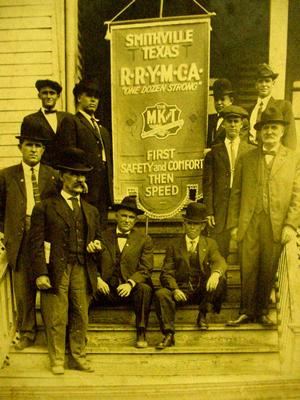 |
"Two Dozen
Strong"
The Smithville Chapter of the Katy Railroad RRYMCA poses for a photograph
(two members absent and one man short).
Photo courtesy Smithville Chamber of Commerce |
| Texas
Escapes, in its purpose to preserve historic, endangered and vanishing
Texas, asks that anyone wishing to share their local history, stories,
landmarks and vintage or recent photos, please contact
us. |
|
|
 HOME
HOME