|
|
Certainly
one of the worst atrocities of the Civil War occurred in Gainesville,
Texas in Oct. 1862, when 40 men, suspected of Union sympathies,
were hanged. Although they were condemned by a questionalble "People's
Court," and found guilty by a simple majority of 7 slaveholders, Dr.
Richard Peebles characteried the act as "the great lynching," for
which statement he was exiled.
Cooke County and
4 of its Red River neighbors were a center of opposition to secession
from the Union. Five counties voted an average of from 61% to 70%
against secession. When the Butterfield Stage Line connected the region
with Kansas and elsewhere, many new residents resettled there from
Kansas and Missouri, but the opposition to secession stemmed mostly
from a fear for personal safety, rather than Northern sympathy. The
369 slaves in Cooke County
were owned by only 10% of the population, and 95 of those were owned
by the 2 men, Cols. James G, Bourland and William C. Young, who were
principally responsible for the atrocity.
Actual opposition was quiet until the Confederate Conscription Act
of April, 1862, was announced. Thirty men, calling themselves the
Peace Party, sent a petition to the Confederate Congress, protesting
the exemption from the draft for the largest slaveholders of Cooke
County.
Bourland was commander of a battalion of Texas State Troops, called
the "Border Regiment." Young commanded the 11th Texas Cavalry, but
as of Oct. 1862, he was home on extended sick leave.
On Oct. 1, 1862, the two colonels arrested 150 men, who were accused
of treason and conspiracy. The colonels impaneled to try them, an
extralegal "People"s Court" (unlisted in "Gammells Laws of Texas").
Conviction came upon a simple majority of 7, and Bourland and Young
made certain, that of the impaneled jurors, 7 of them were the county's
largest slaveholders. Hence it became a contest between the slaveholders
and the 90% who owned no slaves.
The 40 defendents were convicted by the "People's Court," and the
first 21 were hanged during the same week. About Oct. 10th, Col. Young
was murdered by an unknown assassin, and as a result, his son, Capt.
James Young of the 11th Cavalry, took his place, exhibiting a real
vengeance; and he soon hanged the other 19 defendents. Young tracked
down 2 men, accused of killing his father, and he shot one, and lynched
the other, using his own family slaves to do the dirty work.
Bourland was also accused of other atrocities, but the Confederate
Army took no action concerning them. At the end of the war, he obtained
a pardon from President Andrew Johnson, but there is no record that
he was ever subjected to a Union court martial. He was also acquited
of wrong-doing by a civil court at Gainesville.
He died in seclusion, a lonely and broken old man, on Aug. 20, 1879. |
 |
M
any other atrocities
and harassments were committed against the Central Texas immigrant
Germans, even though many of them served in the Confederatre Army.
Generally the Germans opposed slavery, and like Gov.
Houston, opposed secession as well. Yet enough Texas Germans went
north to fight in 1861, that they comprised the nucleus of 1st, 2nd,
and 3rd Texas Regiments of the Union Army. Neighbors harassed, pillaged
and burned the farms of Germans who were loyal to the North.
In Aug. 1862, 65 Germans from Comfort,
Texas attempted to flee to Mexico,
hoping to go north to fight. They were intercepted by a Confederate
company, which killed 19 at the Battle of Nueces, and executed 15
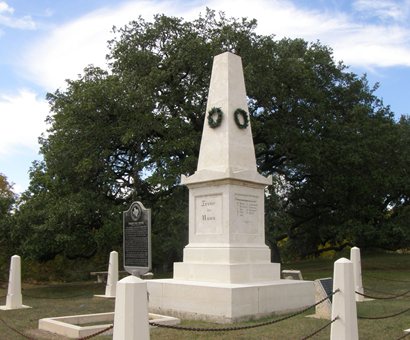
others that were captured. In 1866, their bones were gathered and
buried in the Comfort
Cemetery, beneath the tall "True
der Union" monument.
© By W.
T. Block, Jr
"Cannonball's
Tales" December 1, 2006 column |
|
|
 HOME
HOME


