|
During
the early days of the Republic
of Texas, stagecoaches rumbled across East
Texas, carrying passengers from one distant community to another.
But passengers who were unlikely to have friends and relatives conveniently
living in certain communities found overnight lodging hard to come
by.
Some roadside homeowners saw the need and opened their homes to the
passengers. As a result, many pioneer homes evolved into some of East
Texas' best known stagecoach inns.
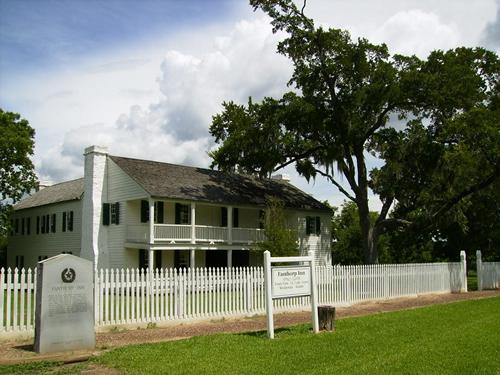
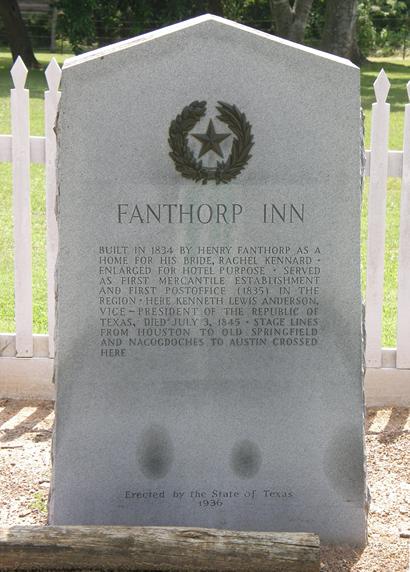
One such place was the Fanthorp
Inn in Anderson,
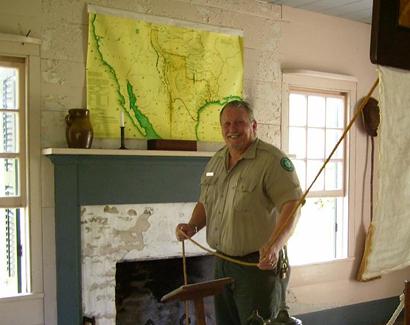
today maintained as a state
historical park with many of its original furnishings. |
Houston
Chronicle writer Susan Love Fitts recently called the inn "the
Hyatt Regency of its day, probably worthy of a five-star rating if
such designations had been issued in the mid -19th century."
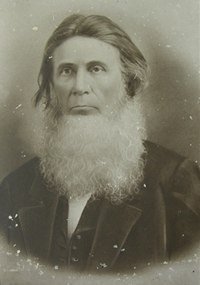
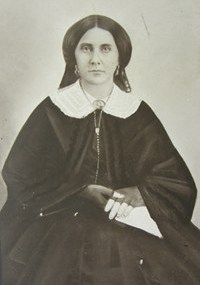
Henry Fanthorp, an Englishmen who migrated to Texas in 1832, and his
wife Rachel founded the Inn in the l840s to serve stagecoach passengers
passing the dogtrot log house he built in 1834. |
Henry and Rachel
Fanthorp
Photo Courtesy Fantrop Inn State Historic Site |
The house was expanded by Fanthorp between 1848 and
1859 to accommodate more guests and soon became known as the Fanthorp
Inn. The Fanthorps' parlor became a room where travelers could rest
on their journey.
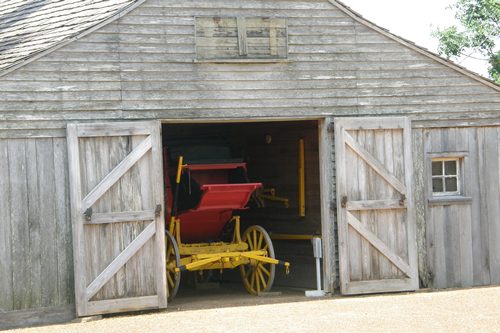
The stagecoaches not only carried East Texans and the mail, but newcomers
seeking new lives for their families in Texas,
where land was plentiful, fertile and inexpensive.
Anderson residents picked up their mail at the inn (Fanthorp was the
postmaster) and received news of other Texas communities from travelers.
Visitors could be seen playing a game of cards or reading one of the
two newspapers Fanthorp subscribed to, including the Galveston News.
The inn also became a community center, a polling place, the site
of dances and community parties, and the founding site for a Masonic
Lodge and a Methodist church.
Business was brisk in the town, which at the time was known as Alta
Mira, meaning high view. An early victim of annexation, Alta Mira
lost its identity in 1846 when Grimes
County was organized and the settlement was absorbed into Anderson.
Fanthorp, a shrewd businessman, served liquor in the parlor, guaranteeing
the return of the men of the community as well as traveling men. Women
seldom traveled in those days.
General Sam Houston,
a friend of Fanthorp, was a frequent visitor. So were Anson
Jones, Ulysses S. Grant, Zachary Taylor, Jefferson Davis, Robert
E. Lee and Kenneth Anderson, the last vice president of the Republic
of Texas and the man for whom Anderson
was named.
Just outside the dining room was the kitchen, where slaves prepared
meals. A nearby cistern became a breeding ground for mosquitoes and
a contributor to yellow fever, a disease that killed Henry and Rachel
in 1867.
After their deaths, the Fanthorps' daughter, Mary Fanthorp Stone,
took over the inn. She turned it into a private home, however, and
Fanthorp descendants lived in the house until it was conveyed to the
state.
Today, as a state
historical site, the inn helps modern Texans understand the hardships
of life on the Texas frontier in the 1850s. |
 |
Fanthorp Inn
Barn
TE photo, May 2008 |
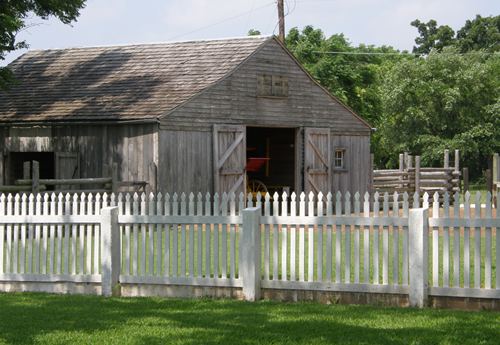
Stagecoach in
Storage
TE photo, May 2008 |
All
Things Historical
May 11-17, 2003 column
This column is provided as a public service by the East Texas Historical
Association. Bob Bowman is a former president of the Association and
author of nearly 30 books on East Texas. |
|
|
 HOME
HOME