|
Texas
historians never gave Fort Boggy much more than a few sentences, but
today it has something to make up for the years of benign neglect:
Texas' first new state park in six years.
Located along Interstate 45 near Centerville,
the county seat of Leon
County, Fort Boggy State Park derives its name from an 1840s log
fort built by early settlers on the north side of Boggy Creek, a tributary
of the Trinity River, about two miles north of Leona.
Until now, Fort Boggy was remembered only by a 1936 Texas Centennial
marker and nine lines in the six-volume Handbook of Texas.
The fort was built by the Texas Rangers to protect East
Texas settlers from Indians who controlled much of the territory.
Some seventy-five people lived in eleven homes and two blockhouses
while the Rangers patrolled an area between the Navasota
and Trinity rivers.
Republic of Texas
President Mirabeau
B. Lamar sent Captain Thomas Greer to head up the protective force,
but he was killed in 1841 while tracking down Indian raiders.
The first settlements on Leon Prairie grew up around Fort Boggy and
the first store in the area was opened there by Moses Campbell. Thomas
Garner built the first sawmill.
After years of conflict, the Indians living around Fort Boggy fled
to Mexico and Indian territory. Several years later, hardships and
illness forced the settlers from Fort Boggy as well
By 1941, Fort Boggy had been dropped from Texas maps, but through
the persistence of local residents and a gift of 1,847 acres of land
by Leon County resident
Eileen Crain Sullivan in 1985, after letting her family's ranchland
sit idle for 60 years and revert to its natural state, the historic
site is back on the maps -- this time as a scenic state park. At present,
only one section of the park, the day-use area, has been developed.
However, the public has access to much of the park's scenery via hiking
trails.
Anchoring the day-use area is a iron ore rock and hand-hewn pine pavilion
built to resemble the structures erected in Texas parks in the l930s
by prison inmates working for the Civilian Conservation Corps. All
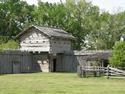
that remains of Fort Boggy today is a wooden shack and its weathered
Centennial marker, but the lack of historical relics is offset by
the area's archeological and biological diversity.
Researchers have documented human occupancy in the Boggy Creek vicinity
dating from 10,000 B.C. to 6000 B.C. and biologists have identified
more than 700 species within the park's boundaries, including the
rare Centerville Brazos mint plant that grows in alluvial sands. Abundant
wildlife includes white-tailed deer, raccoons, foxes, beaver and squirrels.
All
Things Historical
January 29, 2004 Column
A syndicated column in over 40 East Texas newspapers
Published with permission |
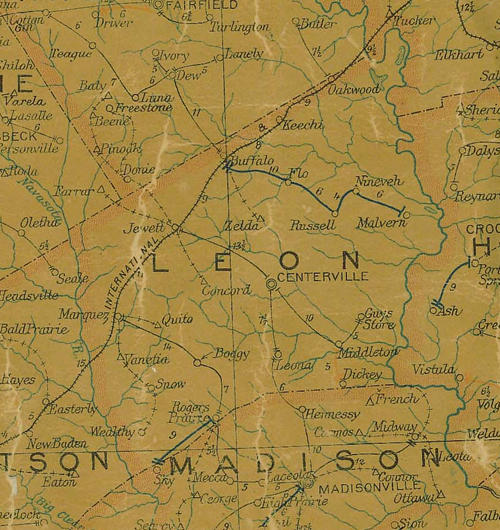 |
1907
Leon County postal
map showing Boggy
From 1907 Texas state map #2090
Courtesy
Texas General Land Office |
|
|
 HOME
HOME