|
Books by
Jeffery Robenalt
|
|
|
Former
Presidents of the Republic of Texas, Sam
Houston and Mirabeau Lamar, differed in many ways. Many of the
differences were personal and unimportant in the political scheme
of things, like Houston’s
love of flashy clothes and his reputation for frontier boldness,
and Lamar’s somber dress and enjoyment of quieter pastimes such
as reading and poetry. However, both men were strong leaders, and
their vastly different visions for the new Republic would do much
to shape the future of Texas.
|
|
|
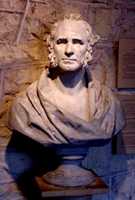
Sam Houston
by Elizabet Ney
TE photo
|
When Sam
Houston took office in 1836, as the first elected president of
the Republic of Texas, the new nation faced many problems. Foremost
among them was Mexico’s
refusal to recognize the independence of the new republic. Technically,
the two nations were still at war. In addition, the new president
faced severe financial problems based on the government’s inability
to pay debts incurred while conducting the Revolution. Native Texans,
who had remained neutral during the war, based on promises made by
Houston and other
Texas officials, also resented the growing number of settlers invading
their territory and threatened war. Finally, the question of annexation
to the United States loomed large.
Houston believed
his primary responsibility as president was to prevent another war
with Mexico. In accordance with this policy, he appointed Stephen
F. Austin as his Secretary of State. Austin spoke fluent Spanish,
and it was hoped that the good relations he had established with many
Mexican officials as an empresario prior to the Revolution would aid
in the cause of peaceful relations. However, Houston’s hopes were
soon dashed when Austin died on December 27, 1836, at the age of 43,
after serving less than three months.
Adding to the growing tensions with Mexico,
were hundreds of newly arrived United States citizens, eager for battle,
though they had come to Texas too late
to fight in the Revolution. Instead of calming the situation as his
position called for, the commanding general of the Texas army, Felix
Huston, incited the new arrivals by speaking out in favor of renewing
the conflict with Mexico.
To prevent further bloodshed, President Houston sent General Albert
Sidney Johnston to relieve Huston. However, when Johnston attempted
to take command, Huston challenged him to a duel. Honor required that
Johnston accept the challenge, and he was severely wounded, leaving
Felix Huston in command. Sam Houston wisely defused the situation
by sending all but 600 soldiers home on leave and never calling them
back to duty. |
 |
President Houston’s
decision to disband the majority of the Texas army also saved the
government a good deal of money, but it did not resolve the Republic’s
financial problems. Texas had incurred a debt of more than one million
dollars fighting the Revolution, and Houston
was forced to cut expenses to the bone, while trying to raise revenue
for those items he considered to be absolutely essential by levying
customs duties and property taxes. In spite of his efforts, the tax
collections resulted in little revenue, and the debt continued to
rise.
In 1837, at President Houston’s urging, the Texas legislature authorized
the issuance of $600,000 in promissory notes to pay government expenses.
The promissory notes represented a government promise to pay a specified
sum to the holder at a future date in exchange for the notes’ cash
value at the time they were issued. Dubbed “Star Money” because of
the star displayed on the front of the bill, the notes circulated
at or near face value, or their actual cost, for most of Houston’s
presidency. However, when financial prospects failed to improve, people
began to reject the notes as legal tender.
In addition to tensions with Mexico,
the new Republic faced growing conflicts with Native Texans, who resented
settlers moving onto lands they claimed as their own. Although President
Houston was sympathetic toward the Indian population, most Texans
failed to share his views. Prior to the Revolution, Houston
negotiated a treaty with the Cherokees, whereby they had been promised
title to the land they occupied in East
Texas in exchange for remaining neutral during the conflict. However,
East Texas was some of
the richest farm land in the Republic, and many Texans were in favor
of removing the Cherokees in spite of the treaty. Although the Cherokees
remained relatively peaceful in the face of this threat, other Native
Texan tribes, including the fierce Comanches, fought back. Houston
enlisted the aid of the Texas Rangers to keep the peace on the frontier,
however, the attacks continued.
Of all the problems facing the new Republic, Houston
was most concerned with the process of annexation by the United States;
a move that he felt would alleviate most of the problems facing the
new Republic. During his election to the presidency, a majority of
the electorate voted in favor of annexation. After all, many Texans
had immigrated from the United States, and their language, customs,
and ideas about laws and government were the same as most Americans.
The addition of Texas would also allow for the westward expansion
of the United States. For all of these reasons and more, most Texans,
including President Houston, thought the United States would be eager
to accept Texas as a new state.
With the assistance of several Texans, including William H. Wharton
and Anson
Jones, members of the U.S. Congress who favored annexation introduced
a bill to admit Texas into the Union, but former United States President
John Quincy Adams, now a member of the House of Representatives, blocked
its passage. Adams, an avowed abolitionist, was determined not to
admit any state that supported slavery, and many other politicians
opposed to slavery agreed with this view. The issue dragged on until
Houston, not wanting
Texas to be embarrassed by any more foot-dragging, reluctantly ordered
Anson Jones
to withdraw the request for annexation. |
 |
|
The
Texas Constitution limited the first president of the Republic to
a term of two years, and no president could be elected for two consecutive
terms. Therefore, in 1838, Houston
was forced to hand over the reins of government. Later Texas presidents
would serve for three years. In the subsequent election, Mirabeau
Lamar, Houston’s
popular vice-president, announced his bid for the presidency. Houston,
who thought little of Lamar or his policies, handpicked first Peter
Grayson, and then James Collingsworth to run against his much disliked
vice-president. Unfortunately, both men died before the election.
However, Lamar would have most likely won the election, without
the untimely death of his opponents, because he offered a new vision
for the future of Texas, one in sharp contrast to that of Sam
Houston. Houston
had worked to maintain peaceful relations with Mexico
and the Native Americans, spent as little money as possible, and
promoted the annexation of Texas. Lamar, on the other hand, stood
ready to confront Mexico
and drive all the Native Americans out of Texas, and he was willing
to borrow large sums of money to support his efforts. He also wanted
Texas to remain independent from the United States and expand its
territory all the way to the Pacific Ocean.
President Lamar’s aggressive approach to policy making can best
be summed up in his inaugural address where he stated, “If peace
can be obtained only by the sword, let the sword do its work.” In
1840, he heightened tensions with Mexico
by sending Commodore Edwin Moore and the Texas navy to assist Yucatan
rebels in their revolt against the Mexican government. Lamar further
angered Mexican officials with his interpretation of the Treaties
of Velasco signed by Santa Anna in 1836. The secret portion
of the treaty set the boundary between Mexico and Texas at the Rio
Grande River. Lamar insisted that this provision included the full
length of the Rio Grande, as far north as its headwaters in Colorado,
which meant that Santa Fe and half of New Mexico belonged to Texas.
In 1841, President Lamar sought authority from the Texas legislature
to send troops to New Mexico to enforce his view, but Congress refused.
Undaunted, Lamar exercised his own authority, by sending General
Hugh Mcleod and 270 men to Santa Fe under the guise of a trading
expedition, with orders to convince the New Mexicans that they were
Texans. However, after straggling across the dreaded Llano Estacado,
the men arrived in Santa Fe dying of thirst and nearly starved.
With no other choice, the Texans surrendered and were immediately
put in chains and marched to Mexico City, where they were imprisoned
until 1842. The disastrous expedition resulted in needless loss
of life and the expenditure of money Texas did not have.
When the financial situation continued to worsen, Lamar turned to
the ill-fated solution of printing more paper money. The money,
known as “redbacks” because of the color of the ink used on the
reverse side of the bills, was backed by nothing but empty promises
and fell steadily in value, until a Texas dollar was only worth
about 12 U.S. cents. Nevertheless, Lamar continued to seek additional
credit for such things as the Santa
Fe expedition and battles with the Native Americans. As a result,
the public debt increased to almost $7 million dollars by the end
of his term in office.
Unlike Sam Houston,
who had been sympathetic toward Native Americans, Lamar’s policy
called for the Indians to be either removed from Texas or exterminated.
He began by ordering Chief Bowles to lead his Cherokee people out
of East Texas. When
Bowles refused, Lamar sent General Kelsey Douglass and the Texas
militia to drive the Indians out. Bowles was killed during a militia
attack near the Neches River on July 16. 1839, and the Cherokees
were forcibly moved to Oklahoma. Lamar had similar plans for the
Comanches, but "the Lords of the Plains" proved to be a much superior
foe.
After a few skirmishes with the Texas Rangers in 1839, some Comanche
leaders consented to hold peace talks at the Council House in San
Antonio on March 19, 1840, where they agreed to surrender their
white captives. However, the Texans became angry when the Comanches
returned only one mutilated white girl, fifteen year-old Matilda
Lockhart, and fighting broke out. Many of the Comanche leaders were
killed in what became known as the Council
House Fight. When news of the fighting reached the villages
in the Comancheria, the Comanches were furious. They tortured and
killed the remaining Texas prisoners and launched the Great
Comanche Raid of 1840 deep into the heart of central Texas,
attacking the town of Victoria
and burning the Gulf
Coast town of Linnville
to the ground. The Texans met the Comanches returning from the coast
at the victorious Battle
of Plum Creek on August 11, killing more than 100 warriors,
but the bad feelings and bloody warfare continued for decades.
President Mirabeau Lamar is best known for his far-sighted education
policy. A public education system had always been at the forefront
of Texas thought. In fact, the Texas Declaration of Independence
listed the failure of the Mexican government to establish public
schools as one of its major grievances. In 1838, Lamar spoke of
the importance of public education, “It is admitted by all that
the cultivated mind is the guardian genius of democracy, and . .
. is the noblest attribute of man.” The Texas legislature responded
to Lamar’s words of wisdom by setting aside 18,000 acres in each
county for public schools and 220,000 acres for two universities.
Lamar became known as the “Father of Education."
|
 |
|
In
the election of 1841, Sam
Houston was once again eligible to run for president. Although
Texas did not have political parties, a clear division in the electorate
stood forth between those individuals who supported the policies
of Houston and
those who supported the policies of Lamar. Houston
easily carried the election, defeating Lamar’s Vice-President and
choice of candidate, David G. Burnet, on a platform of preventing
war with Mexico, cutting government expenditures, and seeking annexation
to the United States.
President Houston wasted no time in implementing his policies. First,
he concentrated on government spending by cutting salaries, including
his own, reducing the size of the army, and tackling the problem
of the Texas Navy. He ordered Commodore Moore to return to Texas
from Yucatan, but Moore defied Houston’s orders and sailed to New
Orleans to repair his ships and supply his crews. In answer, President
Houston declared Moore a pirate and invited other countries to sink
his ships. Moore quickly returned home, and Houston disbanded the
navy and sold the ships, adding the money to the treasury. As a
result of these actions, Houston spent less than $600,000 in his
three year term.
Finally, Houston
turned his attention to annexation. Though he had withdrawn an earlier
request during his first term, Houston’s
representatives in Washington thought that annexation was now a
good possibility. John Tyler of Virginia had assumed the presidency
after the death of William Henry Harrison, and in April 1844, John
C. Calhoun, Tyler’s Secretary of State, agreed to a treaty that
would have accepted Texas as a territory of the United States. Texas
voters reluctantly accepted, but the treaty failed by one vote in
the U.S. Senate.
In the Texas election of 1844, Houston’s candidate of choice, Anson
Jones, defeated Edward Burleson, and annexation became a key
issue in the U.S. presidential election. The Democratic Party, which
called for the annexation of Texas, nominated James K. Polk of Tennessee.
Polk won the election, and the United States Congress approved a
joint resolution on February 26, 1845, accepting Texas as the twenty-eighth
state in the union. Houston’s
long dream of annexation had finally become a reality.
Although the visions of Sam
Houston and Mirabeau Lamar stand in sharp contrast, both men
made vital contributions to the fledgling Republic of Texas. Lamar’s
aggressive approach to Texas policies helped steer the Republic
through troubled times, and has come to represent the bold image
for which Texans are known throughout the world, while Houston’s
level-headed brand of leadership added credibility to the new nation,
and his persistence in gaining annexation secured the future for
Texas and all Texans.
© Jeffery
Robenalt, May 1, 2012 Column
jeffrobenalt@yahoo.com
References
›
More "A Glimpse of Texas Past"
|
References
for "Sam Houston and Mirabeau Lamar: A Contrast of Visions
"
|
|
Brinkley, William
C. (1979), The Texas Revolution, Texas State Historical Association,
ISBN 9780876110416.
Davis, William
C. (2006), Lone Star Rising, College Station Texas: Texas
A&M University Press, ISBN 9781585445325 originally published 2004
by New York Free Press.
Fehrenbach,
T.R. (2000), Lone Star: A History of Texas and Texans, Cambridge:
Da Capo Press, ISBN 0-306-80942-7.
Haley, James
L. (2004), Sam Houston, University of Oklahoma Press, ISBN
9780806136448.
Ramsay, Jack
C. (1984), Thunder Beyond the Brazos: Mirabeau B. Lamar, a Biography,
Eakin Press, ISBN 0890154625.
Siegel, Stanley
E. (1977), The Poet President of Texas: The Life of Mirabeau
B. Lamar, President of the Republic of Texas, Austin: Jenkins
Publishing Co., ISBN 0836301536.
The Handbook
of Texas Online, Texas State Historical Association, Sam Houston,
(http://www.tshonline.org/handbook/online/articles/fho73), accessed
Nov 15, 2011.
The Handbook
of Texas Online, Texas State Historical Association, Mirabeau
Lamar,
(http://www.tshonline.org/handbook/online/articles/fla15), accessed
Nov 15, 2011.
|
|
|
 HOME
HOME