|
|
During
the Great Depression, when President Franklin D. Roosevelt sought
ideas for public relief projects to inspire Americans to rebuild their
lives, an artist friend asked the President to employ artists to beautify
the walls of public buildings with positive images of American life
and history.
George Biddle's suggestion came from the 1920s Mexican murals renaissance
as an example of how government-sponsored art could inspire public
pride.
Roosevelt accepted Biddle's idea and dozens of artists went to work
all over America painting murals
on post offices and other public buildings. Today, if you take
the time to drive around East
Texas, youšll find that many of the murals
are still in place, offering unique and colorful snapshots of history,
community life and the economy of the 1930s.
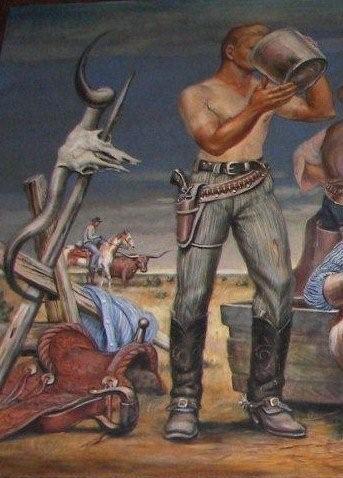
One of my favorite post office murals is at Cooper
in Delta County, where artist Lloyd Goff painted a 44-foot by nine-foot
mural titled, "Before the Fencing of Delta County," in 1939.
It is especially noted for the richness of its colors. |
 |
At Kilgore,
Xavier Gonzalez left behind four murals in the local post office.
One captures the vibrancy of the East Texas oil boom, another depicts
Texas' pioneers, a third speaks to the music of the plains, and a
fourth honors the town's youth. All of the murals have been restored
by Kilgore historians.
In neighboring Longview,
Thomas M. Stell produced a panoramic view of "Rural East Texas"
in the Longview post office in 1942 -- one of the last murals painted
in East Texas. A similar
mural, entitled "Agriculture
and Industry," was painted by Bernard Zakheim at the Rusk
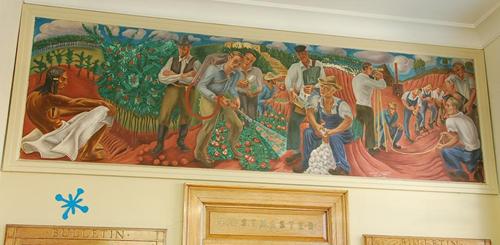
post office in 1939. East Texas' vanished cotton industry was depicted
by Victor Arnautoff with a 1939 mural called "Cotton Pickers"
at Linden's post office.
The timber industry, long an important East Texas industry, was illustrated
in post office murals created by artists Alexander Levin, Edward Chavez,
and Jerry Bywaters at Jasper,
Center and Trinity between
1939 and 19421. |
 |
Liberty's
proximity to the Trinity River became the subject of a Liberty mural
by Howard Fisher in 1929 and titled "The Story of the Big Fish."
Sadly, some of the Depression-era murals have been lost, destroyed
or damaged during the passage of time.
Two murals at Livingston, "Buffalo Hunting" and "Landscape,"
both painted in 1941 by Theodore Van Soelen, were damaged when stripped
from a former post office building. They are now in storage, unavailable
for viewing.
Henderson also
lost its 1937 mural by Paul Ninas. Titled "Local Industries,"
the fresco illustrated segments of the oil and agricultural industries,
but was eradicated when painted over in the 1950s. A 1938 mural painted
by Nicholas Lyon at Conroe,
depicting a family of East Texas pioneers, was also lost. And a Mineola
mural, also painted in 1938 by Bernard Zakheim, has vanished*,
too. It depicted "New and Old Methods of Transportation."
If you would like to know more about this remarkable and historic
art project, we recommend an excellent book by Philip
Parisi, "The Texas Post Office Murals: Art for the People,"
published by the Texas A&M University Press. Parisi's book includes
photos of all of the Depression murals painted throughout Texas. |
|
|
 HOME
HOME