|
Without
the interest of an East Texas
woman, American theater icon Tennessee Williams might still be writing
high school plays in a small town.
In the summer of 1942, theater director Margaret Virginia (Margo)
Jones, a lawyer's daughter from Livingston
in Polk County, was
a drama instructor at the University of Texas in Austin.
Leaving New York on her way back to Texas, agent Audrey Wood thrust
a script into her hands and suggested she read it.
On the train ride to Texas, Jones read the script, "Band of Angels"
by the then unknown Williams. |
|
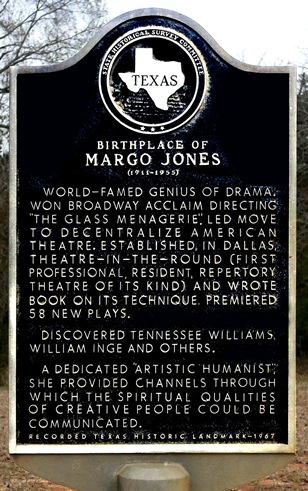
Birthplace
of Margo Jones
Historical
Marker
Photo courtesy Jim Evans, 2016
|
Fascinated by
his talent, Jones turned her considerable drive to Williams' writing
career and, at the same time, began focusing on her new theater venue
in Dallas, Theater 47, where
she produced a Williams play, "Summer and Smoke."
The Dallas production brought
Broadway's attention to Williams and led the blossoming playwright
to coin the term "Texas Tornado," in reference to Jones. The nickname
was indicative of Jones' strong personality and the fact that she
was one of the first women to handle both the producing and directing
sides of theater productions.
In June, before "Summer and Smoke" opened in Dallas,
Jones summoned Williams to the city. Williams, however, did not want
to go because he believed that his "unconventional private life" would
not be appreciated in Dallas.
Jones managed to persuaded him to come to Dallas
only after the play had closed.
When Jones signed the deal for "Summer and Smoke" in Williams' New
Orleans apartment, she only had the legal rights for the Dallas
production. To get the rights for the Broadway production, Jones offered
Williams several things no one else had. She promised "to protect
him as would no other producer," she said she had a "greater understanding"
of Williams work, and said Williams was "unable to deny my passion
and dedication for the play." He granted her the rights.
Jones directed two other Williams plays, which encouraged her work
in a production called "The Gentlemen Caller," which would eventually
become "The Glass Menagrie" in 1945. She served as assistant director
of the play when it came to Broadway, but she directed most of the
production when the director, Eddie Dowling, wanted to take an actor's
role in the play.
The success of Williams' play not only made him a household word in
America, but established Jones as a director on Broadway.
In his autobiography, Williams disclosed that he did not like the
work Margo Jones did on the Broadway production of "Summer and Smoke,"
but he never told her during her lifetime. The New York production
strained their friendship and even resulted in a legal battle over
royalties. The critics were divided over the play.
At the time of her death in 1955, Margo Jones and Tennessee Williams
had changed the face of theater not only in Texas, but nationally
as well.
Margo was buried in her hometown cemetery at Livingston
and on April 26 the Texas Historical Commission and Polk County Historical
Commission placed a state marker on her grave. |
All
Things Historical -
May 29, 2006 Column
Published with permission
(Distributed by the East Texas Historical Association. Bob Bowman
of Lufkin is a past president of the Association and the author of
more than 30 books about East Texas.)
More People
| Columns |
|
|
 HOME
HOME

 Gulf
Coast
Gulf
Coast East
Texas
East
Texas Central
North
Central
North Central
South
Central
South Panhandle
 South
Texas
South
Texas Hill
Country
Hill
Country West
Texas
West
Texas Ghost
Towns
Ghost
Towns COUNTIES