|
| We
are all aware that the Battle
of San Jacinto effectively ended the Texas Revolution in the Texan's
favor, mostly because it resulted in the capture of Mexico's leader,
Antonio Lopez de Santa Anna.
Hoping to save his life, Santa Anna agreed to order his troops, about
5,000 of them and more than enough to have defeated the few hundred
victors at San Jacinto,
to return to Mexico.
Contrary to what was best for Mexico,
they did so. That left Santa Anna in the custody of the Texans, and
many still wanted to kill him. But General Sam
Houston, and later Interim President David G. Burnett, chose negotiation
instead of revenge for the massacres
at the Alamo and Goliad.
|
 |
The
"negotiations" that Santa Anna
accept, began on the battlefield,
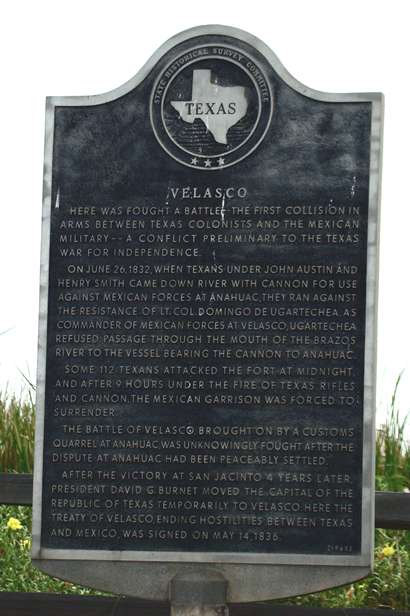
then moved to Velasco,
located on the lower Brazos River. The Treaty of Velasco, or
more accurately the treaties of Velasco, for there were two of them,
were concluded on May 14, 1836.
In the public treaty, Santa Anna agreed that all hostilities
would cease; that he would not resume fighting in the future; that
all Mexican troops in Texas would return home; that all Texan prisoners
would be released; and that the treaty would be binding on General
Vicente Filisola, then commanding Mexican soldiers in Texas.
Burnet agreed that Santa Anna would be released and return to Vera
Cruz as soon as possible.
A secret treaty turned out to be more important. By its terms,
Santa Anna agreed to work for the recognition of Texas independence
by Mexico's new government when he returned home, and most importantly,
that the Rio Grande would be the boundary between Mexico
and Texas.
That river had never been a boundary before. If anything, Anglo settlement
ended at the Nueces River, which
was a boundary between Coahuilla and Texas
when they were joined in Mexican statehood. Remember that the Rio
Grande does not stop in El
Paso through central New Mexico to headwaters in the San Juan
Mountains of southwestern Colorado. That meant that all of what we
recognize as Texas today, plus half of
New Mexico, and by projecting a line north of the San Juans to the
Adams-Onis Treaty line,
half of Colorado and some of Wyoming, were all in Texas!
Texas was whittled to its present borders through the Compromise of
1850, but for a time, it was a really big place.
All
Things Historical August
3, 2004 Column
A syndicated column in over 70 East Texas newspapers
This column is provided as a public service by the East Texas Historical
Association. Archie P. McDonald is director of the Association and
author of more than 20 books on Texas. |
|
|
 HOME
HOME


