|
|
History
in a Pecan Shell
In 1821 the first of Stephen
F. Austin's colonists arrived here. A lonely house marked the
site as a "port" until 1831 when the Mexican government made the site
a customs house. Over the years an estimated 25,000 immigrants entered
Texas through Velasco.
Like its neighboring town of Quintana
across the Brazos, Velasco was named to honor a Mexican general. The
battle of Velasco took place in 1832 and two years later a cholera
epidemic reduced the town to a mere 100 residents. Velasco was made
the (temporary) capital of the Republic shortly after San
Jacinto and the "Treaties
of Velasco" signed by Santa
Anna officially ended the Revolution when they were signed in
May of 1836.
Velasco and its sister town of Quintana
became resorts for the families of inland plantation owners. Businessmen
from Galveston operated
warehouses and the town even opened the Velasco Female Academy (a
seminary) in the late 1830s. Large hotels were built to accommodate
the crowds and Velasco also served as a port of debarkation to New
Orleans and Galveston.
When a canal was connected to Galveston Bay in the mid 1850s, Velasco
(and Quintana) began to lose importance.
Velasco was turned into a Confederate stronghold during the Civil
War, forcing Union gunboats to operate out of distant New Orleans.
When possible, blockade runners defied the blockade and took cotton
to exchange for guns and medicine. The status of the two towns declined
further after the Civil War when no one had the money or leisure to
spend summers on the beach. The hurricane of 1875 destroyed most of
the town and by the 1880 only fifty people called the place home.
By 1891 plans were made to plat a new town which had official recognition
by the US Treasury Department. Over $1,000,000 worth of lots were
sold to Midwesterners looking for greener pastures and a seaside environment.
In short order the town was electrified and the port was dredged to
a depth of nearly 18 feet.
Settlers came by rail through Houston
where they transferred to the Columbia Tap branch of the IG & N Railed
and finally by riverboat down the Brazos River. In the mid 1890s a
lighthouse was constructed and Velasco was on it's way to becoming
a rival to Galveston.
An electric railroad connected the town to Surfside
(AKA Old Velasco). The population was right at 3,000 persons in 1900
when disaster struck.
The population was reduced by two thirds by 1914 and the town lost
one of its two newspapers. By the time of the Great Depression it
was down to only 400 people and around a dozen businesses. The Brazos
River was diverted in the 1940s and an estuary was dredged deep enough
for large ships. Velasco and Freeport
were revitalized. The population was restored to nearly 1,000 and
by 1950 it reached 5,200. Velasco was incorporated with the city of
Freeport in 1957 when it had an independent
population of nearly 4,000. The former Velasco post office became
Freeport's "Velasco Station." |
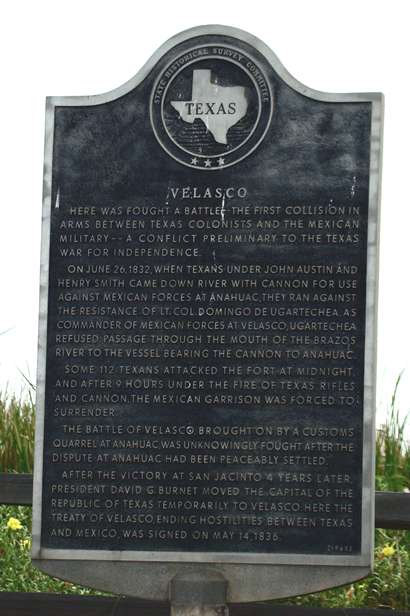 |
Velasco
historical marker
Photo courtesy Ken
Rudine, July 2007 |
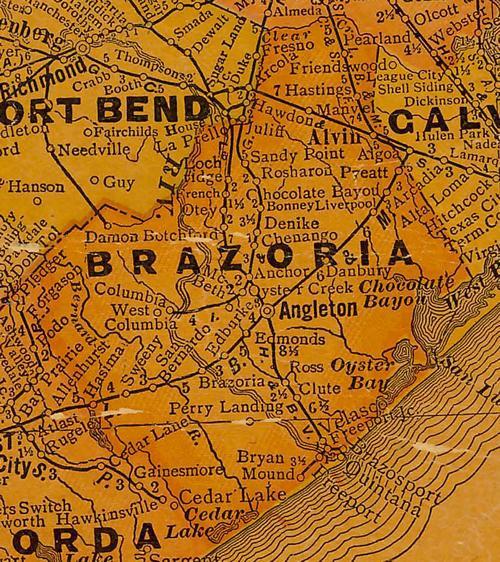
Brazoria
County 1920s map showing Velasco
From Texas state map #10749
Courtesy
Texas General Land Office |
| Texas
Escapes, in its purpose to preserve historic, endangered and vanishing
Texas, asks that anyone wishing to share their local history, stories,
landmarks and recent or vintage/historic photos, please contact
us. |
|
|
 HOME
HOME

 Texas
Gulf Coast
Texas
Gulf Coast East
Texas
East
Texas Central
Texas North
Central
Texas North Central
Texas South
Central
Texas South Texas
Panhandle
Texas
Panhandle South
Texas
South
Texas Texas
Hill Country
Texas
Hill Country West
Texas
West
Texas Texas
Ghost Towns
Texas
Ghost Towns Texas
Counties
Texas
Counties