|
Austin's "Guy
Town"
1870-1913
Austin, Texas
Contemporary Name
/ Traditional Vice
by Brewster Hudspeth
Worldwide, there's always been a distinct line between business conducted
during banking hours and business conducted after sunset. The section
of Austin known as "Guy Town" was defined as the area bounded by Congress
Avenue to the east, the Colorado River to the south, Guadalupe Street
to the west and 4th Street to the north. The entire area was eight
square blocks. |
|
|
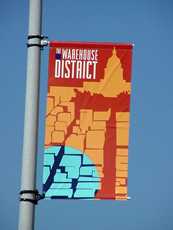
The area is now identified as Austin's "warehouse district."
TE Photo 10-04 |
Austin
has always been a high contrast town. During the early years, it was
said that one could stand on Congress Avenue (if one had nothing better
to do) and hear baying coyotes, the clicking of billiard balls (the
reassuring sound that civilization had arrived) and even the war-cry
of hostile Indians. Then there was Mrs. Eberly's artillery practice...
but that's another story.
The "cry of hostile Indians" that was heard may actually have been
confused with the sounds of merriment coming from Guy Town. Although
settlers were still being scalped out in Medina and Kerr Counties,
Austin had become civilized to the point where its most pressing "Indian
problem" in the second half of the 1800s was a single Native American
named Bigfoot who had acquired the distinctly urban diversion of looking
in people's windows. (He was named for the oversized footprints he
left in flower beds.)
Worldwide, there's always been a distinct line between business conducted
during banking hours and business conducted after sunset. The section
of Austin known as "Guy Town" was defined as the area bounded by Congress
Avenue to the east, the Colorado River to the south, Guadalupe Street
to the west and 4th Street to the north. The entire area was eight
square blocks. |
|
|
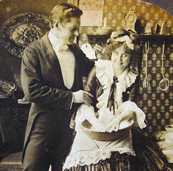
Class distinction didn't matter in Guy Town. Here a legislator requests
a biscuit recipe from the help.
TE Postcard Archives |
Guy
Town was where one went after one cashed one's check. It was
a demimonde where cash was king and hard coin won out over paper currency
every time. Guy Town had an agreement with the banks of Congress Avenue
- Guy Town didn't cash checks and Congress Avenue didn't allow patrons
to buy drinks for their female employees.
In Austin: An Illustrated History, researchers listed some
trivial and/ or amusing crimes of old Austin. Austinites at one time
could actually be arrested for misdemeanors including "indulging in
exercise calculated to scare a horse," "appearing in clothes not belonging
to one's sex," "rudely displaying a pistol," "playing city marshall"
(Ben Thompson evidently didn't want to share the limelight), using
"abusive language over the telephone," and playing baseball on Congress
Avenue - a problem that has stubbornly persisted to this day. While
ordinary folk were being arrested and/or fined for these offenses,
denizens of Guy Town were cut some slack. Make that lots of
slack.
Saloons and beer halls were everywhere. The difference between Anglo
saloons and German beer gardens in Austin and San Antonio was that
the beer gardens were family-friendly places where Germans came to
socialize. Women and children could play croquet on real grass and
men could drink and play horseshoes. Croquet never got a foothold
in Guy Town - a fact that still puzzles historians and sociologists.
Not quite as dangerous as New Orlean's Storyville or even Fort
Worth's Hell's
Half Acre, Guy Town still had dangers of it's own - not the least
of which was City Marshall Ben Thompson who enjoyed firing blanks
into crowded saloons just for the hell of it. What a card.
Like
the Mexican "Zones of Tolerance" of the 20th Century - Guy Town was
tolerated (enthusiastically). Protests were made, but the eyes and
ears of the city council were blind and deaf. When one crusading reformer
reported that on a single night he counted over 100 UT students in
Guy Town, the city council had to ask: "What's your point?" Guy Town
was so popular with politicians that the businesses known as "female
boarding houses" had to hire new boarders whenever the legislature
was in session. Defenders of the neighborhood and those who claimed
never to have visited there referred to it quaintly as "Lively Town."
These were the same people who would call Mardi Gras "a little religious
parade."
While whiskey and women were the two main rings of the Guy Town circus,
there were continuous side shows sponsored by cocaine and opium. Trade
was so brisk in these drugs that they spawned a new business - an
early version of what we now call a recovery clinic. Hanging their
shingle at 108 7th Street, the Hagey Hospital advertised that their
"Bi-Chroride of Gold" treatment was guaranteed to cure "Liquor, Opium,
Morphine, Cocaine and Tobacco Diseases" and "not to cause delirium."
And if that wasn't enough to get you to enroll; their clincher was
that you wouldn't even miss a day of work. Good for the addict - maybe
not so good for his coworkers.
Austin
once chided Waco
for it's officially sanctioned "Reservation" - a downtown district
where prostitutes were issued annual non-tranferable city licenses.
But Waco imposed very strict rules. Prostitutes (a.k.a. "actresses")
who left their boarding houses to go shopping were not allowed to
speak to the general populace under threat of banishment. In Austin,
wayward actresses were merely escorted back within the boundaries
of Guy Town. Waco's Reservation outlived Guy Town by about four years.
It was closed by order of the U.S. Army during W.W.I
- when it was viewed as a potential health hazard to the troops preparing
for the slaughter in Europe.
The Austin city council did vote to shut down Guy Town at one point,
but the decision was vetoed by the Austin mayor. It wasn't until Ragtime
music appeared that complaints got more vociferous. The raucous music
was bad enough - but when the "professors" of Guy Town took the felt
off the piano keys - it was the proverbial last straw. Sporadic gunshots,
screams and vile language were tolerated - but it must've seemed to
citizens of Austin that the pianists of Guy Town were playing their
out-of-tune pianos in shifts. Finally in October of 1913, Austin Police
Chief Will Morris carried out the order to close Guy Town for good. |
|
|
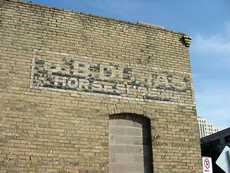
A ghost sign for
horseshoeing
TE Photo 10-04 |
|
The
only extant building from Guy Town's heyday is the old Schneider
Store. The building underwent a restoration in 2001 while excavations
went on over a four-block area. The dig yielded over 100,000 artifacts.
Marbles, dice and poker chips reveal there was a strong interest
in interactive games. Bottles of champagne and French perfume show
that although the neighborhood was rough, there were still those
who wanted to enjoy the finer things - especially if someone else
was paying for them. A key, a lone spur (as with most lost footwear
- there's never a pair), a corset stay, buttons and snuff bottles
round out the inventory of relics. Back-alley privies and cisterns
were discovered - and even a limestone beer vault. While privies
traditionally reveal many artifacts - in this case they were shallow
places carved into the limestone which were periodically emptied.
The area that was once Guy Town has become much less colorful over
the years, but with all the incidents of mayhem and suicide that
occurred there; it's a wonder there aren't volumes of ghost stories
coming from the offices and restaurants that now conduct business
there. It's been years since anyone has indulged in "exercise calculated
to scare a horse" although "using abusive language over the telephone"
is frequently heard. As for "appearing in clothes not belonging
to one's sex" - it doesn't even raise eyebrows in contemporary Austin.
© John Troesser
|
|
|
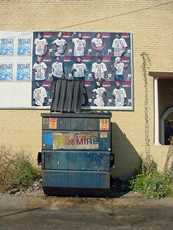
Contemporary
view of an alley in "Guy Town."
TE Photo 10-04 |
| Texas
Escapes, in its purpose to preserve historic, endangered and vanishing
Texas, asks that anyone wishing to share their local history, stories,
landmarks and recent or vintage photos, please contact
us. |
|
|
 HOME
HOME