|
WACO, TEXAS
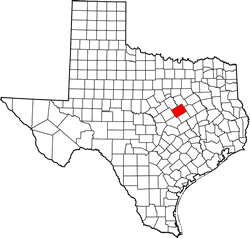
McLennan
County Seat, Central
Texas North
31° 33' 5" N, 97° 9' 21" W (31.551389, -97.155833)
I-35, US-77, US 84 and Hwy 6
22 miles E of Crawford
105 miles N of Austin
36 miles N of Temple
97 miles S of Dallas
87 miles S of Fort
Worth
ZIP Codes 76700–76799
Area code 254
Population: 138,486 (2020)
124,805 (2010) 113,726 (2000) 103,590 (1990)
|
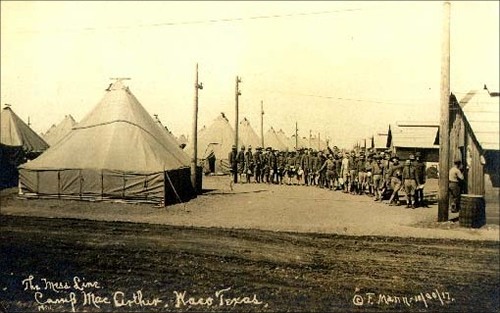
Camp MacArthur
Mess Line, Waco Texas 1918
WWI
Postcard
courtesy www.rootsweb.com/ %7Etxpstcrd/ |
History in
a Pecan Shell
The city is built
near springs that used to flow not far from downtown Waco (still marked
- on the grounds of a former elementary school (more recently the
Helen Marie Taylor Museum).
A timeline of significant events in Waco
1837: Fort Fisher, a Texas Rangers outpost was established
in but abandoned within the year.
1838: Neil McLennan moved onto land nearby on the South Bosque
River, a somewhat romantic mural commemorating the event is in the
post office in nearby Mart, Texas.
Land agent Jacob De Cordova accquires the property and has George
B. Erath survey the area. Erath had first visited the area as a ranger
stationed at Ft. Fisher.
1849: Geo. Erath laid out the first block of the new town that
they first wanted to name Lamartine.
1850: McLennan
County was organized. The Waco Era, the town's first newspaper
is published.
1856: Waco Village is incorporated as the town of Waco and
a new courthouse is built that year.
The Civil War: Seventeen companies of Confederate soldiers
were raised from Waco and the surrounding countryside. Waco also produced
six Confederate generals. After the Civil War, Waco's economy recovered
rapidly despite the trials of reconstruction.
1868: Waco becomes a spur on the Chisholm Trail and cattlemen
and their cowboys often stopped in Waco for suppies and entertainment.
1870: The Waco Bridge Company opened a suspension
bridge spanning the Brazos. Designed by Robeling - the man who
went on to build the Brooklyn Bridge - the Waco bridge served as his
working model.
1871: The Waco and Northwestern Railroad was built.
1872: The African Methodist Episcopal church opens Paul Quinn
College (now in Dallas)
1880s: Two other railroads, the St. Louis and Southwestern
and the Missouri-Kansas-Texas lines, came to Waco in the early 1880s.
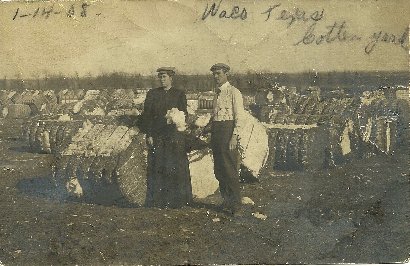
1884: The population reaches 12,000. 50,000 bales of cotton
were being shipped through Waco annually. During the 1880s and 90s
artesian wells were expanded and two natatoriums were built - one
of them a hotel built by J. Reily Gordon who later built the McLennan
County courthouse in 1901.
1887: Waco University merges with Baylor U., which had
moved to Waco from Independence,
Texas.
1890: Waco had streetcars pulled by mules and began to build
a system of parks, often with donated land.
1898: Waco industries include railroads, ice plants, flour
mills, foundries, boiler plants, and bottling works.
1900: Waco becomes the 6th largest city in Texas.
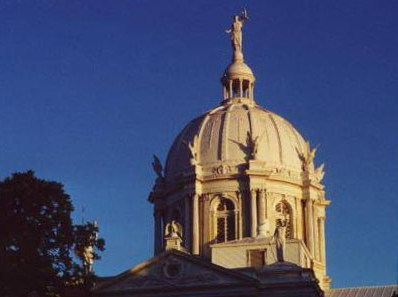
190I: Twenty electric trolleys were operating on city streets
and the Beaux-Arts
courthouse was finished.
1905: a street paving program began
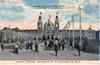
1909: The Cotton Palace
was built, and soon became one of the most popular fairs in the south;
in 1913 an estimated 500,000 people visited the site.
1911: The
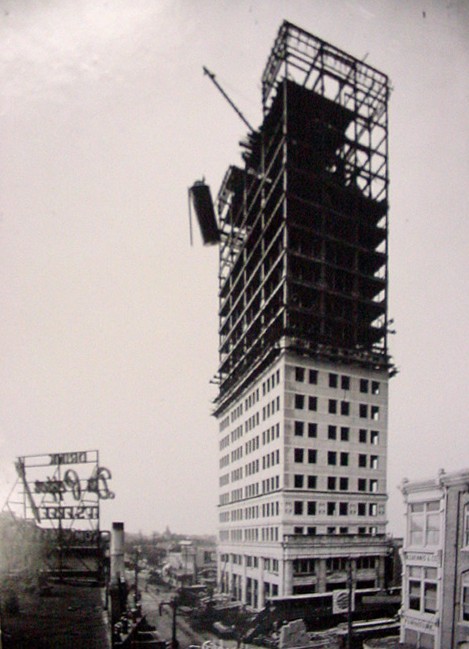
Amicable Insurance Building, at twenty-two-stories becomes the
tallest building in Texas
1913: An electric interurban railway opened between Waco and
Dallas.
1917: Camp MacArthur opens (1917 to 1919) an infantry training
base covering more than 10,000 acres The 35,000 troops assigned to
the camp doubled Waco's population.
"The Reservation" - Waco's licensed red-light district since
the 1870s is shut down this year.
1930: population reaches 53,848
The Cotton Palace, a symbol
of the city's prosperity, was shut down. It later burned.
Based on a fear of not appearing "progressive"- the electric trolleys
were discontinued and replaced with buses.
1940: 55,982 people lived in Waco
World War II
revives the cotton industry and Waco Army Flying School and Blackland
Army Air Field (China Spring) were opened.
1948: Waco Army Air Field was reactivated as Connally Air Force
Base
1952: population was 84,300
1953: A tornado nearly levels downtown. Hundreds of people
were buried in the rubble of buildings whose brick walls were not
braced. The loss of nearly 600 downtown buildings is still evident
today.
1966: Connally Air Force Base is closed
1970: the population was 95,326
1980: population reaches 101,216
1990: population was 103,590 |
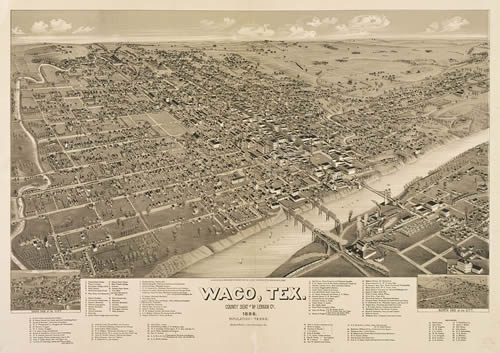 |
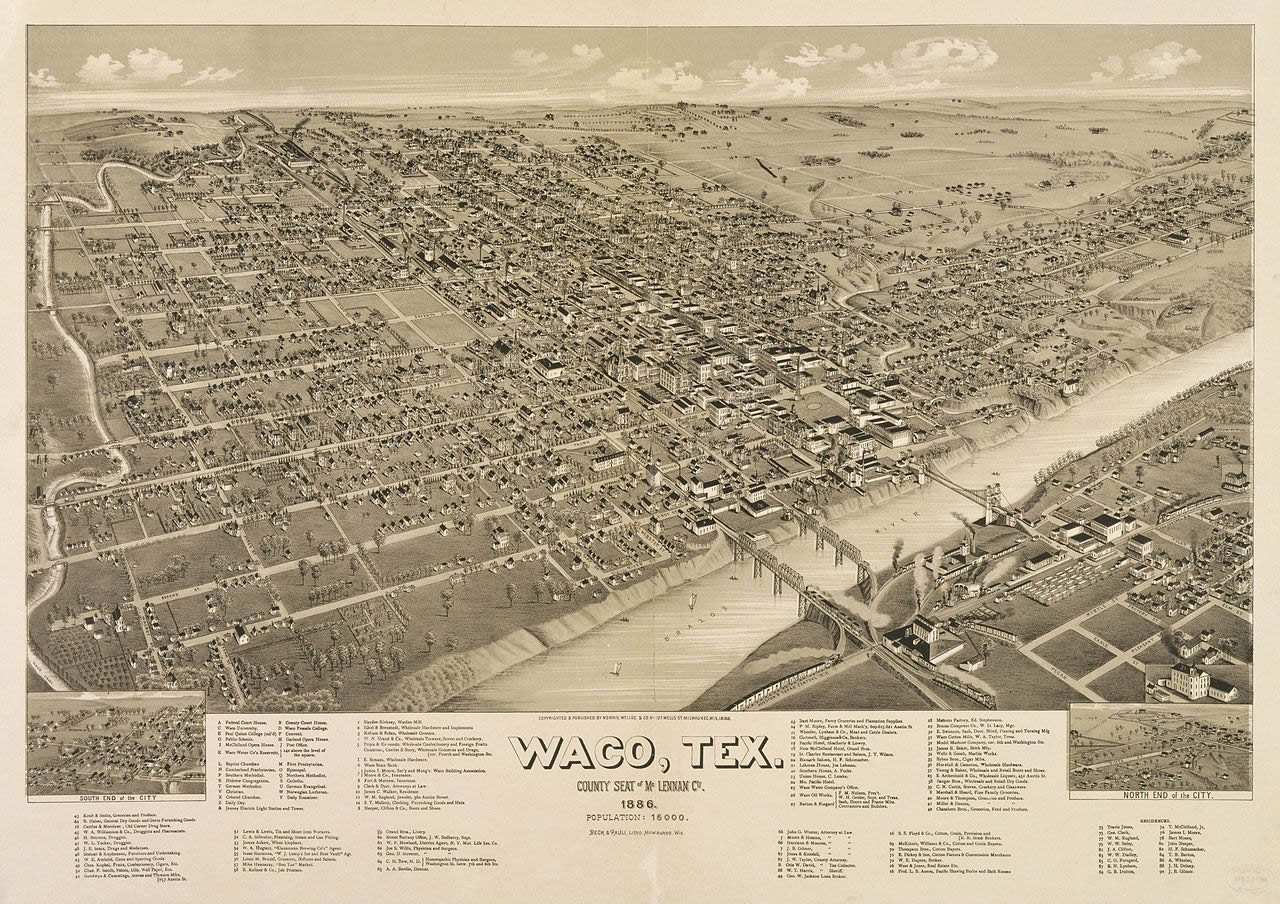
1886 Bird's
eye view of Waco, Texas
Clcik on image to enlarge
Wikimedia |
Waco, Texas
Landmarks / Attractions
|
| Photo
Courtesy Texas Collection, Baylor University |
The
ALICO Building
c. 1911 - The tallest building in Texas when it was first built. Built
over artesian springs, the building was self-sustaining. Employees
of the building witnessed the destruction of downtown Waco during
the 1953 tornado. |
|
|
Bridges
crossing the Brazos at Waco
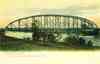
Waco Suspension Bridge: c. 1870, The Waco Steel Bridge AKA The Washington
Street Bridge, The Iron Bridge c. 1902, The Interurban Railway Bridge
c.1910, Union Pacific Bridge |
 |
Armstrong Browning
Library:
On the campus of Baylor University- World's largest collection of
Robert and Elizabeth Barrett Browning's works and memorabilia
Mayborn Museum
Complex:
Governor
Bill and Vera Daniel Historic Village -
"...Bill Daniel is best remembered by some admirers for one
of the strangest events in East Texas--the move of an entire town
from Liberty to Waco, a distance of more than 200 miles, in October
of 1986 during the Texas sesquicentennial celebration..."
Baylor campus. www.maybornmuseum.com
Homestead
Heritage Crafts Village:
a 350 acre 19th century working farm
Texas Ranger
Hall of Fame and Museum:
On the Brazos River at the site of old Fort Fisher
Dr Pepper Museum:
Building c. 1906
Historic Homes
Tour:
Contact the visitor's bureau for information 1-254-750-8696
|
The
Crash at Crush by Luke Warm
The field that once was Crush, Texas is now occupied by cows, but
a recently replaced historical marker south of West, Texas tells
the story of one of the most bizarre publicity stunts of all time...
Read full article
Waco
Mammoth Site Nearing National Monument Status by Britt Towery
Last month the U.S. Congressional committee approved the Waco Mammoth
Site to become a national monument...This was the biggest hurdle
so far in the ten-year struggle to protect the site of a mammoth
herd's death just north of Waco. This is the world's largest known
concentration of prehistoric mammoths perishing in the same event...
Read
full article
Mayhem
at Mount Carmel by Mike Cox (Excerpt from "Time of the
Rangers")
On any given Sunday morning in Waco, home of the largest Baptist
university in the nation, a lot of the city’s residents are sitting
in church. That was where Company F Captain Bob Prince could be
found on the morning of February 28, 1993... A Texas National Guard
helicopter had been shot down and numerous federal Bureau of Alcohol,
Tobacco and Firearms agents killed and wounded while attempting
to serve a search warrant at David Koresh’s Branch Davidian ranch...
Read
full article
|
|
Lover's
Leaps by Mike Cox
The best known Lover's Leap in Texas is the cliff overlooking the
Brazos River in Waco's Cameron Park. It's such a well known landmark
that there's a church named after it - Lover's Leap Baptist... Read
full article
|
| Photo
courtesy Richard Wilshire |
| Photo
courtesy Charles Watson |
Waco Native
Sons & Daughters
|
Hello,
Sucker by Clay Coppedge
Necessity may be the mother of invention but it can also be the
mother of re-invention. Other than perhaps Kinky Friedman, nobody
exhibits that twist on the old axiom more than Mary Louise Cecilia
Guinan, known to history as Texas Guinan and for her famous greeting:
“Hello, Sucker.”
Texas
Guinan by Luke Warm
She may have been Waco's Answer to Mae West - but no one remembers
the question...
Doris
Miller: Hero by Archie P. McDonald
African American hero of WWII
Sleeper's
Song by Mike Cox
As a long-time Texas lawyer, Ben Sleeper wrote many a legalese-laden
petition alledging this or that in behalf of his clients, but few
if any of them ever knew of – much less heard – the patriotic song
he composed as a young Army officer in training back during World
War I.
|
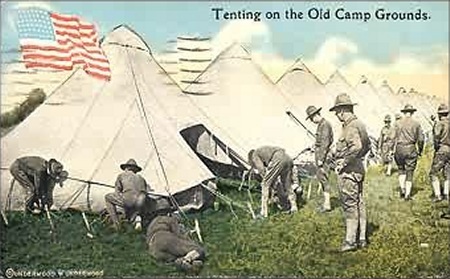
Tenting on the
old camp grounds, Waco Texas 1918
WWI
Postcard
courtesy www.rootsweb.com/ %7Etxpstcrd/ |
| Waco Architecture:
Gone but not Forgotten |
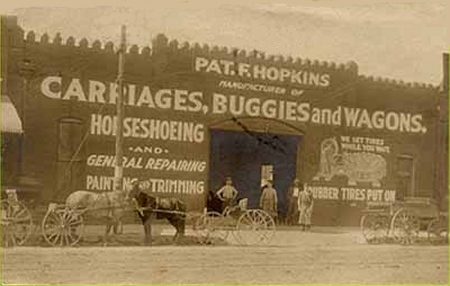
Hopkins Carriages,
Buggies and Wagons
1908
Postcard
courtesy www.rootsweb.com/ %7Etxpstcrd/ |
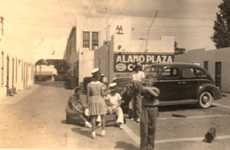
Waco's
Alamo Courts
Photo circa 1940s courtesy George Lester |
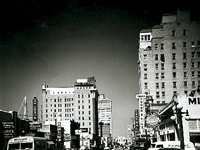
Downtown
Waco in the 1950s
Photo courtesy of TXDoT |
|
Waco's location
and its involvement in so many historical Texas events and developments
makes it one of Texas' most interesting towns. Fortunately, Waco
has a very active historical society which has printed a historical
magazine for many years. An Illustrated History of Waco in two volumes
has been published by Texian Press, a Waco company with a strong
personal involvement in the project.
The unfortunate events that took place at "Mount
Carmel" have linked the name Waco with those events. It's our sincere
hope that people will eventually forget this association and that
Waco will be known for what it is and has been, and not for a single
incident. - Editor
|
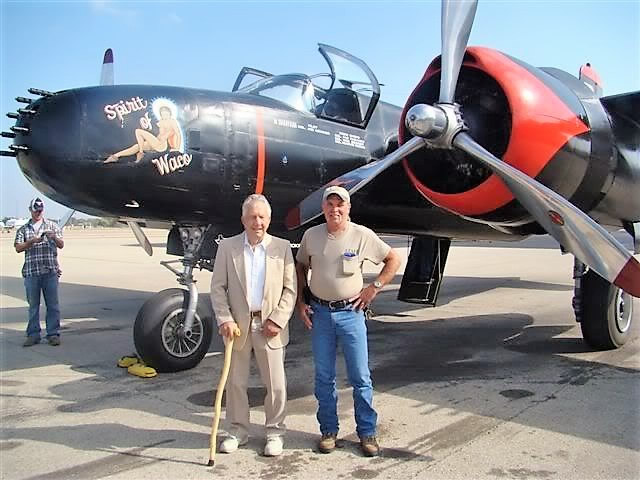
| "In 2008
I had the privilege of flying on the 'Spirit of Waco' with retired
Air Force pilot who had piloted one of these A-26 Bombers during an
air show inn Waco - Richard Wilshire, November 21, 2022 |
Subject:
Waco forgotten history
A history of the Headquarters 12th Air Force 1957-68 Waco, Texas.
In the years following the Korean War and the build-up of the nuclear
US Air Force in the mid to late 1950’s the offices of the 12th Air
Force were established in Waco, Texas near where 25th Street and
Windsor Ave intersect. The mission of the command was to prepare
and train tactical forces of the Air Force to work jointly with
the Army for units located west of the Mississippi River. They played
a key role developing tactics and methods of these forces during
the increasing US presence in Southeast Asia. The offices were located
in two major buildings facing 25th Street with a small office housing
an officer club near Bosque Blvd and 25th. This facility was used
until the command was relocated to Bergstrom AFB, TX in 1968. The
buildings were abandoned and turned over to their previous owners,
presumably the City of Waco.
The headquarters were not located at nearby James Connelly AFB as
some sources write.
My father, SSgt Robert Torn was stationed there 1961-1963 as an
administration clerk assigned to the fledgling Direct Air Support
Center (DASC) and part time bartender at the Officer’s club.
No photos are available of the facility despite its 10 year location
at the site. - September 16, 2014
Rich Field,
Waco
I am looking for information on anything to do with Rich Flying
Field, in Waco. This was home to a unit of the Air Force of France,
the US Army Flying Service, and U. S. Signal Corps. This World
War I base was located near 42nd street in Waco and was the
basis for Richfield High School (now Waco High School) . My father
served at Rich Flying Field in 1918. USAF records are slim concerning
WWI because of the
great fire in St. Louis, Mo. I am searching other Air Force centers
for records. I would like to contact members of Waco, Texas Historical
Society that might help with this project. Many pilots went to the
front from Rich Field, if planes were available. Their contribution
to the war should not be forgotten. The beginnings of the Air Force
is a part of Waco's history and the military history of our country
and the struggle in Europe.
I am looking for records of my fathers military service with the
Army Signal Corp and Army Air Service at Rich Flying Field in 1918.
My fathers name was Henry M. Harris. - John Harris, Fort Worth,
February 18, 2005
|
| Texas
Escapes, in its purpose to preserve historic, endangered and vanishing
Texas, asks that anyone wishing to share their local history, stories,
landmarks and recent or vintage photos, please contact
us. |
|
|
 HOME
HOME