|
As
Hopkins County’s
first seat of government, Tarrant had more troubles than most frontier
communities in East Texas.
In the end, the misfortunes converged to cause the town’s demise after
24 years of tenuous existence.
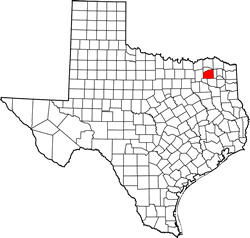
In 1846, the Texas Legislature created a new county named for the
Hopkins family from portions of Lamar
and Nacogdoches
counties.
Two places within three miles of the center were chosen as suitable
sites for the county seat. Eli Hopkins offered the county suitable
land for a public square and courthouse if voters would decide in
has favor. His brother Eldridge, however, made a similar but competing
offer.
Eldridge’s tract won out and the county seat was named for General
Edward H. Tarrant, a legislator who decided that he had rather fight
Indians on the frontier than deal with politicians. He became a Texas
Ranger and was popular among the frontier’s settlers.
As
a county seat, Tarrant began to grow. The county used a log cabin
as the first courthouse and county officials often carried county
records to their homes for safekeeping. In 1851, a contract for a
permanent courthouse was awarded, but the construction floundered
for lack of money.
The solution was ingenious, if not legal. When an official noted that
cattle herds being driven through East
Texas by Louisiana cattlemen were munching on Hopkins
County’s grasslands, the cattle were found to be in violation
of a law that supposedly said Texas grass was not free.
Hopkins County
charged the herd’s owners with breaking the law and seized some 300
head of cattle, sold them at auction and raised $1,772 to finish the
courthouse. |
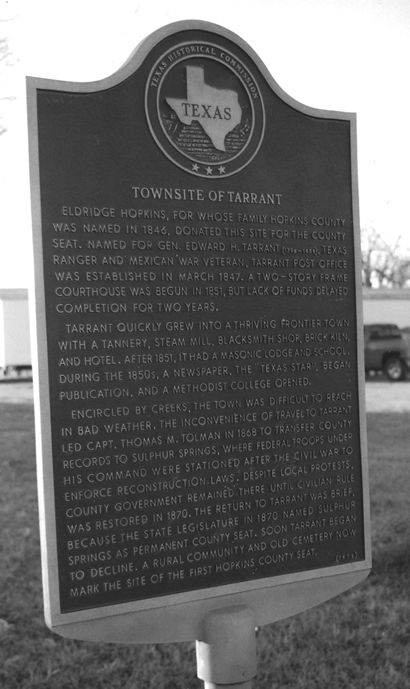 |
| A
Texas State Historical Marker reminds East Texans of the site of old
Tarrant, once a Hopkins
County seat of government. |
Following
the Civil War, and the imposition of Reconstruction rule in Texas,
Tarrant’s people found that federal soldiers had little sympathy for
East Texas.
The commander of a federal company in East
Texas deployed his men at Sulphur
Springs, instead of at the county seat, and ordered the county’s
records delivered to his headquarters.
The county records remained there until 1870 when civilian rule was
reestablished in the county and the records were returned to Tarrant.
But Tarrant’s victory was short-lived.
The Texas Legislature soon approved a special act to make Sulphur
Springs the county seat. The Tarrant courthouse was closed and
sold at auction.
When the county seat was moved permanently to Sulphur
Springs, many county residents objected, particularly those living
in the north side of the county. They claimed Sulphur
Springs was not the center of Hopkins
County.
But under another act of the Texas Legislature, a part of Lamar
County and the northern portion of Hopkins
County were organized into a new county known as Delta
and the southwestern part of Hopkins
County was deleted and became Rains
County. The gerrymandering placed Sulphur
Springs near the exact center of Hopkins
County.
Tarrant began to fade away and today, except for a well-kept cemetery,
there are no reminders today of Old Tarrant.
© Bob
Bowman
February 8, 2009 Column.
More Bob Bowman's East Texas
»
A
weekly column syndicated in 109 East Texas newspapers |
| Texas
Escapes, in its purpose to preserve historic, endangered and vanishing
Texas, asks that anyone wishing to share their local history
and vintage/historic photos, please contact
us. |
|
|
 HOME
HOME