Books
by
Byron Brown
Order Here |
|
| I
cannot take my eyes off of it. Or, rather, I just can’t put it down.
I even put it in the other room so that I would take up another. But
like trying to quit smoking when there’s still a cigarette in the
house, I went and grabbed it back up again. |
| It
is a book, ‘Jeff Davis County, Texas’ by Lucy Miller Jacobson and
Mildred Bloys Nored. A tome of a work, the text attempts to span the
history of that section of west Texas from pre-historic times to the
early 1990s when the book was published. And, because the pages, all
676 of them, are filled with the histories and brief biographies of
the county’s more influential families, I have become enthralled with
the book. |
|
|
Every writer
is something of a voyeur. Typically, we enjoy peering into other’s
lives, watching when they themselves are paying little attention.
I honestly believe that this desire to observe is a God-given personality
trait. When I was in school at Texas Tech back in the late 1980s
I spent many hours in the medical library scanning through psychiatric
textbooks and journals. Some of these held intriguing patient case
studies. Sometimes grossly personal and always informative, these
stories revealed those aspects of a person’s personality when it
is at its most vulnerable; when the behavior is illustrated in stark,
honest detail by a subjective, third party. Because of or due to
this separation, the information proffered presents a picture of
the individual in its most naked form. And again, because of this
we, as the audience, receive a very real and unaltered version of
the subject.
This is the case with all of the family portraitures within Jacobson
and Nored’s book. The individual stories are presented with heart-felt
honesty and attention to personal detail that only persons who have
a direct connection can reveal. Indeed, both Mrs. Jacobson and Mrs.
Nored are (were) residents of Fort
Davis, their family’s ancestries reaching far back into west
Texas history. Together they created a book that relates the story
of Jeff Davis County from a perspective that few others could have
obtained.
I would do an injustice to the book if I told of all the stories
that seized my interest. For starters, there are simply too many
for that. The story of the Griersons I have already mentioned here
before. Of course, there is much more to relate about that family
but the rudiments have already been exposed. The Grierson story
forms a large portion of the foundation of Fort
Davis. Anyone interested should take the time to study this
family’s story. It has all the elements of a good novel: greed,
sickness, untimely death, wealth, genius and a healthy dose of surrealism.
Fort Davis
may have, eventually, become what it is today without this family
but it certainly would not have had as much of the color or illustriousness
that it does without them.
Additionally, the Keesey family, brothers Whittaker and Otis
in particular, are in many ways responsible for the early construction
and general dynamic of Fort
Davis. Having served in the Ohio infantry during the Civil War,
Whittaker Keesey came to Fort
Davis as a carpenter under the employment of Col. Wesley Merritt
(later the superintendent of West Point). When his service was due
in 1875 Keesey stayed in the area and opened a “mercantile” store.
Enormously successful, Whittaker’s store enabled him to also branch
into banking. In fact, as Jacobson and Nored write, “W. Keesey &
Co. served as banker for the entire area and loans and credit extended
by the firm helped many early cattlemen, as well as others, become
established”. Another entry states that, “At one time or another
nearly every resident of the area was in debt to W. Keesey” (364).
Whittaker’s younger brother Otis “was the politician of the family”
(368). The first County Judge as well as the first school superintendent
of Jeff Davis County Otis was also somewhat careless and whimsical.
Maybe the expanse of the country invited a haphazard attitude, maybe
owning the majority of the land in the area induced a certain insouciance.
Whatever the reason, Otis was removed from office in 1891 when he
was, “… indited [sic] by the Grand Jury for drunkenness in office”
(368).
Otis was also responsible, at the time, for one of the greatest
dramas in the town. After his divorce from Adelina Fernandes in
1894, Otis left town for the rich climes of California. Adelina
however, stayed in Fort
Davis and opened a “bawdy house”. Difficult to imagine such
a business in the area nowadays but Adelina was wildly successful
in the early years of the twentieth century. In fact, one of the
couple’s daughters, Belle, continued the Keesey tradition of liberal
thinking when she became the mistress of Nick Mersfelder years later.
Belle, a married woman lived just next door to Mersfelder who was
himself, the county’s coroner and judge and something of a local
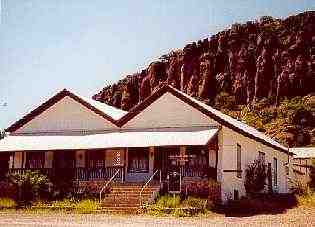
celebrity due to his eccentricities. In fact, Mersfelder’s old home,
with it’s dual front doors, is today, the Overland Trail Museum.
Belle’s house, the one Mersfelder bought for her and her husband,
is directly across the side street.
|
|
|
Overland Trail Museum
TE photo, 2000 |
|
Without a doubt,
the boots in this section of the state kick a different dust from
their heels at the close of each sun-baked day. This could be due
to the fact that many of these families trace their roots back to
the eighteenth century when the Irish or German relative, by way
of either Pennsylvania or Virginia, settled in Texas
where the land was still up for grabs. Obviously many Texas families
can sketch their lineage back more than two centuries. What demarks
these ruddy clans as extraordinary was their willingness, indeed,
eagerness, to settle down in an area where danger was omnipresent.
This was a land teeming with Mexican Bandits, hostile Apache and
Comanche Indians, rattlesnakes, flooding and space that is dangerously
expansive; so open and broad that it invites a certain degree of
lawlessness.
Jacobson
and Nored’s book opens its chapter on the “Twentieth Century” with
an entry on one of just this sort of family. The authors write of
the Sproul family: “Franklin Lee Sproul was elected sheriff of Jeff
Davis County in November 1914. He was honest and fair with all citizens
and was extremely popular.” This sort of writing, drawn as much
from the heart as from personal experience and introduced with the
same earnestness as any lore or mythology, is the type with which
this book is filled. The section continues with a sad but not uncommon
story for this part of the state during this era, “On February 24,
1933 three young tramps robbed the Sproul Ranch north of Fort
Davis…”. Later the same day Sheriff Sproul assembled a posse
and soon found two of the three “… near the Sproul Ranch house.”
The third robber had sought his escape farther into the countryside.
When the posse found this man, “… he rose up from behind some boulders
and shot `Sheriff Sproul in the abdomen.” (287) The sheriff died
that evening.
All of the accounts state how the community was devastated by their
singular, incorporate loss. The robbers, on trial in Fort
Stockton a month later, had to be constantly guarded and shuffled
around on back roads in order to shield them from the lynch mobs.
Due to their ages they were given lenient sentences (seven years
each) and the citizens of Fort
Davis were understandably incensed. Then, in what was obviously
an effort to regain some of what they had lost, the town appointed
F. Lee Sproul’s wife, Louise, to finish her husband’s term as sheriff.
Noted for her refusal to wear a gun while on the job, the community
announced itself to be under “Petticoat Rule” for these years. Indeed,
Louise Sproul won the next sheriff’s election and held that position
until 1936.
As with most stories that emigrate from west Texas the Sproul’s
story is too lengthy to just be outlined here. In fact, even in
Jacobson and Nored’s enormous book the family’s tale is only a detailed
sketch. However, that is all right. The peripheral glance offered
leaves room for dozens of other similar stories. Each one is as
enthralling as the previous. From the four and a half page tale
of Civil War veteran Henry Mayfield and his wife Zilla (Old Moss
and Old Miss) to the eight sentence paragraph about NIcanor Estrada
who was called Gringo “…because he could not speak plainly,”
(362) each story is, itself, a vivid albeit brief, glimpse into
our past. The authors have presented a book that is a treasure of
Texas ’ roots.
I
had thought that Jeff Davis County, Texas,
on account of that title, was going to be as dry as a seventh grade
science textbook. A large, white hardcover book it certainly gives
that impression. However the authors have delivered a text that
is as honest in its revelations as it is insightful. These stories
and histories are related with a confederate’s knowledge. Only someone
intimately involved with his or her subject could have produced
such a volume. The writing not only describes but also offers candor
as brutal as that heard at the breakfast table. For local writer
and historian Barry Scobee, Jacobson and Nored have little patience.
Regularly hinting at a hint of megalomania the authors write that
many of his newspaper and magazine stories were little more than
tall-tales told to him by the council of locals. Of these, “Scobee
accepted them for the literal truth but if they were not quite romantic
enough he had no compunction about adding to them.” (587) Again,
when the Fort Davis Historical Society had wanted to mark the graves
of the Confederate soldiers in the old cemetery, the authors write
that, “Barry Scobee, with his usual attention to accuracy, kept
adding Charles Mulhern (a thirty year veteran of the United States
Army) to the list.”
Another story that has stayed with me is the one of Mrs. Sarah
Janes Locke. The daughter of John and Susan Janes, Sarah married,
in 1907, Dr. Scott Locke, himself the son of Dr. George Locke. (It
was the Locke family who donated the two hundred acres to the University
of Texas as space for the McDonald
Observatory in the early 1930s) The younger Locke was a chronic
alcoholic (a fact the authors try not at all to conceal) and, although
nursed lovingly during the course of their brief marriage, “Scott
Locke died at age thirty-five from pneumonia and contributory alcoholism
in November 1910.” (455)
After her husband’s death Sarah Janes found that the Locke family,
now living back in New Hampshire, declared that Scott had not only
had a prior marriage but a daughter as well. This daughter, now
sixteen, was to be the doctor’s heir and family representatives
soon arrived in Fort Davis to reclaim every item that was in the
Locke-Janes house. Those items repossessed even included Sarah’s
piano; the one she had had since childhood. Devastated, Sarah moved
to El Paso
where she soon passed away. A young woman when she died I have been
unable to discover an age at death or even a cause. Although, whatever
the official cause of death, it is not difficult to imagine what
precipitated the occurrence.
Other stories told with graphic honesty and a sense of realism are
the dozens of tales of gunfights and shootings. While all true and
accurate, as far as we know, sometimes I find that I wish the authors
had been less than forthcoming with their information. As in the
case of one thirteen year-old boy who on one page is shown smiling
in an early daguerreotype image, linked arm in arm with his large
family and then from the following page’s text we learn that that
same year he accidentally shot and killed himself while crossing
through a barbed-wire fence. Another story involves a man who, after
surviving a gunfight at the Valentine train depot, dies a couple
of short months later in Alpine; shot accidentally by a Mexican
bandit who was blazing his way out of a saloon after being identified
by a deputy sheriff.
There are other stories; lots of others. Some are so moving as to
bring tears. Others are as horrific as any fiction. Regardless,
Jacobson and Nored’s book is full of the clarity and attention to
detail that any recounting of history demands. Whether the story
is a historical fact check or a family’s saga the writing here is
delivered as potently as expected or hoped. The text unfolds with
all the cold candor that a family member would deliver. The editorial
blunders and numerous solecisms only endear the work; they serve
to illustrate the innocence of the tales told. However, even with
the mistakes and errors I cannot put the thing down. The story it
tells is a majestic history-it is our history.
© Byron Browne
Notes From Over Here June
8 , 2011 Column
Byron Browne can be reached at Byron.Browne@gmail.com
|
|
|
 HOME
HOME