Books
by
Byron Brown
Order Here |
|
I
had been as inactive as the couch cushions that supported me. If I
had stopped breathing, the couch and I could have been mistaken for
relatives. However, I was watching the high-dive event of some summer
Olympics and that was pumping some animation into my sack of bones.
I listened while the announcers described each diver as he or she
took their place atop the broad, flat tarmac before throwing themselves
into space. Many of them, backs to the pool, balanced on the platform
only by the clutch of their toes. Every dive was preceded by a short
biography, delivered by the television’s announcer, such as: Chip
Rutherford is about to attempt a triple reverse backward somersault,
half-pike. He is a sophomore at Yale University majoring in astro-physics.
Then, the second announcer, might add: He’s also a Naval pilot,
flying F-16s from the deck of the USS Kittyhawk. And so, as I
sat eating a tuna fish sandwich and drinking the last half of the
last beer in the house, I pondered on my own accomplishments to that
point. I thought of Julius Caesar who is said to have cried while
inspecting the Pyramids in Egypt because he was thinking of Alexander
who had accomplished world domination (Caesar’s own, slightly-tacit,
ambition) at half his (Caesar’s) age. Luckily, the phone rang and
interrupted what was sure to be a short list when I focused my attention
on my own career. It was my little sister. “Are you watching this?”
she asked. She too had been watching the Supermen of the Olympics.
“These people are unbelievable!” she exclaimed. While we spoke about
the super human efforts we were witnessing Chip nailed his triple-reverse
backwards somersault half-pike, leaving barely a ripple in the pool’s
surface as his lithe, trim body knifed through the water. Of course.
I recently had a very similar experience while doing some research
about southwest Texas. I was reading about Fort
Stockton, Texas and its namesake, one Robert Field Stockton. Robert
Stockton’s life was one of those extraordinary events that persuades
and affects the lives of, not only those who were contemporaries,
but also the generations that follow. |
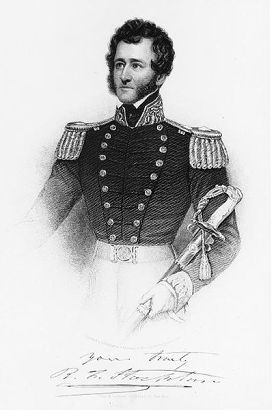 |
Robert Field
Stockton
commons.wikimedia |
|
Robert
Stockton was born August 20, 1795 into a prominent and political
New Jersey family. His father, Richard Stockton had been
the Senator from New Jersey from 1796-1799 and then later served
as congressman, again representing New Jersey, in the House. Stockton’s
grandfather, Richard Sr., was not only a close friend of
George Washington’s but also served in the Second Continental Congress.
After Judge Stockton endured imprisonment and very brutal
treatment by the British, he was later a signer of the Declaration
of Independence as the representative of the state of New Jersey.
Robert F. Stockton enrolled at the College of New Jersey (now Princeton)
in 1808, at the age of 13. In 1811, at the green age of sixteen,
he joined the U.S. Navy as a midshipman and saw action during the
War of 1812. In fact, Stockton was aboard the USS President
during this phase of his naval career. This was the vessel, with
Commodore John Rodgers at the helm, that “fired the first shot of
the War of 1812” during an engagement with HMS Belvidera.
While in this service Stockton began devising plans for an under-hull,
screw propeller that allowed larger war ships more speed and maneuverability.
After
these war years Stockton was assigned duty in the Mediterranean
Sea. He saw action in the war in Algiers and against the infamous
Barbary pirates. Presumably it was during this time in and near
Africa that Stockton became concerned with the slavery issue back
in the United States. In the early 1820s Stockton became involved
with the American Colonization Society or, more fully, the
Society for the Colonization of Free People of Color of America.
This organization was founded with the stated intent of allowing
“Free Blacks” to return to Africa where there was potential for
a better quality of life than in the U.S. In fact, this organization
also saw slaveholders amongst its ranks since several of them felt
threatened by free African-Americans. The slaveholders saw this
as a way to part company with a group that might be diametrically
opposed to themselves. Along with founding member and famous Kentucky
statesman, Henry Clay, Stockton was instrumental in the creation
of the colony of Liberia and the township of Monrovia (the only
city in the world, outside of America, named for a U.S. president).
Indeed, one story has Stockton involved with trying to persuade
an African chieftain, one King Peter, to appropriate and offer land
for this effort…from the business end of a pistol.
Around 1840 Stockton assisted engineer John Ericsson in overseeing
the building of a sail and steam war ship, the first U.S. ship with
a screw propeller blade that, due to its powerful and therefore
smaller diameter, operated under the water line. The ship was named
in honor of the Stockton family as Robert had been instrumental
in securing federal funds for its construction. Commissioned in
1843, the USS Princeton saw several years of service however,
it came to be better known for a horrific accident than any other
occurrence.
|
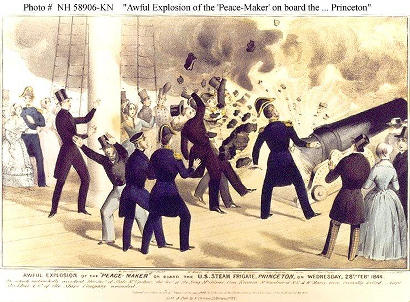 |
“Awful Explosion
of the Peace-maker Aboard the US Steam Frigate Princeton” 1844
Currier and Ives Lithograph
Credit: Department of the Navy, Historical Center |
| Then Captain
Robert Stockton, namesake of Fort
Stockton, Texas wasn’t the only person aboard the Princeton that
fatal day to be honored by Texas. Secretary
of the Navy Thomas Walker Gilmer and Secretary of State Abel P. Upshur,
both killed in the mishap, were remembered. Gilmer,
Texas is the County Seat of Upshur County. President John Tyler,
who missed the explosion by seconds, had Tyler,
Texas named in his honor. |
The
USS Princeton had two enormous cannons on board, an
attribute that Stockton had been very eager to accomplish and even
assisted in the construction of one of the giant guns. As was the
custom then, the cannons came complete with monikers. The gun designed
by Ericsson was initially named the “Orator” and then changed to “Oregon”.
The other cannon, the “Peacemaker”, designed by Stockton, was
to be the cause of the Princeton’s infamy.
Ericsson’s “Oregon” had iron bands around the breech end of the barrel,
an invention that reinforced the mechanism. Stockton’s gun, equally
large at just over 12 tons, simply relied on a thicker casing for
the barrel rather than the hoops that Ericsson had used. As one writer
wrote years ago the cannon was, “certain to burst” at some point because
of its design flaw. Burst it did on February 28, 1844 during an inspection
tour on the Potomac River. Present on deck and killed instantly by
the red-hot shrapnel were Secretary of State Abel Upshur and
Secretary of the Navy Thomas Gilmer who had been the one to
ask for the Peacemaker’s firing (the mammoth gun had already been
fired three times during the course of the afternoon. Stockton had
initially refused the request for the fourth blast until he learned
that it had been Gilmer’s request.) Because the ship was sailing on
a decorative mission, as it were, the vessel was filled with Washington
dignitaries and socialites. After the explosion of the enormous weapon
these same socialites were covered in blood, viscera and body parts.
In fact, one female debutante was knocked unconscious by the flying
arm of one of the blast’s victims. President Tyler was almost
one of the victims himself but had been detained just below deck,
and just before the cannon’s firing, by his son-in-law. In all nine
people died that afternoon. Stockton was also wounded and hospitalized
by the explosion and was spared further injury when he was absolved
of any malfeasance. Ericsson, who had missed the afternoon’s trip
because he did not trust the Peacemaker’s design, ended his relationship
with both Stockton and the U.S. Navy, for a while. During the Civil
War, Ericsson designed the Monitor ships, those metal flotillas that
lay close to the water’s surface thereby utilizing the water as another
protective layer.
Stockton’s
fame however, was not to be diminished or determined by this single
event. While the tragedy did have a deleterious effect on him for
some time, Stockton was soon aboard another Navy ship. This time he
headed to Texas with sealed orders from then President Polk
to request that Texas agree to annexation by the United States. Stockton
arrived in Galveston
aboard the Princeton in 1845. By now known for his brashness,
Stockton was warned by his superiors to not behave “rashly” with Texas
President Anson
Jones. Stockton, well aware that Texas’ annexation would likely
cause the Mexican government to declare war on the United States (ownership
of the area was still a dispute nine years after the Alamo
battle) confided to Jones
that Texas should, after accepting the annexation deal, invade Mexico
in a sort of first-blow effort.
Texas was annexed and Mexico did declare war, just as Stockton had
guessed. Stockton’s next move was to California where he relieved
Commodore John Sloat at Monterey. Having arrived with marines, infantry
and artillery the Mexican Californios troops quickly retreated
in the face of Stockton’s superior forces. In true form, Stockton
proclaimed himself the first Military Governor of California.
There is much more to the role Stockton played during the Mexican-American
War and his acquisition of Alta California. He and his forces were
instrumental in re-capturing Los Angeles. Monterey and San Diego also
were reinforced and supplied through Stockton’s efforts. The Mexican
General JosÈ Castro who, up to Stockton’s arrival, had been the Governor
of Alta California, retreated and left that position open for Stockton.
However, the U.S. Naval command objected to Stockton’s self-promotion
and replaced him with General Stephen Kearney in 1850, coincidently
the same year that Stockton “resigned” from the Navy.
Robert
F. Stockton then served as senator from New Jersey from 1851-1853.
During his tenure he passed a bill forbidding the naval custom of
flogging as a punishment method. Later still, in 1863, Stockton was
appointed as head of the New Jersey Militia during the Civil War.
He died three years later, in 1866, and is buried at Princeton, New
Jersey. |
|
While I was
reading through several different websites and articles about Stockton,
I came upon an auction house’s offerings of some old Americana.
The item I noticed was a nineteenth century flag with Henry Clay,
Sam Houston
and Robert Stockton’s names embroidered across the face. The note
on Stockton’s name stated something about him not being a “Big Name”
in American politics but one of those that “had a hand in many pivotal
events”. Indeed. From designing a style of ship that would revolutionize
naval battles to helping secure enormous reaches of land for his
country Robert Stockton was one of those individuals like ____________
(insert your own favorite icon’s name here) who shaped the portrait
of this country through the sheer power of his character. (I found
I was usually inserting Douglas McArthur’s name in the above blank
while reading about Stockton).
I suppose we all need to be able to hear and read about such people
while we sit on our couches, drink our beer and consider our own
accomplishments, otherwise we might never get up. But, Robert F.
Stockton, as so many men
and women connected with Texas’ history, seems larger than life
when trying to absorb his story all at one sitting. Stockton left
an enormous legacy behind. Not only are Camp
Fort Stockton and subsequently, Fort
Stockton, Texas named in his honor but Stockton, California
is also his namesake. Additionally, there is the Stockton Borough
of New Jersey, Stockton Street in San Francisco, a Fort Stockton
in San Diego (from the nineteenth century) that is today, a ruin
and even a Stockton rest stop on the New Jersey Turnpike.
Personally, I have not accomplished too much as to warrant a town’s
naming in my honor I might, however, settle for a rest stop on I-35.
© Byron Browne
Notes From Over Here February
1, 2011 Column
Byron Browne can be reached at Byron.Browne@gmail.com
|
|
|
 HOME
HOME


