|
William Marshall
Means established Meansville in the late 1850s. He came to Texas
as a boy, brought by his widowed mother. They homesteaded on the
Pedernales, but apparently shortly moved eastward, probably because
of Indians. On 21 April 1836 William Means was in Sam
Houston's army at San
Jacinto. He was detailed as a baggage guard because of his youth,
and thus didn't take an active part in the battle. Nevertheless
he was considered a soldier, and in lieu of wages - Texas didn't
have any money - he got land warrants for a section and a half (960
acres, 1½ sq. mi.), which he took up in Sabine
County.
William M. Means was the first sheriff of Sabine
County under the
Republic. For reasons unknown he migrated west, and by 1860
he and his son Pole - Napoleon Bonaparte Means - were established
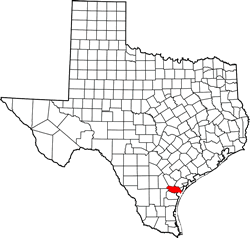
in San Patricio
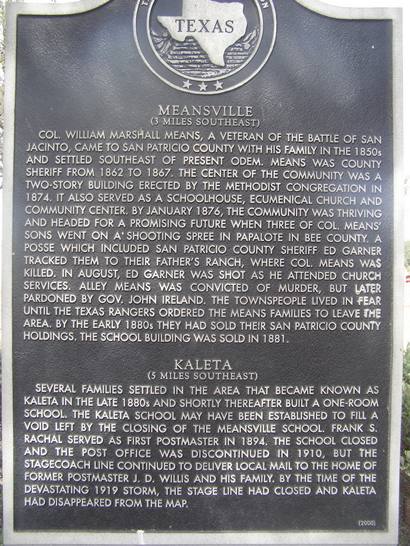
County. They started the town of Meansville, and in 1862 'Colonel'
Means (the title was apparently honorary) was elected sheriff of
San Pat County.
He served until martial law was established by occupying troops
in 1867.
'Colonel' Means had six sons. The older three, F. B., N. B., and
W. B., were all apparently honest, hard-working citizens. All were
ranchers in San Pat County. W. B. Means once served as his father's
deputy. The three younger boys, John H., Hugh, and Alley, were 19th
Century juvenile delinquents.
The elder Means fell afoul of the law in San
Pat County in 1875. To combat Texas fever, also known as Mexican
fever and redwater fever, since an infected cow's urine was red,
South Texas cattle, which carried the disease but were immune to
it, were required by law to be dipped to kill the fever ticks. Dipping
did no good unless everybody dipped his cattle, and William Means
refused to dip his cattle. The San Pat sheriff, Ed Garner, together
with several ranchers, rounded up the Means cattle, drove them to
the vats, dipped them, and drove them home. William Means was sent
a bill for the dipping, but he never paid it.
The
three youngest Means boys are scattered all through court records
in San Pat,
Bee, and Nueces
counties. Their offenses were minor but annoying-and often downright
dangerous. On 30 January 1876 all three rode to Papalote,
in Bee County, for a dance. Apparently they hit every saloon in
Papalote, because
by late afternoon they felt neither pain nor remorse. They rode
their horses into a general store and began to shoot the place up.
If it would break, spill, or make a mess they shot at it, including
shooting several holes in a barrel of blackstrap molasses.
Somewhere in there a sense that they'd gone a mite far penetrated
the alcohol fog, because right after shooting up the store they
pulled freight for San Pat County and home. We know they got to
their father's place, but we don't know what he was told about the
happenings in Bee County.
Sheriff W. K. Clark of Bee
County raised a posse and started after them. He also sent word
to Ed Garner in San Pat. It was pretty late when the two sheriffs
and their posses reached the Means place. When they called for Colonel
Means to send the three out to be arrested on charges of willful
destruction of private property and disturbing the public peace
of Papalote,
Bee County, Texas,
the old man came out in his nightshirt. He was also packing a rifle.
What was said and by whom isn't known to this day. We also don't
know who popped the first cap. We do know that William Marshall
Means stopped a load of blue whistlers and was dead when he hit
the porch boards. The three younger Means boys, apparently seeing
that the law meant business, surrendered without a fight. Alley,
who was 18 and had no better sense, told Sheriff Garner "You killed
my father. This isn't the end of it."
The 'end of it' was a while in coming, and it didn't really end
then. Seven months and 27 days later, August 26, 1876, was a Sunday.
The Garner family went to evening services at the Methodist Church
in Meansville. Ed Garner, as was his custom, took off his gunbelt
and put it in the crotch of a tree so he wouldn't be entering the
church with a sixshooter on his hip.
About the time the sermon ended Alley Means was seen to ride up
to the church, dismount, and tie a horse. Ed Garner turned to his
brother Marion and said "Alley Means is out there and I believe
he's going to shoot me right here in church." He was right. He got
up and walked to the door, probably intending to bluff Alley down.
Alley tied the horse, and there was someone out there with a rifle,
but most of San
Pat County doubted it was Alley. The someone fired two shots,
one hitting a pew just inside the door and the other taking Ed Garner
through the heart. It was fairly dark. While folks could tell somebody
got on the horse Alley tied and rode away, it was too dark to be
certain who the shooter was. According to oral history in San
Pat County, the following morning Eliza Means, William's daughter,
went to the church and danced a jig on the blood spot left where
Ed Garner fell.
Nobody believed it was Alley Means who actually fired the shots,
but he was tried and convicted of the murder. He was the one who
made the veiled threat the night his father was shot. He was seen
riding up to the church and tying the horse the killer escaped on.
He was greeted by several people outside the church but didn't come
in. He was seen peering in the church windows during the service.
All the circumstantial evidence pointed to Alley, if not as the
actual shooter, certainly as an accomplice.
John Means was a crack shot with a rifle. He was also of the same
general build and appearance as his younger brother. He was, though,
a married man and considered to be 'old enough to know better.'
Most folks in San
Pat County believed that, although John actually fired the shots,
the family decided Alley should take the fall because of his youth.
That might, say those who still talk about it, get Alley off light.
Alley Means was arrested and made bond. On 7 November 1879, he married
Sallie Campbell in DeWitt
County. By the time he was finally tried and convicted, he and
Sallie had a year-old son. He was convicted of willful murder of
a law enforcement officer, Sheriff Ed Garner of San
Patricio County, in district court in Nueces
County. He was sentenced to life in prison.
While he was in prison John cared for Sallie and the boy. Alley
entered the Texas State Penitentiary at Huntsville
on 6 March 1881. On 9 May 1885 he walked out a free man, having
served four years, three months, and three days. According to the
Means family, they paid $500 for a gubernatorial pardon-"as was
customary at the time."
After his release, he and Sallie, together with their son, moved
to Real County near Leakey.
He apparently remained a law-abiding citizen the rest of his life.
There are no Meanses in San Pat County today. All that's left of
Meansville are a few old, weatherworn gravestones. Records indicate
that between 1876 and 1882 the Means family sold all property in
San Pat County.
Local legend says they were 'persuaded' to do so, and some of those
doing the 'persuading' were Texas rangers (The word 'ranger' was
not officially capitalized until 1882.)
Whether that's true or not, it is recorded that early in 1879 the
Meanses, all their worldly goods loaded in a 23-wagon train, rolled
out of Meansville headed west. It was accompanied well beyond the
San Pat County
line by a number of people, several of them Texas rangers. The Means
family never returned to San
Pat County, and the only Means remaining is the old Colonel,
buried in a cemetery that's all that's left of what he once hoped
would be a thriving town bearing his name. Not even a lonesome ruin
marks that hope today. All that's left are tombstones, and most
of them are so weathered it's hard to read the inscriptions.
|
 HOME
HOME

 Texas
Gulf Coast
Texas
Gulf Coast East
Texas
East
Texas Central
Texas North
Central
Texas North Central
Texas South
Central
Texas South Texas
Panhandle
Texas
Panhandle South
Texas
South
Texas Texas
Hill Country
Texas
Hill Country West
Texas
West
Texas Texas
Ghost Towns
Texas
Ghost Towns Texas
Counties
Texas
Counties