|
 |
History in
a Pecan Shell
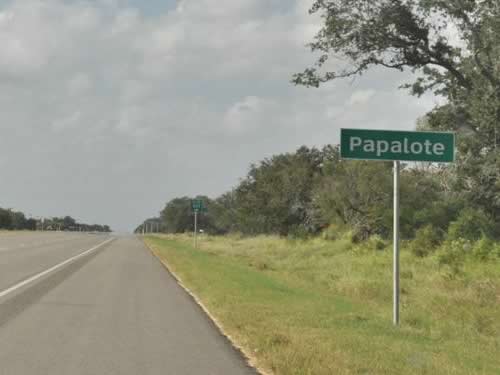
Papalote is regarded
as one of Bee County's
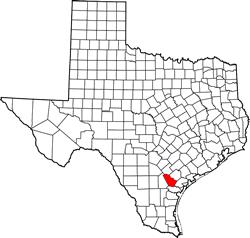
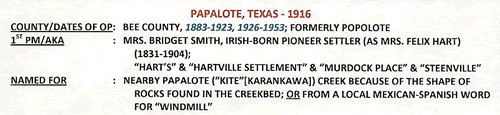
oldest communities. Settled on Papalote Creek, the name is believed
to either be a Karankawa word for "kite" or a colloquial Mexican-Spanish
term for windmill.
Like settlers in neighboring San
Patricio County, early Papalotians were immigrants from Ireland
settling on Spanish grants.
Prior to 1857 the town was actually three separate settlements:
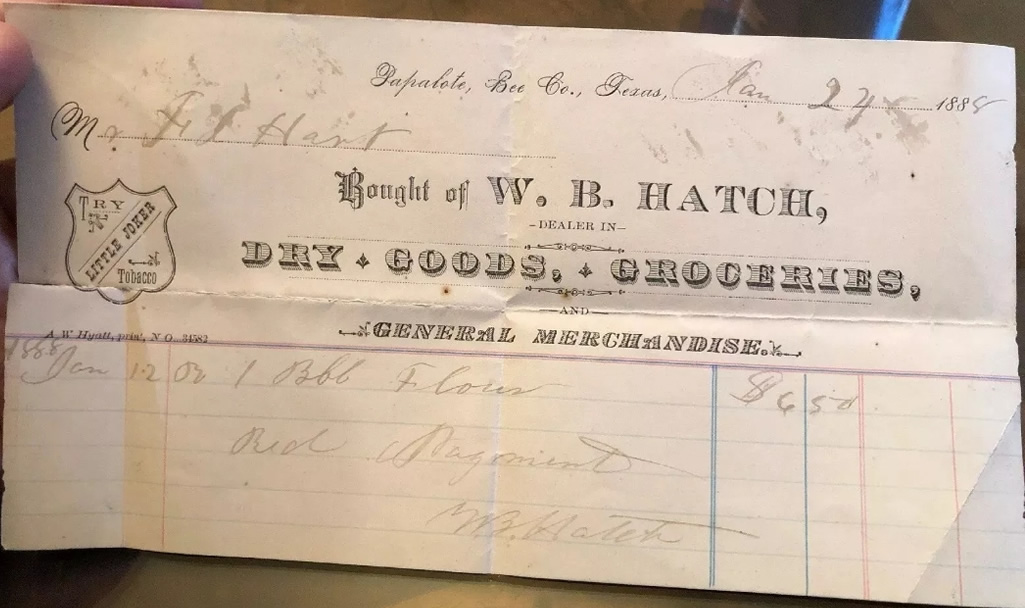
Lower Papalote, a.k.a. Steenville was named after local storekeeper
R. W. Steen. This settlement had the advantage of having the post
office.
Central Papalote, a.k.a. Cravensville developed around a lumberyard
run by Felix Hart and named to honor a local family with the surname
Craven.
Upper Papalote, a.k.a. Murdock Place had another store run
by a man named Luke Hart. This settlement was on the south side of
the creek.
By the mid-1880s the three Papalote communities united.
Merging benefited all and by 1872 Papalote had a doctor, grist mill,
butcher, sadler, and several saloons.
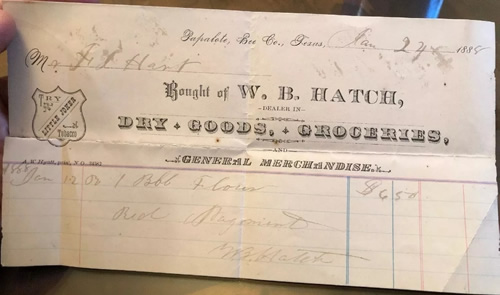
The railroad (the San Antonio and Aransas Pass) arrived in 1886 and
laid tracks on land donated by a local named Hatch. He also sold land
to the German-American Land Company who resold it to settlers from
Iowa and Hawaii (!) in five acre tracts. Intended to be orange groves,
hopes were dashed when a freeze devastated the crop.
1910 brought a small land boom and a few more businesses, but the
hurricane of 1919 was another discouragement. From a population of
52 in 1890, Papalote blossomed to 134 residents in 1904 which declined
in the thirties. It has since risen to 70 residents - a number it
has used since the late 1960s.
The detailed TxDoT County map for Bee
County shows a cemetery on the south side of Papalote Creek (Upper
Papalote). |
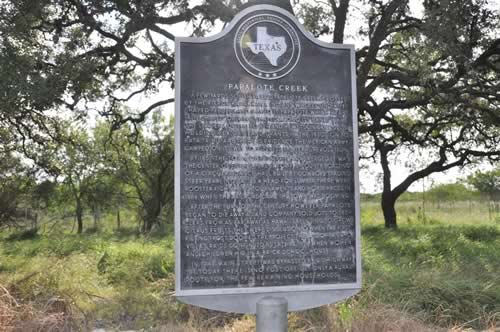 |
Papalote Creek
Historical Marker
US 181 roadside park, 20 miles SE of Beeville
Photo
courtesy Gerald
Massey, October 2010 |
Historical
Marker
Papalote Creek
A few yards south
passes Papalote Creek, crossed by the fierce Karankawa Indians who
found kite-shaped pebbles and named it Papalote, which means "kite-shaped"
or "wing-shaped". Along its banks came the leaders of the Power and
Hewetson colonists, holding Mexican land grants in the 1830's. On
its Rata tributary there is evidence the Mexican Army camped on its
way to suppress the Texas Revolution.
By 1857 the town of Papalote had emerged. It was the center of entertainment
for the county, boasting of a circular dance hall built by cowboys
trading steer yearlings at $3 a head for lumber. There were rooster
fights, ring tournaments and horse races. In 1886, when the railroad
came, the town was booming.
After the turn of the century, however, Papalote began to die away.
A land company sold lots to settlers from as far away as Hawaii. Expecting
to grow citurs fruits, they were disillusioned when the first killing
frost doomed the project. Threats of Pancho
Villa's raids continued as late as 1916, when women and children
hid in a brick schoolhouse.
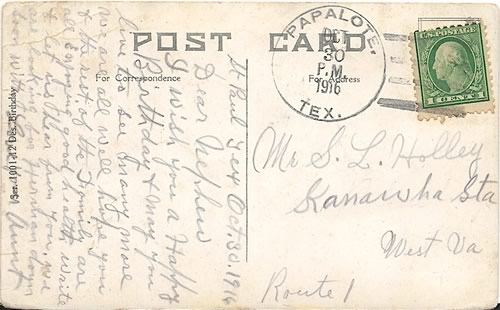
In 1948, Main Street was bypassed by U.S. Highway 181. Today there
is no post office--only a rural route for the few remaining households.
(1965) |
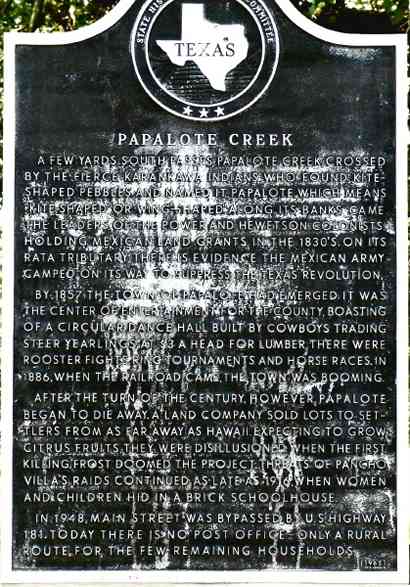 |
Papalote Creek
Historical Marker
Photo courtesy Ken
Rudine, August 2007 |
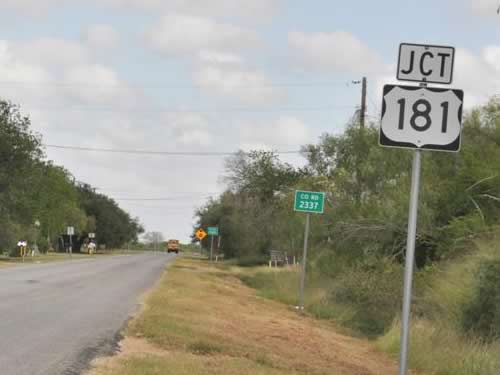
JCT 181 sign
on CR 2337
Photo courtesy Gerald
Massey, October 2010 |
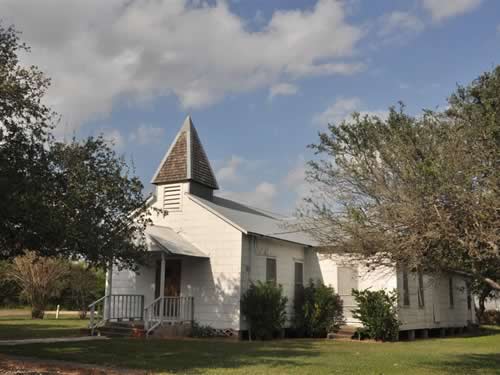
Papalote Baptist
Curch
Photo courtesy Gerald
Massey, October 2010 |
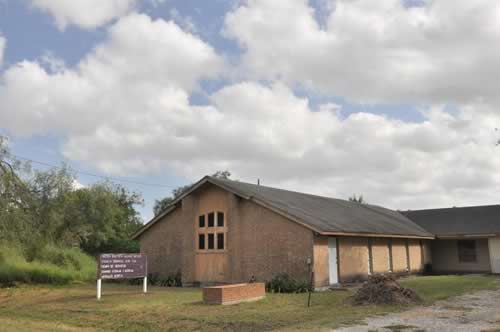
"Welcome
to the Ranch"
Photo courtesy Gerald
Massey, October 2010 |
 |
 |
 |
Papalote, Texas
Forum
"I just
love to read Texas Escapes and think about vanished Texas of my
childhood. Today I read about Papalote in Bee
County. My Bonham grandparents had a farm there. Wolves would
get the livestock. My grandfather said Papalote meant windmill.
My grandfather had several farms. The nicest was Sabinal,
the beautiful stone house where VP John Nance Garner's wife, Ettie
grew up. I lived there too when I was early teenage and the house
is magic. Has an historical marker now. We would go to Garner
State Park and I still remember how sweet and pure was the air.
How fresh and crisp. I could smell the trees.
My grandfather, James Forrest Bonham was very much into words although
he was not a writer. He like to play with words and rearrange the
letters. When he was at Papalote there was no post office so he
had to get his mail elsewhere. The closest post office was at Skidmore.
He and his brothers called it Skid City. He refused to have an address
in Skid City, so he drove more than twice as far to pick up his
mail once a week at Beeville.
I was a kid back then but never forgot he drove so far to avoid
Skid City!" - Barbara
Duvall Wesolek, July 30, 2020
|
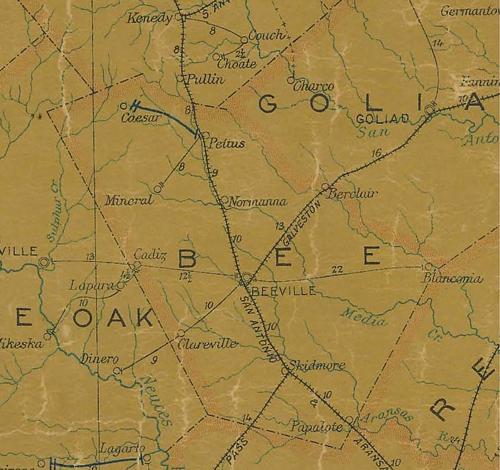 |
1907 Bee
County postal map showing Papalote
on San Antonio and Aransas Pass Railroad
near San Patricio
County line
Courtesy Texas General Land Office |
| Texas
Escapes, in its purpose to preserve historic, endangered and vanishing
Texas, asks that anyone wishing to share their local history, stories,
landmarks and recent or vintage photos, please contact
us. |
|
|
 HOME
HOME