|
| One
of the least-known heroes of the Texas frontier was a man known to
his followers as ‘The Whirlwind’ and to his enemies as ‘The Thunderbolt.’
His name was John Lapham Bullis, and he was a Lieutenant in the US
Army. |
|
|
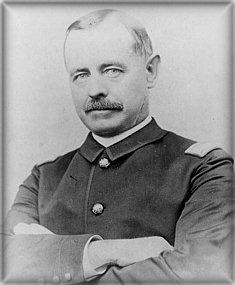
John
Lapham Bullis
Photo Courtesy National Park Service |
Bullis enlisted
as a private in a New York volunteer infantry regiment in 1861. He
was promoted to corporal, wounded and captured at Gettysburg, and
exchanged. He was appointed a captain in the 118th United States Colored
Infantry, a volunteer regiment made up entirely of Black enlisted
men and white officers. In 1866, like many other volunteer officers,
he was mustered out of the army. For a year he ran a wood business
on the Mississippi, supplying steamboats with fuel.
In 1867 the Regular Army was reorganized into the largest peacetime
establishment it had ever had-or would ever have again until the onset
of the Cold War following WW
II. The cavalry was expanded from 6 regiments to 10, the infantry
from 19 regiments to 45. Two cavalry regiments, the 9th and 10th,
and four infantry regiments, the 38th, 39th, 40th, and 41st, were
composed of Black enlisted men with white officers. The army was also
authorized up to 1,000 Indians as scouts, to be recruited as needed.
At that point the Regular Army was larger and better suited for the
purpose for which it existed than it ever had been in the history
of the United States—or ever would be again until the latter
half of the 20th century.
John L. Bullis, like many other volunteer officers who'd served with
'colored' troops during the war, was offered a Regular Army commission
to return as an officer in one of the new 'colored' regiments. 'Regular'
Regular Army officers-West Pointers-tended to shun the 'colored' regiments
as social, political, and promotional graveyards. George A. Custer
turned down a full colonelcy in 1867 in favor of a captaincy in the
7th Cavalry because, as a colonel, he would command a 'colored' Cavalry
regiment. Bullis accepted a commission as a Lieutenant in the 41st
Infantry.
In 1869 the army was reorganized yet again, into the structure it
would hold for the remainder of the Indian wars. The Cavalry was left
pretty much untouched, though the number of privates in a cavalry
company, which by law could be anywhere from 50 to 100, was fixed
at 64.
The Artillery was left at 5 regiments, but these, for the most part,
were assigned to coastal defense forts. The Infantry was reduced from
45 regiments to 25, with the 4 'colored' regiments consolidated into
2. The 38th and 39th became the 24th Infantry, while the 40th and
41st became the 25th Infantry. The 42nd, 43rd, 44th, and 45th Infantry
regiments, the 'Veterans' Reserve Corps,' made up of wounded and overage
veterans, were disbanded entirely.
The 1869 reorganization also eliminated some 900 officer slots, forcing
many officers to resign. Had this served to eliminate the deadwood-over
age in grade and incompetent-it might have considerably improved the
army's combat efficiency, but unfortunately that's not what happened.
Many of the men eliminated were, instead, highly qualified combat
officers with considerable Indian-war experience who were removed
because they lacked the social connections or political influence
that pervaded promotion in the 19th century Regular Army. About the
only non-socially connected, non-politically connected officers who
were allowed to remain were those willing to serve in the 9th and
10th Cavalry or the 24th and 25th Infantry—or those who volunteered
for frontier duty. John Bullis had served his entire commissioned
career with Black troops. He also had no objection to going west.
|
From
1869 until 1873 Bullis served with the 25th Infantry on the frontier.
Then, about 1872, something began to happen in southern and western
Texas. Indian raids from inside Mexico-not to mention bandit raids
from the same source-were devastating the border. The one thing the
army lacked was scouts-really competent trackers who could follow
the faint trails of the Comanche, Lipan, Kickapoo, and Kiowa.
Living south of the border in the Santa Rosa Mountains of Mexico was
a very peculiar group of people. They were—and are—called
Seminole Negroes. They are the descendants of escaped slaves
from Alabama, Georgia, and northern Florida who fled into the swamps
of Florida and southern Georgia, joined with—and intermarried
with—the Seminole tribe, and considered themselves part of the
Seminoles.
When the Seminoles, along with the Cherokees, Choctaws, Chickasaws,
Creeks, and Shawnees, were removed to the new Indian Territory along
what those peoples still call 'The Trail Of Tears,' the Seminole
Negroes went along. It didn't take them long to realize that what
is now Oklahoma would never be a home to them. While the Seminoles—and
to some extent the Cherokees—accepted them completely, almost
no other tribe did. A large band of them packed up and removed themselves
entirely from the United States, to settle in the Santa Rosa Mountains
of northern Mexico.
Though many of their descendants live there to this day, their new
home was an uneasy one. They were distrusted by the Mexicans and disliked
by the local Indians, who decided—on more than one occasion—to
see if these strange-looking newcomers knew how to fight. The Seminoles
remain the only tribe never to have signed a treaty of peace with
the United States, and the only tribe that had to be run down and
captured, one by one, rather than ever voluntarily entering a reservation.
The Seminoles—and the Seminole Negroes—were plenty tough
customers. The warlike Indians of northern Mexico quickly learned
to leave them strictly alone.
Part of the distrust in Mexico seems to have arisen over religion.
Mexico was—and to a large extent still is—Roman Catholic.
The Seminole Negroes were Baptists—but very peculiar Baptists.
Most of their church ritual seems to have been brought by their Black
ancestors and interpreted by their Indian forebears. Among other things,
at Communion neither wine nor grape juice is served. The Seminole
Negroes use, to this day, iced tea. It seems the Indian side of the
family couldn't regard wine, which any white man would sell you, or
grape juice, which you could squeeze out of the grapes growing wild
in the forest, as sacred. They were just too commonplace.
Tea, on the other hand, was expensive and hard to get, and ice was
almost impossible to come by. Something as rare as iced tea simply
had to be far more sacred than wine or grape juice and therefore more
suitable for the Lord's Supper. |
In
1872 the United States finally admitted that it took Indians to trail
Indians. Right south of the border were the Seminole Negroes, still
nominally US Indians—and they could track a lizard across rock.
Agents were sent to them, promising them land of their own, permanent
enlistment in the army, food for themselves and their families, and
a chance to strike back at the Indians who'd harassed them when they
first moved to Mexico. A good many trekked north of the border and
formed a company of scouts being raised at Fort
Clark, Texas.
Trouble was, however, the army now had a company of some of the best
scouts money could buy—and nobody to command them. While there
was some glamor-later on-associated with commanding Indian scout companies,
the Seminole Negroes didn't look like Indians. They looked like Black
folks. Regular Army officers fought shy of commands involving Black
troops, and the Seminole Negroes were no exception. A call went out
for an officer who wanted to serve on the frontier, who had experience
commanding Black troops, and who didn't mind continuing the experience.
1st Lieutenant John Lapham Bullis, fresh from the 25th Infantry, volunteered.
The man and the job met at Fort
Clark in 1873, and never was a soldier more perfectly suited to
a job than the man the Seminole Negroes nicknamed 'The Whirlwind.'
Militarily, the function of a scout or a group of scouts is to find
the enemy's forces, identify their location, then contact the combat
troops and lead them to the enemy. John L. Bullis didn't agree with
that definition. To his way of thinking, the function of the Seminole
Negro scouts was to find the enemy, identify his location, fall upon
him like the wrath of God, leave nothing but corpses and ashes behind,
and then tell the 'combat troops' what you'd done.
Of LT Bullis one of the Scouts, Joseph Phillips, said: "That feller
suffer just like we did out in the woods. He was a good man. He was
a Injun fighter. He was tough. He didn't care how big a bunch they
was, he went into 'em every time, but he look after his men. His men
was on equality, too. He didn't stand back and say 'go yonder,' he
say 'come on boys, let's go get 'em." |
April,
1875. LT Bullis and three Seminole Negro scouts—SGT John Ward,
Trumpeter Isaac Payne, and PVT Pompey Factor—struck a trail of
about 75 horses, some shod, being driven by riders on unshod horses.
That meant exactly one thing. Those were stolen horses headed for
Mexico with Indians driving them. Though Bullis and his men had already
ridden some 70 miles and were actually headed for home, they took
up the trail. They followed it for eight days.
Early on the afternoon of April 26, several miles above Eagle's Nest
Crossing on the Rio Grande, they cut into the trail where it was fresh.
At the crossing itself they came up on the thieves. Four men-Bullis
and the three scouts-attacked some 25 to 30 Lipans. The shock of the
attack was effective at first. Bullis and his men recaptured the horses.
Unfortunately, the shock wore off. They lost the horses to the Lipans,
then recaptured them in about 45 minutes of non-stop shooting. Finally
Bullis' horse was shot out from under him and, with the scouts and
the LT almost out of ammunition and on the verge of being captured
by the Lipans, they were forced to retreat. Much to Bullis' regret,
they had to abandon the recovered horses to save themselves.
Bullis was on the ground. SGT Ward picked him up 'on the fly' as they
retreated. On May 28, 1875, SGT Ward, Trumpeter Payne, and PVT Factor
were awarded Congressional Medals of Honor for their courage above
and beyond the call of duty at Eagle's Nest Crossing. Ward's carbine
had to be turned in for repair after the fight. A bullet had shattered
the stock just behind the breech.
June 20, 1876. LT Bullis and scouts were returning to Fort
Clark from a long ride into the Davis Mountains far to the north.
They struck a fresh trail-stolen horses, headed for Mexico. Bullis,
of course, turned to follow it. It led to the Rio Grande, then across
into Mexico. US troops weren't supposed to cross the border. How long
Bullis hesitated we don't know, but on topographical maps of the Big
Bend country you'll find what's known as Bullis's Crossing. For three
days the Seminole Negro scouts followed a band of Mescalero Apaches
into Mexico. They weren't able to bring them to a fight, but they
pressed them so hard they had to abandon the 36 horses they were driving—each
of which bore a Texas brand. Bullis and his men drove them back across
the Rio Grande. Then the LT, who'd been in the saddle for perhaps
a week with little rest, saddled a fresh horse, rode 140 miles in
36 hours to Fort Clark,
and reported what he'd done.
Less than a week later Bullis and 90 scouts were back in Mexico. They
planned to attack a Lipan village not far from Saragosa, Coahuila,
in retaliation for a Lipan raid in May that left 12 to 15 Texans dead.
The village was empty-the Lipans had been warned. Bullis burned the
lodges to the ground.
On July 29 Bullis, accompanied by 20 scouts and 20 troopers from the
24th Infantry, crossed the Rio Grand in the dark. Twenty-five hours
later, just at dawn, they attacked a Lipan village of 23 lodges on
the Rio San Antonio not far from Saragosa.
Disciplined volley fire by the troopers of the 24th, plus highly accurate
individual fire from the scouts, all but destroyed the Lipans. Caught
completely off guard, they tried to counterattack, then broke and
ran. Bullis counted 14 dead Lipan warriors on the field. Signs indicated
that many more had been dragged away by survivors. The scouts and
infantrymen captured 100 horses and mules, all wearing Texas brands,
and 4 women.
Bullis burned the village to ashes and returned to the American side.
There was trouble coming. Some of the Lipans who escaped contacted
the Mexican authorities. A force of about 250 Mexican cavalry mounted
up and gave pursuit, intending to annihilate Bullis and his small
force on Mexican soil. Thirty miles from the Rio Grande, the Mexican
cavalry caught up with Bullis and his 40 men. LT Bullis, 20 scouts,
and 20 infantrymen turned to fight the 250 cavalrymen in what would
surely be their last fight.
As it turned out, there wasn't a fight at all. In the finest tradition
of Hollywood, bugles sounded to the east…everybody looked…and LTC
William R. "Pecos Bill" Shafter and four companies of US cavalry-300
men-came riding over the ridge. There followed a long, tense, quiet
standoff…and then the Mexican troops went home.
There were a lot of official protests over Bullis' incursion-including
allegations that he had raided a peaceful village of farmers. This
despite the fact that every horse and mule recovered wore a Texas
brand, and property positively identified as having been taken from
ranches and settlements in murderous raids was found in the lodges
and brought back as proof.
It didn't discourage Bullis. It also didn't discourage Major General
Edward O. C. Ord from issuing an order which said that in the event
the raids continued, American troops would be allowed and even encouraged
"...when in pursuit of a band of marauders and when…troops are either
in sight of them or upon fresh trail, to follow them across the Rio
Grande, and to overtake and punish them, as well as retake stolen
property…." General Ord meant exactly what he said, and he had the
quiet if not vocal support of the two most powerful men in the army,
Generals William T. Sherman and Philip Sheridan. |
To
a Seminole Negro tracker, there was no such thing as a 'cold trail.'
It eventually dawned on the hostile Indians of the lower border that
they were in trouble. Between the man they called The Thunderbolt
and an Eagle Chief (Colonel) they called Broken Hand or Three Fingers,
Texas was no longer the easy pickings it had been when the bluecoats
were more interested in chasing white men who'd been wearing gray
coats than they were in chasing Indians. To the north the Comanches
had another name for this Eagle Chief. They called him Pony Killer.
His name was Ranald Slidell Mackenzie.
The pace of the raids began to slow down, but a great many of the
raiders swore one thing. They would see The Thunderbolt's bones bleaching
in Mexico and his scalp hanging in a lodge if he chased them across
the Rio Grande again. Which, of course, is exactly what he did. All
during 1877 and 1878, Bullis and his Seminole Negro scouts continued
raiding in Mexico, attacking villages known to harbor or suspected
of harboring raiders who'd raided Texas. The scouts were never wrong.
Each raid returned to Texas horses and mules bearing Texas brands
and property identifiable as stolen in Texas.
In October, 1877, Bullis' command struck an Apache trail, followed
it more than 50 miles into Mexico, killed five braves, and returned
with 60 Texas-branded horses and mules. In November a band of raiders
got away. There were too many, and Bullis couldn't fight them with
the troops he had. A week later he was back with a company of 8th
Cavalry and the Seminoles. They attacked the same band in the same
place. This time the soldiers rode away with 17 horses, 5 mules, and
a burro, all with Texas brands, over a dozen saddles, all made in
the US, 10 water kegs, 54 deer and buffalo hides, and nearly a quarter-ton
of fresh and dried venison and horse meat. The kegs, hides, and meat
Bullis soaked with lamp oil and burned. It would be a long, cold winter
for one band of raiders.
By the early summer of 1878 the raiders were getting the word-and
Mexican authorities were getting madder by the minute. Orders went
out for Mexican forces to stop, fight, and if possible annihilate
any US troops crossing the border in pursuit of hostiles. In June
CPT S. M. B.Young and a half-company of cavalry, accompanied by Broken
Hand Pony Killer himself, set out from a camp on the Devil's River
in pursuit of a band of marauders who would unquestionably try to
escape into Mexico. Less than half a day behind the small force came
Pecos Bill Shafter, leadinga half-regiment (5 companies) of cavalry,
a full regiment of infantry, and a battery of light artillery.
Young, Mackenzie & Co. were bait. Shafter was the trap.
At the village of Remolino on the Rio Rodriguez, Mackenzie's small
force was met by some 200 Mexican troops under a General Valdez. Valdez
told Mackenzie he was going to stop him. Mackenzie told him he was
welcome to try. At 1:30 PM on June 19 Mackenzie's men began to move
forward in skirmish formation toward Remolino. Valdez' men, who outnumbered
them 4 to 1, prepared to receive them-when over the hill behind Mackenzie
came Pecos Bill Shafter, with nearly 1500 men and six cannon. There
were no shots fired. The Mexican army never again tried to interfere
with US troops who were in pursuit of raiders. |
January,
1879. A band of Lipan and Mescalero Apaches crossed the border into
Texas. It wasn't raiding season, but Bullis and his scouts were out
The crossing was found and 39 scouts, 15 cavalrymen, 3 Lipan scouts,
and an ex-Comanchero set out in one of the strangest pursuits in the
history of the Indian wars. The Indians committed no depredations
that Bullis found, but they were followed until his command had them
in sight. For 34 bitterly cold days, Bullis and his men dogged the
Apaches' steps-never moving closer, never falling back, never losing
contact. The pursuit ended with the Apaches rode onto the Fort Stanton
Reservation in New Mexico Territory. After conferring with authorities
at Fort Stanton, Bullis turned his men back for Fort
Clark. They had been in the saddle 80 days and covered 1,266 miles.
By 1880 most of the hostiles south of the border realized that Texas—thanks
largely to LT John Lapham Bullis and the Seminole Negro scouts—was
too hot to hold them. Only a few raiders crossed the Rio Grande, most
were driven back easily, and little was lost in the way of lives or
property. On April 14, 1881 a band of Lipans, possibly under the influence
of bad whiskey, crossed the river, rode all the way to the headwaters
of the Frio, raided an isolated ranch, and killed a woman and a young
boy. They looted the place and, before leaving, killed a horse, skinned
it, and wrapped the hide around their horses' hooves to disguise their
tracks. On April 26 the scouts were informed of the raid. The orders
read "pursue and destroy."
On May 1, deep in the Sierra del Burro Mountains in Mexico, the scouts
ran the Lipans to earth. At dawn the next morning The Thunderbolt
struck. In less than 20 minutes over half the raiders were dead. The
scouts recovered 21 horses and mules and an American woman and small
boy no one knew were missing.
In
1881 US troops mounted 12 expeditions to search for signs of hostile
Indians on Texas soil. They left from 12 different forts or camps
and covered, by their own records, an aggregate of 3,662 miles horseback.
None found any trace of Indians.
The people of West Texas presented LT John Lapham Bullis with a fine,
engraved sword. It read: He has protected our homes-our homes are
open to him. On April 7, 1882, the Texas Legislature, in a Joint Resolution,
commended LT Bullis for his services "..in behalf of the people
of the frontier of this State, in repelling the depredations of Indians
and other enemies of the frontier of Texas."
John Bullis didn't do it all alone. He had a lot of help. The help,
mostly, was the Seminole Negro scouts. What became of them?
The Seminoles had been recruited by a promise of permanent enlistment
in the US Army, homes and food for their families, and land of their
own. Those promises were made by the US Congress, not by the army.
No sooner than the Indian threat ended than Congress ordered the discharge
of the Seminole Negro scouts. There would be no permanent enlistment,
no homes, and most important, no land they could call their own. Every
promise was broken.
Predictably, the politicians didn't bother to tell the scouts themselves.
Instead, they told the army to do it. MG Christopher C. Augur, who
probably had more admiration for the scouts than any man in the army
save Bullis himself, had to tell them that these promises, like so
many others, wouldn't be kept. Some few remained at Fort
Clark, hanging on to the 'good old days' and keeping themselves
alive as best they could. Some of their descendants still live around
Brackettville.
Most simply saddled up and headed back to the Santa Rosas, chalking
up one more bunch of broken promises to go with all the rest.
© C. F.
Eckhardt
"Charley Eckhardt's Texas"
July 26,
2006 column
See
Brackettville
Fort Clark
|
|
|
 HOME
HOME