|
Words,
and even pictures, cannot begin to tell what my visit to the site
of the 1936
Texas Centennial Pictograph Marker was like. If only I had taken
Gerald Massey's advice
and purchased a digital voice recorder. That would have been a big
help to me in telling the story of my meeting Kay and Fred Campbell.
The Pictograph
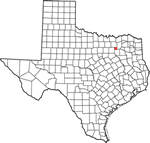
Marker is located near the Concho River on private property just
north of Paint
Rock, county seat of Concho County, Texas. I almost gave up seeing
the marker after finding the gate locked at the entrance to the Campbell
Ranch. Ruthie's notes gave no more information than where the ranch
was located. I went back to Paint
Rock and stopped at the Courthouse.
I asked if anyone knew how I might contact someone to see the Marker
and was given a copy of the Treasures of Concho County Brochure which
had the phone number to Paint Rock Excursions, Indian
Pictographs. |
 |
I
dialed
the number. A delightful voice answered. I asked if I could see the
Pictograph
Marker located on their property. She said I could but she would
have to meet me at the gate. It would be a few minutes because she
had just fixed a cup of hot chocolate. Thus began a visit I will long
remember.
At that point, I didn't know her first name and wouldn't have addressed
her with it anyway, so I'll just call her Jewel in this little narrative
because that is what she was with a special sparkle in her eyes. You
can only imagine how her voice was like a rainbow. |
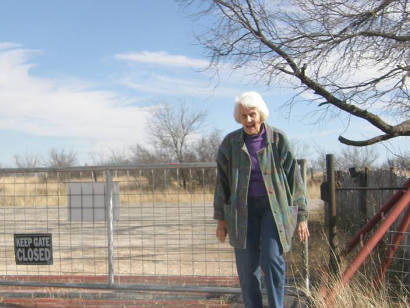
"She laughed
and joked the whole time I was there."
Photo Courtesy Barclay
Gibson, January 2010 |
| I mentioned the
name of Ruthie Cade to
her and that brought on a cheerful laugh. She began telling me stories
about Ruthie's visits. Jewel said Ruthie is a Retired Army Colonel.
She had some friends with her whom Jewel call 'Her Walkers' because
they walked all over the ranch and, I believe, camped there, too.
She mentioned Ruthie and ‘Her Walkers’ many times during my visit.
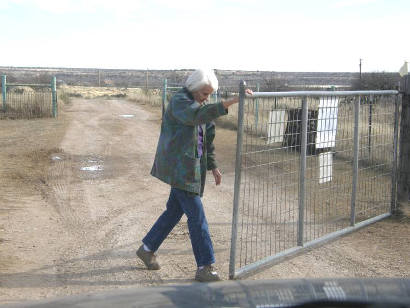
Jewel said she would have to ride with me in my pickup because her
husband had their pickup and he got upset with her because she got
so many flat tires on her little Ford Focus. She had to get out and
open all the gates because they had combinations locks. She asked
me how many Centennial
Markers I had seen and I told her I have not counted them. She
chided me for not keeping better records. |
"She had
to get out and open all the gates..."
Photo Courtesy Barclay
Gibson, January 2010 |
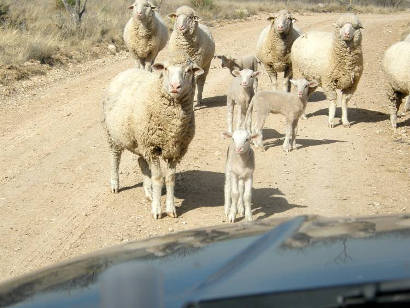
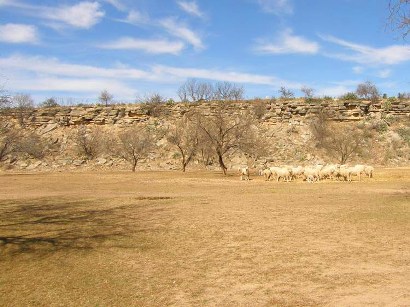
Lambs with their
mothers in Campbell Ranch
Photo Courtesy Barclay
Gibson, January 2010 |
Jewel began to
tell me a series of stories about their sheep, goat, llama and donkey
ranch, about her husband, Fred's world wide reputation as a sheep
fiber expert, and that he had just received a special Sheep Council
award in Nashville. She told me of her teaching days in Clayton, NM,
before they married, of how her grandfather preserved the Indian
Pictographs. Her father died in 1932 right in the bottom of the
Depression leaving her mother with anywhere from eight to twelve children,
but who's counting when there are that many, and of the mortgage on
this ranch of $110,000, roughly $1,400,000 in today's dollars.
She told me that her mother worked extra jobs to raise her children
and pay off the mortgage, how the government even back then was making
life so hard for ranchers with new rules and regulations, that her
uncle survived WWI only
to die of Pneumonia on the troop ship coming back home so that Jewel's
grandmother had to go to the train station to pick up the casket rather
than meet her son returning from the Great
War. |
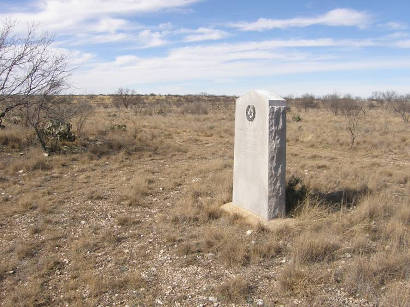 |
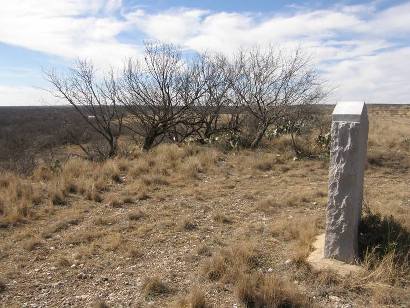
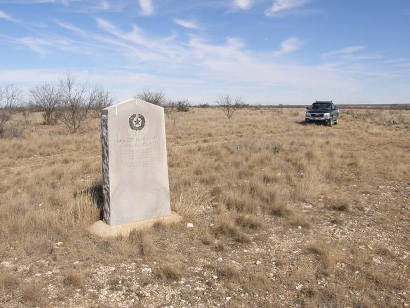
The Pictograph
Centennial Marker
Photo Courtesy Barclay
Gibson, January 2010 |
Jewel was a girl
of nine years old in 1936 when Texas celebrated the centennial of
its independence from Mexico partly by placing granite
markers all over the state. She is certainly one of the very few
if not the only living person to have seen a Centennial
Marker when it was placed and still lives on that very same property.
One of the men who helped place it, James Ashford, was 18 years old
at the time and has stayed in touch with the family all these years
until just recently when he was diagnosed with Alzheimer's disease.
She laughed and joked the whole time I was there. She was constantly
telling me to slow down, don't hit that stump or it will give you
a flat tire and turn here down that rutted trail. We pulled up to
some goat and sheep pin. She showed me Blue Bell, her prized Angora
Goat. I asked her if the marker was located here. She adamantly said,
“No, it wasn't there because, you didn't turn when I told you to."
We went back and I was supposed to have turned where there wasn't
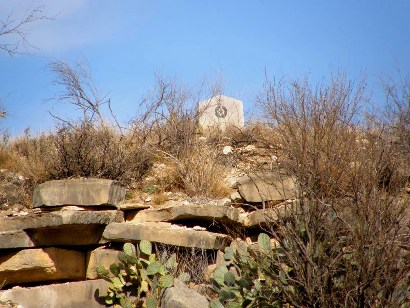
even a trail. No wonder I missed it. As we pulled up to the marker
she kept telling me to slow down and don't run off that seventy foot
cliff. |
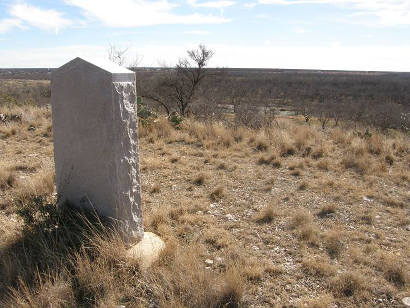 |
The marker near
the edge of the seventy foot cliff
Photo Courtesy Barclay
Gibson, January 2010 |
| The Marker is,
indeed, located very near the edge of a cliff. I took pictures of
it, and I then carefully followed her directions back around to the
base of the cliff. There is a perfectly level plain of probably ten
acres right on the banks of the Concho River where maybe a hundred
sheep had just given birth or were in the process. It was from the
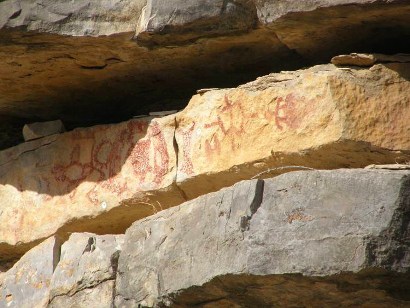
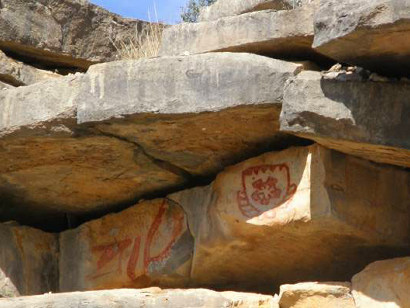
base that we could see the Indian
Pictographs. There are close to 1,500 paintings that are now protected
from vandals and rock hunters. |
Sheep on the
banks of the Concho River
Photo Courtesy Barclay
Gibson, January 2010 |
|
On our way
back to the house, with Jewel closing the gates behind us, Fred
drove up with a load of feed in the back of his pickup. He didn’t
have much to say when she introduced me. His knowing smile let me
know that he knew I knew the history of not only the marker but
of the ranch, the animals, the pictographs, the Campbell family
and a whole lot more.
My visit to the ranch must have been at least a full hour, and when
I left I knew I had met two very special people who are outstanding
examples of what opportunities, through hardship, hard work and
perseverance, are available in our great country.
In perspective, my desire to see granite Centennial marker hardly
enters into the equation at all. I didn't know how to start this
little narrative and now certainly don't know how to end it except
to say I am privileged and humbled to have been in the presence
of two living granite markers whose significance far outweighs any
mere slab of stone. I will remember the Campbells much longer than
I will remember the reason for my visit in the first place.
I hope this makes some sense to you as it is so difficult to re-tell
something that impressed me so much.
© Barclay
Gibson
June
1, 2012
|
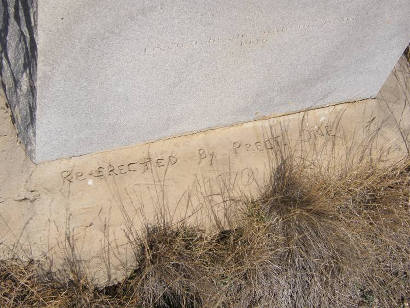
The Pictograph
Centennial Marker
|
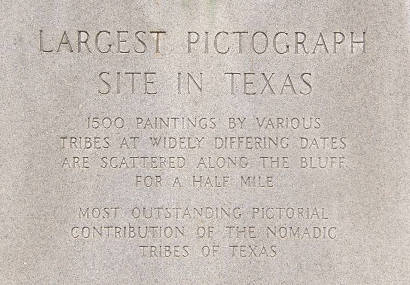
Marker Text:
LARGEST PICTOGRAPH
SITE IN TEXAS
1500 Paintings by Various
Tribes at Widely Differing Dates
are Scattered Along the Bluff
for a Half Mile
Most Outstanding Pictorial
Contribution of the Nomadic
Tribes of Texas |
| Texas
Escapes, in its purpose to preserve historic, endangered and vanishing
Texas, asks that anyone wishing to share their local history, stories,
landmarks and recent or vintage photos, please contact
us. |
|
|
 HOME
HOME