|
|
On the Southwest
Corner of
Comanche's Square
Comanche, Texas
by Margaret Waring |
| Choosing just
one among Comanche's favorite historical
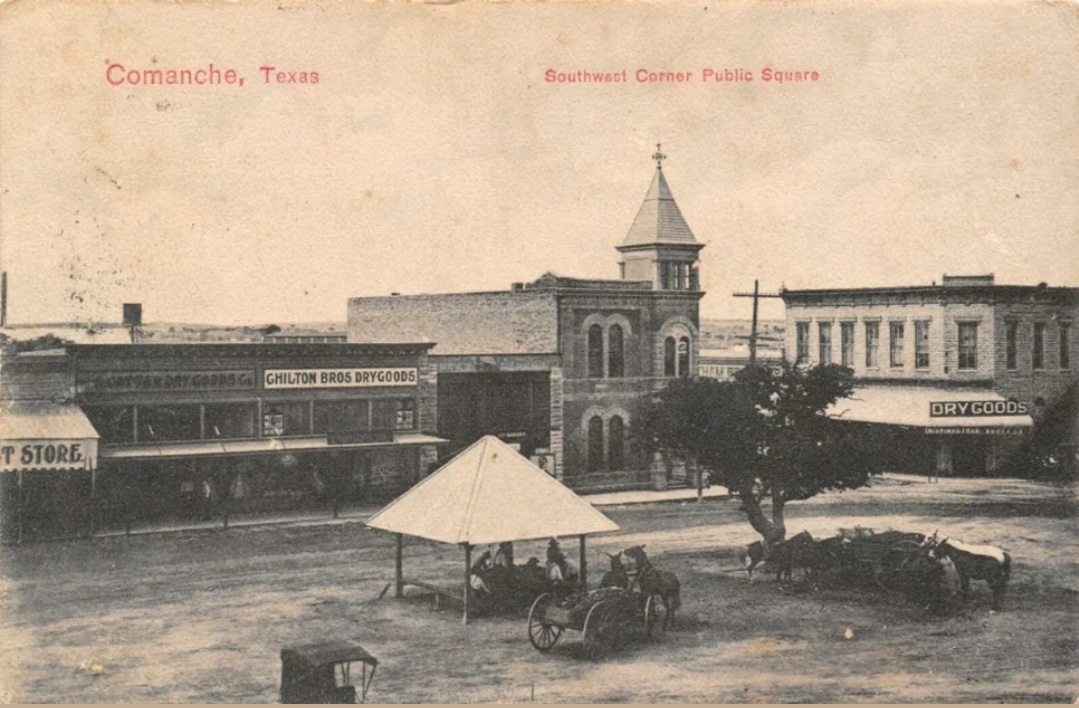
items is not easy. There are several possibilities grouped on the
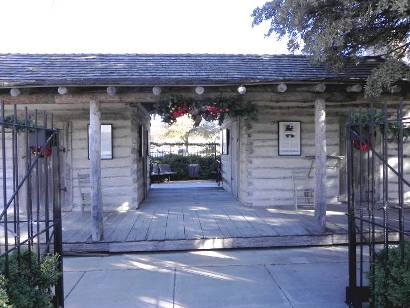
southwest corner of Comanche's square. The double pen log cabin set
beneath the Fleming Oak is
identified as the only
surviving log courthouse in Texas. One of its rooms served Comanche
County during the years the county seat was located at Cora,
some 12 miles southeast of Comanche. Later it was relocated slightly,
a second room added, and it became a residence for many years. A hearty
stand of Texas Historical Commission markers is gathered under the
Fleming Oak where they point
up local events and personalities. |
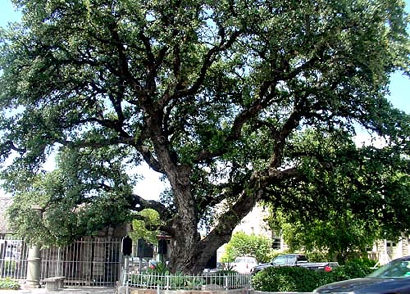
The Fleming
Oak on the SW corner of Comanche's square
TE Photo,
August 2002 |
| One of them
recounts an 1861 night raid
in bright moonlight when Indians made off with most of the horses
in town. They were pursued by a sizeable group of local men who reputedly
killed 19 Indians after a lengthy chase. Dr. Ashbel Smith (1805-1886)
was a distinguished personality, important in Texas history, and his
marker cites only a few of his many achievements. His only connection
with Comanche County
is a 1280 acre land grant patented in 1854. A Comanche resident finally
purchased the property in 1889 and Dr. Smith never saw it. Dr.
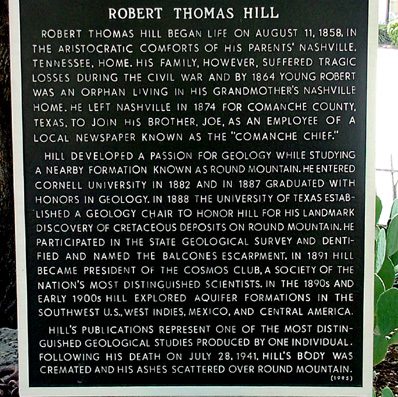
Robert T. Hill's marker honors the "Dean of Texas Geology" mentioning
some of his professional accomplishments and noting his Comanche
County connections. The most modern marker identifies the Bicentennial
Park dedicated July 4th, 1976. This small park contains four limestone
columns saved from the entrances of Comanche's fourth courthouse,
used between 1891 and 1939. |
 |
Continuing to flourish, the Fleming
Oak shades a pleasant spot that once included one of the two town
wells and a limestone watering trough carved to resemble a fish. In
the course of modern paving work, the old well was uncovered. It was
restored with native stone and its original circular well rock located,
recovered, and donated to the project. One can look inside and admire
the well's beautiful rock lining.
Tradition and history surround the Fleming
Oak. William W. Fleming and his sixteen year old son, Martin V.
reputedly camped near the tree as they passed through the area about
1854 freighting on the Ft.
Gates/ Ft.
Phantom Hill Road established to serve the short-lived military
post located above modern Abilene.
It was a prospecting trip, of sorts, before the town of Comanche
was established. The Fleming family was living in Williamson
County in 1850 at Georgetown
but they relocated about 1854 to a home near the site of modern Killeen.
Martin V. Fleming apparently visited in Comanche
again in the late 1850s as he returned to his Bell
County home from a deer hunt. He learned of the Civil War while
in Comanche and joined Co. G., First
Texas Cavalry under Col. Thomas C. Frost in May of 1861 with a group
of area men who mustered in at that time.
Mart Fleming, wounded twice, was discharged on disability in June
of 1863 but he apparently did not return directly to Comanche.
He lived briefly in Mexico after the Civil War but settled in Brenham
about 1866. Some relatives lived in Washington
County and there he was married to his second wife, whom he brought
to Comanche in 1872. Uncle Mart, as
he was affectionately known, was a stockman and a farmer with business
interests in Comanche through the years. He owned and operated a furniture
store and undertaking establishment for a time. He is best remembered
for his meat market located on the south side of Comanche's square
opposite the Fleming Oak and
next to the original Comanche National Bank building. The façade at
the market site is being restored as part of Comanche's
Main Street program. |
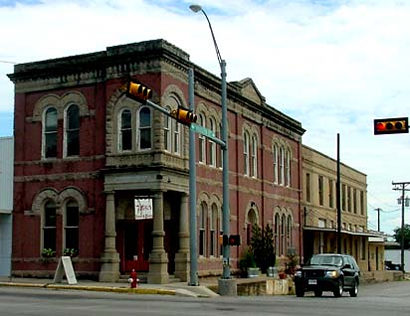 |
Original Comanche
National Bank Building
TE Photo, 2002
More Texas Banks |
|
A beloved Comanche
tradition arises from the city's effort to remove all the old trees
from the square about 1911. The often-told tale recounts the story
of Mart Fleming defending the tree with his shotgun and threatening
anyone who would take an axe to it. A similar story survives about
an event in 1919 when Uncle Mart, again, protected the tree from
a crew paving the square.
In an interview in 1921, Fleming says he did not mention his shotgun
but told those who threatened the tree that he would use his "No.
10's" on them, a reference to his boot size rather than a gun. Fleming
reported that some rough words were needed but workmen laid down
their tools. The shotgun defense legend has been told and retold,
spelled out on an historical marker beneath the tree, and is an
entrenched piece of local folklore. Another long established Comanche
tradition is decorating the Fleming
Oak with lights at Christmas time.
Uncle Mart died in 1928 and is buried in Comanche
along with his only child, Camille, who remained single and lived
at home. Uncle Mart, thrice married, is reputed to have helped rear
several orphans and his family included step children as well. A
colorful figure, tall, lean, and pictured late in life with a white
beard, Uncle Mart continues to remind one of Comanche's
past. The tree he saved is treasured.
|
|
|
|
|
 HOME
HOME

 Texas
Gulf Coast
Texas
Gulf Coast East
Texas
East
Texas Central
Texas North
Central
Texas North Central
Texas South
Central
Texas South Texas
Panhandle
Texas
Panhandle South
Texas
South
Texas Texas
Hill Country
Texas
Hill Country West
Texas
West
Texas Texas
Ghost Towns
Texas
Ghost Towns Texas
Counties
Texas
Counties