|
 |
History
in a Pecan Shell
Comanche County
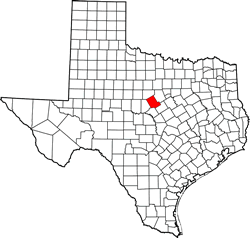
was organized in 1856 and the following year 80 acres overlooking
the river were donated to be the seat of government. Initially the
name of Troy was submitted for a post office, but Bell
County had beat them to the name.
Miss Cora Beeman of Bell
County became the namesake of the village, being nominated for
the honor by Thomas C. Frost, Comanche
County land agent. Her name was accepted and in 1857 Cora, Texas
was officially included on maps.
Shortly thereafter Hamilton
County acquired some land from Comanche
County, redistributing Comanche
County’s acreage and putting Cora far from the geographic center
of the county.
Comanche was created,
and officially became the county seat in 1859.
Meanwhile, back at Cora, the double whammy of Indian misbehavior and
loss of county seat status left the village with only 136 people for
the 1860 census.
Cora’s post office closed its doors in 1867 and by 1900 nothing was
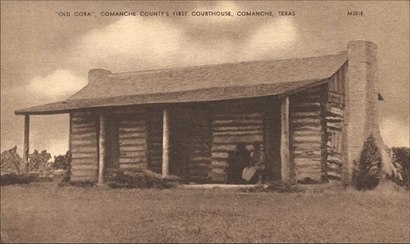
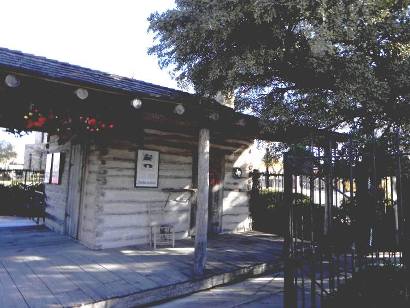
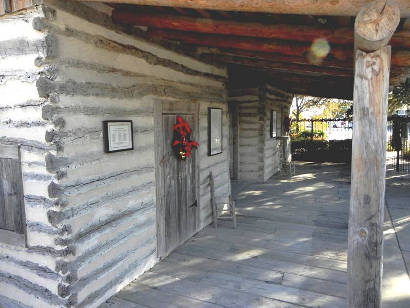
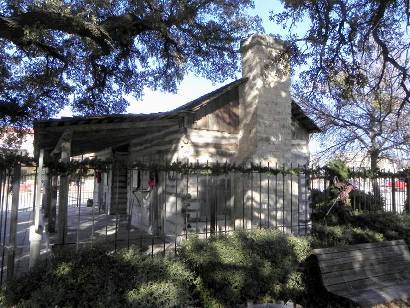
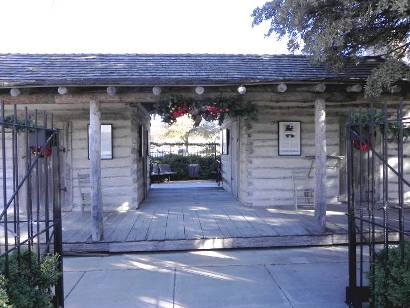
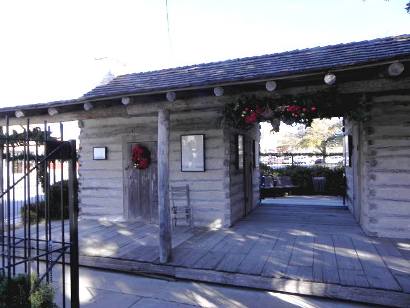
left but a cemetery. A replica of Cora’s log courthouse is now a part
of the Comanche square. |
 |
Historical Marker:
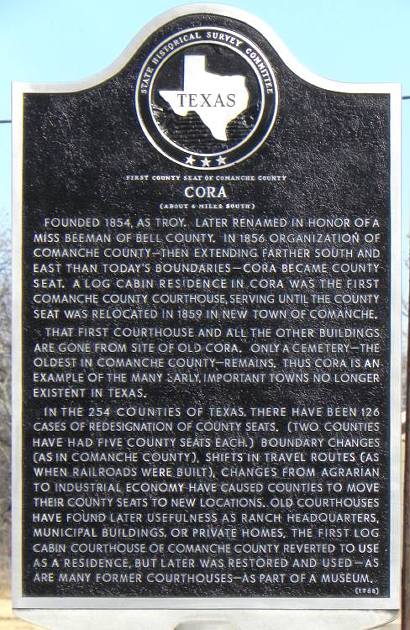
Cora
Founded 1854, as
Troy. Later renamed in honor of a Miss Beeman of Bell
County. In 1856 organization of Comanche
County--then extending farther south and east than today's boundaries--Cora
became county seat. A log cabin residence in Cora was the first Comanche
County courthouse, serving until the county seat was relocated
in 1859 in new town of Comanche.
That first courthouse and all the other buildings are gone from site
of Old Cora. Only a cemetery--the oldest in Comanche
County--remains. Thus Cora is an example of the many early, important
towns no longer existent
in Texas.
In the 254 counties of Texas,
there have been 126 cases of redesignation of county seats. (Two counties
have had five county seats each.) Boundary changes (as in Comanche
County), shifts in travel routes (as when railroads were built),
changes from agrarian to industrial economy have caused counties to
move their county seats to new locations. Old courthouses have found
later usefulness as ranch headquarters, municipal buildings, or private
homes. The first log cabin courthouse of Comanche
County reverted to use as a residence, but later was restored
and used--as are many former courthouses--as part of a museum.
(1967) |
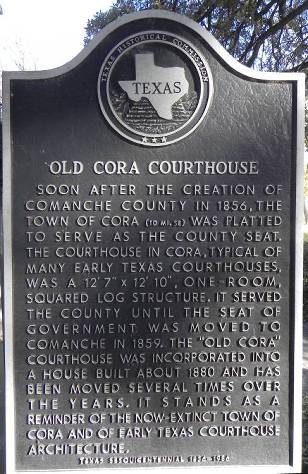
Historical Marker:
Soon after the
creation of Comanche
County in 1856, the town of Cora (10 mi. SE) was platted to serve
as the county seat. The courthouse in Cora, typical of many early
Texas courthouses,
was a 12' 7" x 12" 10", one-room, squared log structure. It served
the county until the seat of government was moved to Comanche
in 1859. The "Old Cora" Courthouse was incorporated into a house built
about 1880 and has been moved several times over the years. It stands
as a reminder of the now-extinct town of Cora and of early Texas
courthouse architecture.
Texas Sesquicentennial 1836 - 1986 |
 |
Cora, Texas
Forum
Subject: Cora, Comanche County, Texas
My great great grandfather was Francis Marion Collier (FM Collier)
and his son Thomas Anderson was the first white child to be born in
Comanche County after Frank built a log cabin for his wife Julia Grayson
to give birth in. Or at least that is what my father told me. I would
love to have more information about the town of Cora, like the exact
location and what happened for the town to die. Thanks, Elizabeth
Collier, March 25, 2013 |
| Texas
Escapes, in its purpose to preserve historic, endangered and vanishing
Texas, asks that anyone wishing to share their local history, stories,
landmarks and recent or vintage photos, please contact
us. |
|
|
 HOME
HOME