|
|
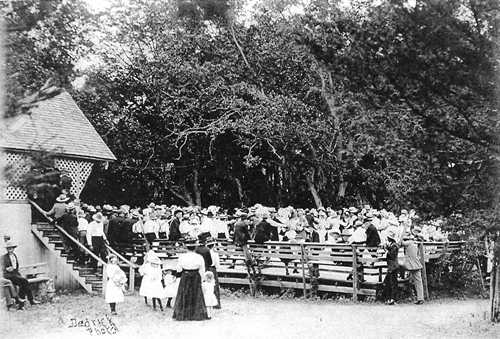
Peter
Dance Platform, Circa 1900
Fayette Co Hist Commission; submitted by Carolyn
Heinsohn, FCHC member |
History in
a Pecan Shell
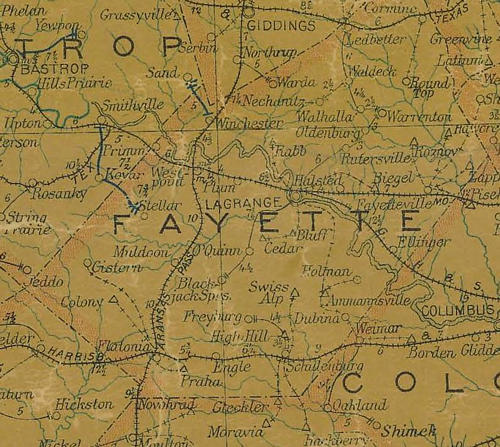
Dubina dates from
1856 when a group of recently arrived Czech immigrants found shelter
under a group of large oak trees (Dubina is Czech for Oak Grove).
Its first name, however, was Navidad and then Bohemian Navidad
(after the nearby Navidad River).
The settlers planted cotton and harvested only one bale from their
first crop. Just when they were adjusting to life in Fayette
County along came the Civil War and many of the men were
drafted. After the war, Dubina became a toehold for recently arrived
Czech immigrants, much like the nearby town of Hackberry
was for German settlers.
The railroad
ran straight from Weimar
to Schulenburg
in 1873 and Dubina was ignored. Population was drawn off, yet by
1900, the church still served 600 families who lived within the
sound of the Saints Cyril and Methodius' Church bell.
Dubina's first church was built in 1876, but was destroyed by a
1909 hurricane. Rebuilt in 1912, it survived a fire that
all but destroyed the town.
Dubina Attractions
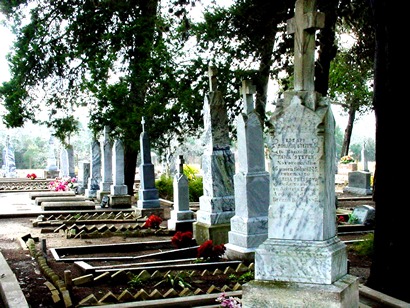
Today, Dubina and the Saints
Cyril and Methodius Church is included on the well-known "Painted
Churches" tour. |
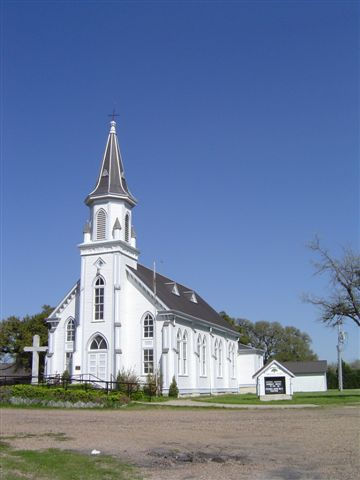 |
| Photo
courtesy Garry Taylor. March, 2005 |
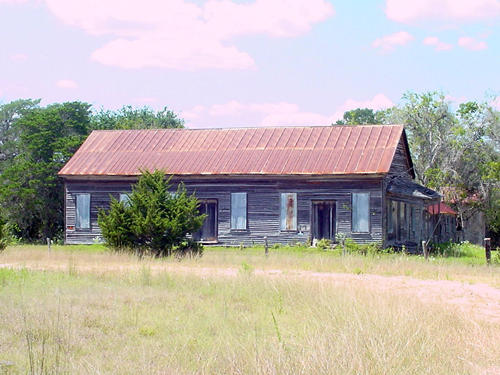
The Old Peter's
Family Store in Dubina
"Endangered
Historic Properties of Texas"
Photo by John
Troesser, August 2006
|
|
|
Dubina
Store in 2001
TE photo March 2001 |
Photo
by Gordon Hesketh
|
Following the road ( County Road 480 ) past the church
in Dubina, you will pass the Old Dubina Store and continuing west
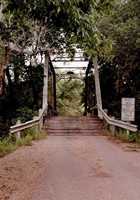
you will cross the "Piano Bridge"
It's one of the few remaining iron bridges in Fayette County. more
Although 480 is a dirt road, it will connect with FM 615, which is
paved and will take you to Highway 77. |
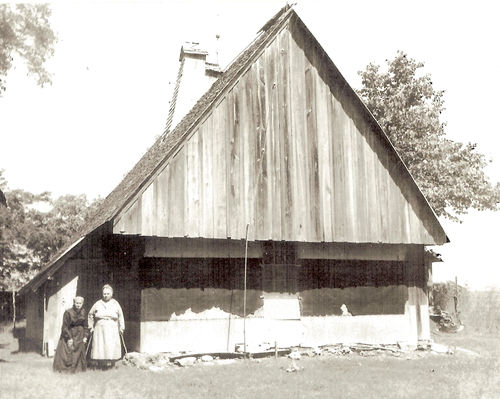
Simon
Pytlovany House, S of Dubina
Courtesy John Janacek; submitted by Carolyn
Heinsohn |
|
Texas
Escapes,
in its purpose to preserve historic, endangered and vanishing Texas,
asks that anyone wishing to share their local history, stories and
contemporary or vintage/historic photos, please contact
us.
|
|
|
 HOME
HOME

 Texas
Gulf Coast
Texas
Gulf Coast East
Texas
East
Texas Central
Texas North
Central
Texas North Central
Texas South
Central
Texas South Texas
Panhandle
Texas
Panhandle South
Texas
South
Texas Texas
Hill Country
Texas
Hill Country West
Texas
West
Texas Texas
Ghost Towns
Texas
Ghost Towns Texas
Counties
Texas
Counties