|
Weimar Band Stand
Click on image to enlarge
Photo courtesy NesbittLibrary |
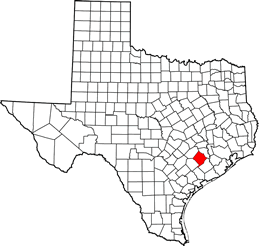
Although
situated in Colorado
County, this is a technicality that Weimaraners shrug off. They
feel a closer kinship with Schulenburg
than Columbus, and
they know they're always welcome in Fayette
County as long as they behave themselves.
A "Railroad" town, Weimar was originally named Jackson Station.
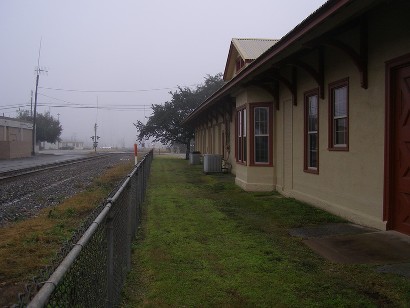
Their railroad heritage is evident with the library occupying the
old Depot and the library offices installed in an old Caboose. Sausage
making and meat consumption occupy many residents, although they still
have enough activities to fill a weekly newspaper, The Weimar Mercury.
|
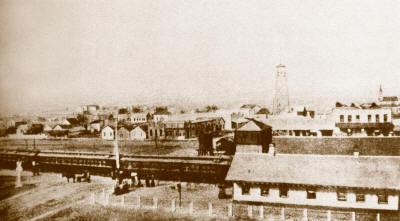
1912 Bird's-eye
view of Weimar showing depot,
train and
water tower
Photo courtesy texasoldphotos.com |
Historical Marker
(in front of Post Office on U.S. 90):
Town of Weimar
This land—once
part of first Anglo-American colony in Texas—grew into a townsite
in 1873 with coming of the Galveston, Harrisburg, & San Antonio rail
line. D.W. Jackson donated half of land for town, which was named
for Weimar, Germany. Post Office was established in 1873. Town incoporated
1875. By 1887 Weimar was enjoying a prosperous cotton
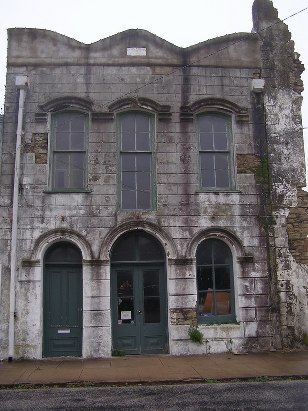
economy, had many stores and 2 newspapers. Local opera house (150
yds.S), built about 1880, was one of the first between Houston
and San Antonio.
Present Economy is based on agriculture. Population is 2,050. |
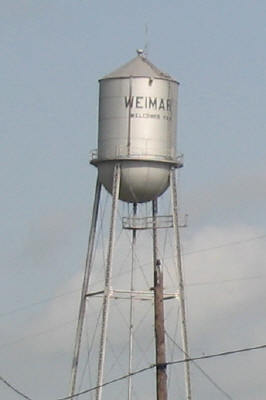
The water tower
in Weimar
Photo
courtesy Teri Brown
More Water Towers |
Weimar, Texas
Landmarks & Attractions
Breakfast, or at
least coffee is an important ritual in Weimar and the menfolk occupy
Bennie's Café while the womenfolk are self segregated down the block
at Letica's Mexican restaurant. Leticias has a timeless (1940s) ambiance
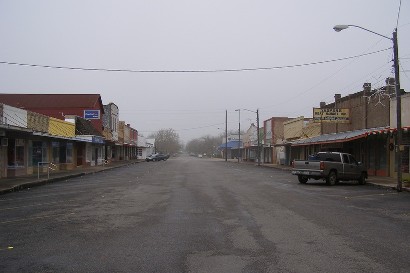
and some wonderful breakfast tacos. Post Office Street serves as the
"main drag" and can be quite active mornings. The Post Office, however,
can be found on Main Street, one block over.
The buildings are mostly brick and contain antique and gift shops,
as well as stores vital to the town's everyday life. The most recent
addition to Post Office Street is a saloon in the reclaimed theater.
Weimar Heritage Society Museum -
125E. Main St. (US 90)
979-725-8203 |
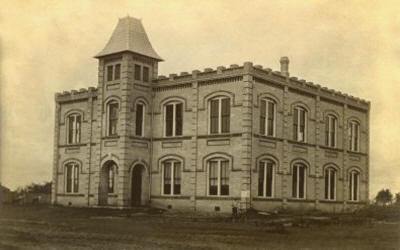
Public School,
Weimar Texas, early 1900s
Photo
courtesy texasoldphotos.com
More Texas
Schoolhouses |
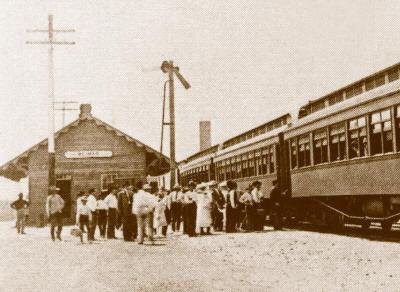
Weimar Railroad
Depot and Train - early 1900s
Photo courtesy texasoldphotos.com |
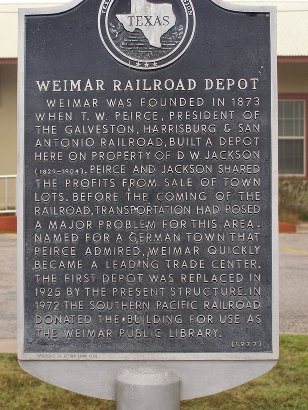
Historical Marker
Text
Weimar Railroad
Depot
Weimar was founded
in 1873 when T. W. Peirce, president of the Galveston, Harrisburg
& San Antonio Railroad, built a depot here on property of D. W. Jackson
(1829-1904). Peirce and Jackson shared the profits from sale of town
lots. Before the coming of the railroad, transportation had posed
a major problem for this area. Named for a German town that Peirce
admired, Weimar quickly became a leading trade center. The first depot
was replaced in 1925 by the present structure. In 1972 the Southern
Pacific Railroad donated the building for use as the Weimar Public
Library.
(1977) |
Nearby Destinations:
Weimar is a pleasant break from the Interstate, and offers a pleasant
winding drive north to LaGrange,
a mere 16 miles away. Schulenburg
is a few miles west on US 90. Or go west 3 miles to Dubina
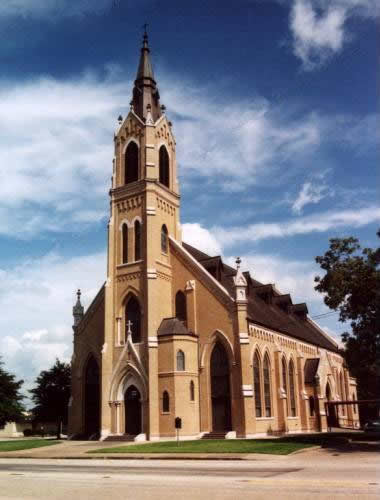
on FM1383 to see the "painted
church" and "Piano
Bridge". |
Weimar, Texas
Personalities
Etta
Moten Barnett
November 5th, 1901 - January - 2004
"Life does not owe me one thing."
While her birth in Weimar, Texas may have just been chance, it's
her accomplishments after she left Weimar that deserve a closer
look. When she died last year of cancer (in Chicago) at the age
of 102, Etta Moten Barnett had had a rich and full life.. She is
now remembered as an actress, singer, and philanthropist ... more
Weimar's
mail carrier in the 1930s by Mike Cox
A pet deer named Billy
The
Weimar Goatherd or J. Alfred Prufrock in Texas
|
| Texas
Escapes, in its purpose to preserve historic, endangered and vanishing
Texas, asks that anyone wishing to share their local history, stories,
landmarks and recent or vintage photos, please contact
us. |
|
|
 HOME
HOME