THE COURTHOUSES
OF ROBERTSON COUNTY
by Terry
Jeanson
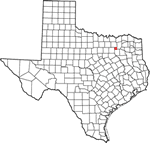
Robertson County
was officially organized in 1837, named for empresario and signer
of the Texas Declaration of Independence Sterling Clack Robertson.
The first county seat of Franklin (later to be known as Old Franklin),
named for pioneer Will Franklin, was formed at the center of the
county. The first courthouse and jail were completed there in 1839.
By 1846, sixteen other counties were carved from lands belonging
to Robertson County,
leaving the county with its present boundaries.
By 1850, Old Franklin was becoming depopulated and the county seat
was moved about twelve miles southeast to Wheelock
near the Old San Antonio Road, which was a more heavily populated
area. Formed in 1833, Wheelock
was named for its founder, Eleazer Louis Ripley Wheelock. The county’s
second courthouse was completed there in 1850. The new county boundaries
left the county seat too far to the south and in 1854 county residents
petitioned for a new county seat near the center of the county.
In 1855, the town of Owensville,
named for the first county clerk of Robertson
County, Harrison Owens, was platted five miles northwest of
Old Franklin and the county seat was moved there in 1856. Land for
the county’s third courthouse was donated by settler David H. Love
and the county’s chief justice, A. L. Brigance was hired to build
it. The courthouse, a virtual replica of the Wheelock courthouse,
was a two-story, forty foot square wooden structure with an exterior
staircase. Court continued to be held in Wheelock
until the Owensville courthouse
was completed in 1856.
After the Civil War, the county was in political and racial upheaval.
In a move to assert their political power, Black leaders, with White
Republican backers, including Reconstruction Judge I. B. Ellison,
managed to wrestle the county seat away from Owensville
in 1870 and move it to Calvert,
about ten miles southwest of the site of Old Franklin. The town,
platted in 1868, was named for its earliest settler, Robert Calvert.
Another attractive aspect of Calvert
was the arrival of the Houston and Texas Central Railway in 1868.
A house was rented for $50.00 a month for the county clerk’s offices
and later, in 1876, the second floor of a brick commercial building
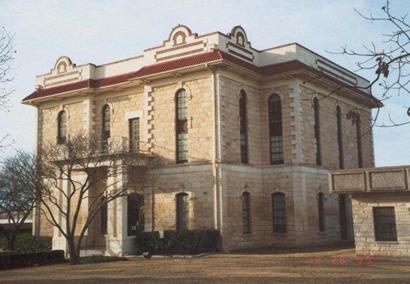
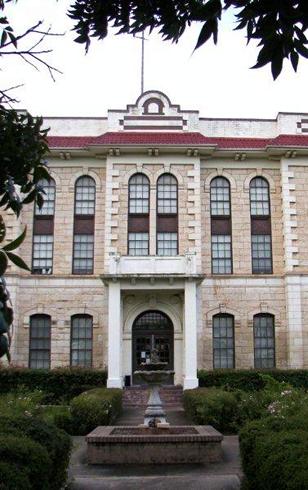
was used for government purposes. A courthouse was never built in
Calvert, but an impressive jail
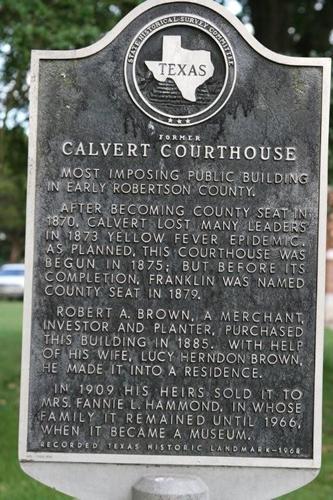
was completed in 1875. (The jail, still standing and known as the
Hammond House today, is often confused for an old courthouse, partly
due to an historical
marker in front of it designating it as an old courthouse!)
In 1872, the town of Morgan, named for an International Railway
Company official, was founded at the center of the county near the
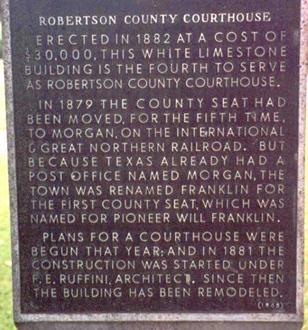
site of Old Franklin. In 1879, the county seat was moved one last
time to Morgan which was renamed Franklin
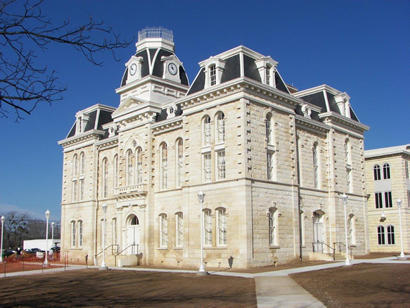
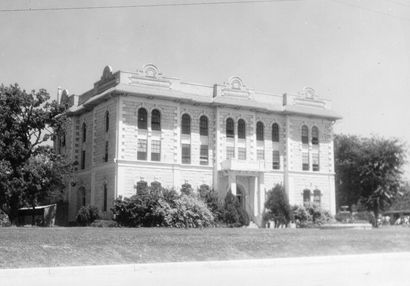
to honor the name of the original county seat. After housing the
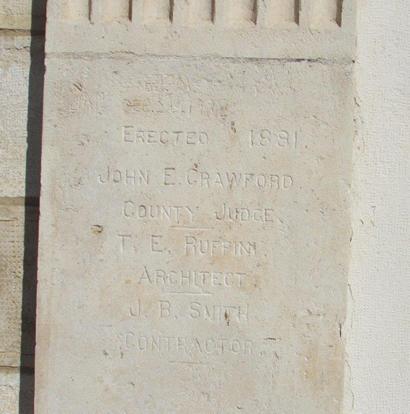
court in temporary quarters, the county’s fourth and current Second
Empire style courthouse was constructed in 1881 and officially accepted
in 1882. Designed by noteworthy Austin architect F. E. Ruffini,
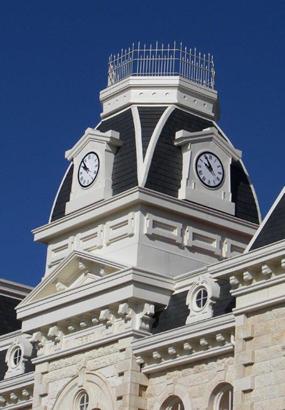
the three-story stone building had corner pavilions with Mansard
roofs and a clock tower dome with cresting and a pediment over the
south side entrance. The building was decorated with a cornice,
corner quoins, dormers, bulls-eye windows, segmented arched lintels
with keystones over the windows and a small balcony over the south
entrance. The building strongly resembled two of Ruffini’s other
courthouses, the 1877
Williamson County courthouse and the 1882
Hays County courthouse (both no longer standing.) Ruffini also
designed the 1882 jail which still stands on the west side of the
courthouse.
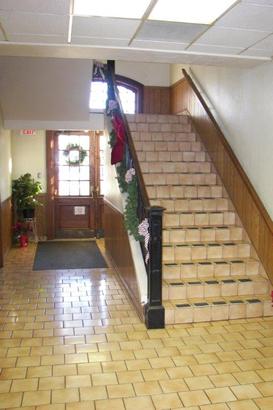
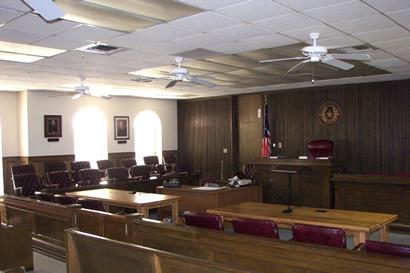
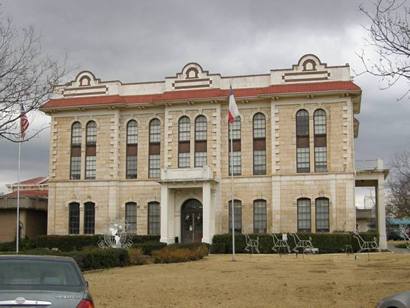
A remodeling that began in December of 1923 replaced the buildings
original roof with a flat one that was surrounded with “Alamo” parapets
and the interior was gutted and reconstructed. (The current county
judge, Jan Roe, told me that this remodeling actually saved the
building from deteriorating so that a future restoration would be
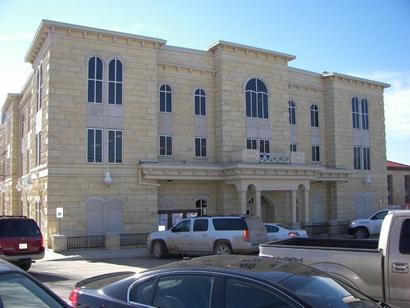
possible.) Annexes were built to the north and west sides of the
courthouse in the 1970s and the old jail was also expanded. Starting
in 2009, the annexes were demolished and a new rear annex, matching
the stone and style of the 1882 courthouse, was completed in 2011.
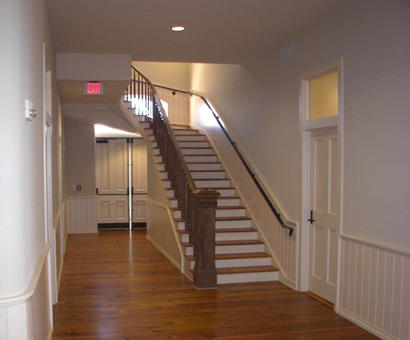
A restoration of the 1882 courthouse’s original roof was completed
in 2014 along with the restoration of the 1882 jail.
Terry
Jeanson, February
16, 2014
Sources: The Handbook of Texas Online, The Texas Historical
Commission’s County Atlas – Texas National Register Program at http://atlas.thc.state.tx.us/shell-desig.htm,
Wanted: Historic Jails of Texas by Edward A. Blackburn, Jr., Hearne
Democrat, Friday, December 21, 1923, "Court House Improvements -
Started Last Monday", Hearne Democrat, March 8, 1973, "Commissioners
Approve Courthouse Remodeling" and Mary Katherine Thompson Galloway,
Robertson County Historical Survey Committee: Owensville Historical
Marker Dedication - June 23, 1974 at www.rootsweb.ancestry.com/~txrober2/GhostTownsOwensville.htm
|
 HOME
HOME