|
|
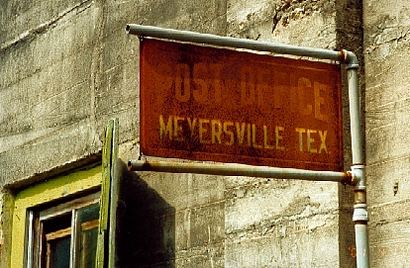
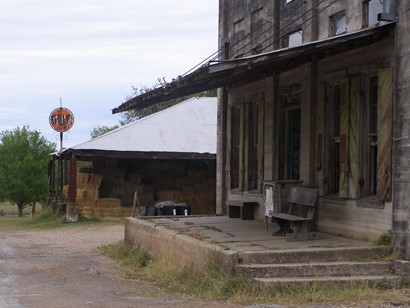
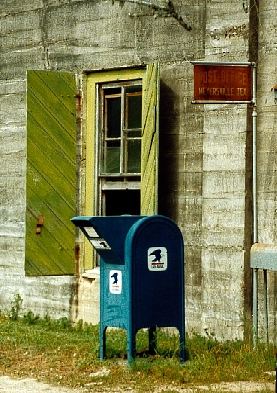
Meyersville Post
Office
TE Photo, 2001 |
History in
a Pecan Shell
Settlement dates
from 1846 when Adolph Meyer and his sister decided to live on the
north side of Coleto Creek. In 1847 the community was named after
Meyer.
The village was supplied through Victoria
until the first store opened. By 1850 the population consisted of
some 20 families and the following year the first school was constructed.
A post office was granted in late 1851. An influx of Polish immigrants
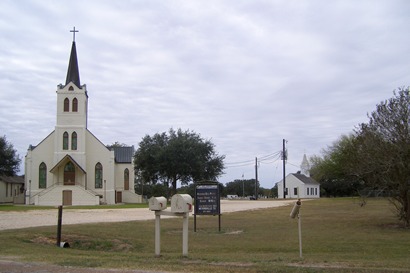
arrived in the 1850s. In 1859 Sts. Peter and Paul Catholic Church
was built. The German and Polish families grouped into separate communities
resulting in an “Upper Meyersville” and a “Lower” Meyersville.
Although no population figures are available for the earliest years,
an estimate of both communities is given as between 200-250 residents
from the 1880s through the 1920s.
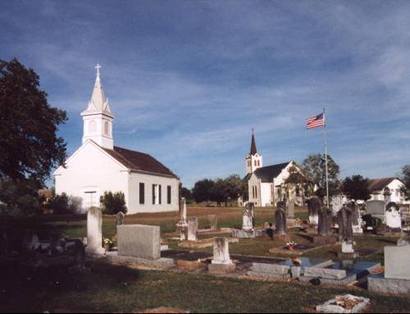
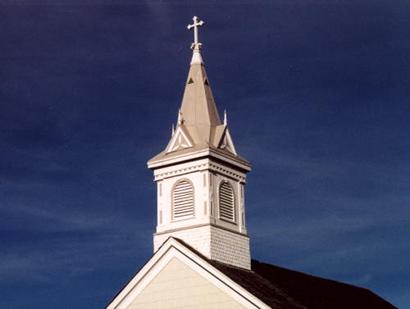
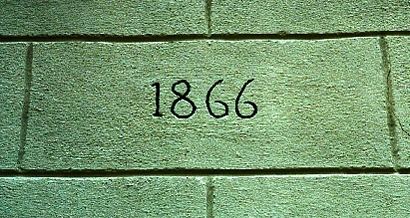
In 1866, St. John’s Church, the county’s first stone church was built.
This Lutheran church was replaced by a second building erected in
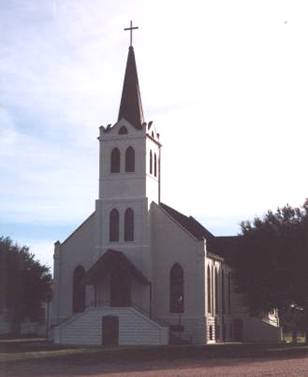
1921. The Catholics erected a church in 1880 and this was replaced
in 1939.
The community was far enough from Victoria
and Yorktown that local businesses
enjoyed a loyal (captive) clientle. The community was mostly dependant
on cotton and in time, Meyersville
operated six separate gins.
After WWII the
cotton market was all but dead.
From a population of 250 in the 1940s, Meyersville fell to 150 in
the 1950s, declining to a mere 110 in the late 1960s.
In the late 1990s, Meyersville was taken off the official state map
by TxDoT. Locals were outraged and led a campaign to reinstate it’s
former status which was done with the next printing.
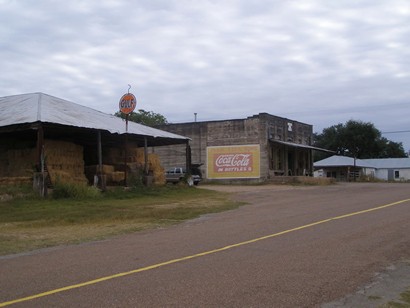
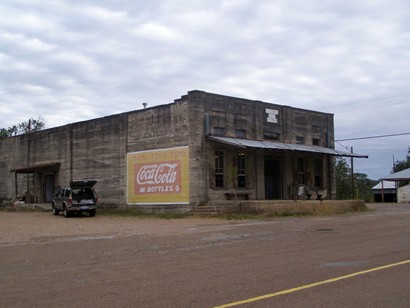
The community is one of the most picturesque in the county.
|
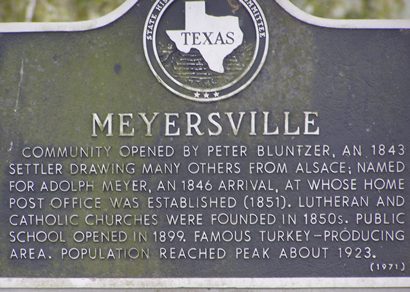 |
Historical Marker
Text
MEYERSVILLE
Community opened
by Peter Bluntzer, an 1843 settler drawing many others from Alsace;
named for Adolph Meyer, an 1846 arrival, at whose home post office
was established (1851). Lutheran and Catholic churches were founded
in 1850s. Public school opened in 1899. Famous turkey-producing area.
Population reached peak about 1923. |
Meyersville
Landmarks/Attractions
Photo Gallery -
Street Scenes, Churches, Post Office, signs: |
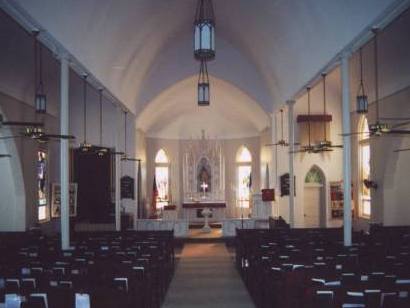
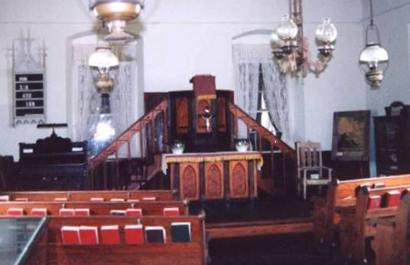
Old
Lutheran Church Sanctuary
Photo Courtesy Barclay
Gibson, October 2003 |
1866 - the year
that the county’s first stone church was built.
TE Photo, 2001.
More Pitted Dates |
Meyersville,
Texas Chronicles:
"Get
Along Little Turkeys..."by Mike Cox
... The first Cuero turkey drive to
make the newspapers came in November 1910, when Rudolph and Oscar
Egg of the small, German-rooted community of Meyersville drove 1,200-plus
turkeys to the county seat for sale at the processing plant, which
one newspaper indelicately referred to as a "slaughter house." It
took the brothers and six hired hands on horseback two days to herd
the birds 13 miles into town..... Read
full article ›
|
| Texas
Escapes, in its purpose to preserve historic, endangered and vanishing
Texas, asks that anyone wishing to share their local history, stories,
landmarks and vintage/historic photos, please contact
us. |
|
|
 HOME
HOME

 Texas
Gulf Coast
Texas
Gulf Coast East
Texas
East
Texas Central
Texas North
Central
Texas North Central
Texas South
Central
Texas South Texas
Panhandle
Texas
Panhandle South
Texas
South
Texas Texas
Hill Country
Texas
Hill Country West
Texas
West
Texas Texas
Ghost Towns
Texas
Ghost Towns Texas
Counties
Texas
Counties