|
|
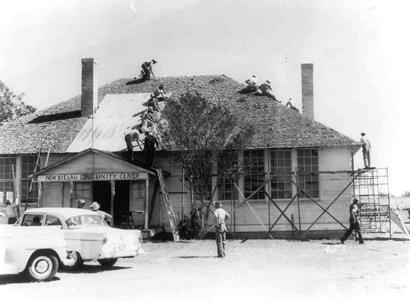
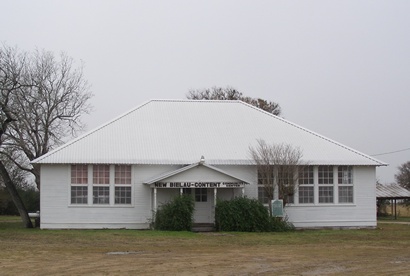
New Bielau Community
Center Being Roofed
1955 photo courtesy Nesbitt Memorial Library, Columbus,
Texas |
History
in a Pecan Shell
Prior to the Civil
War, German farming families established in Industry,
Texas (Austin County) made the 50 mile trip south to settle across
the Colorado River just south of Weimar.
Bolstered by freshly arrived immigrants in the 1870s, the community
named itself after Bielau, Germany just as Weimar,
New Berlin,
Westphialia,
and other German-Texas settlements had named themselves after prosperous
Germany cities and regional centers.
A school was in operation in the 1870s and a Methodist church was
built in 1879. A second church building (Trinity Evangelical) was
completed in 1888. The community's proximity to Weimar
prevented its growth; but it maintained a distinct and separate identity
and supported a general store. New Beilau never developed a town center
since its residents were spread across the landscape. The New Bielau
school merged with Weimar
schools in the late 40s.
Anglo-Texan settlers maintained a separate nearby community named
Content. Churches and school were
shared by both communities and both are still served by the Trinity
Church.
Photographer's Note:
Subject: Visiting New Bielau and Content
These are photos of 2 communities united. Only a mile or so apart
they seemed to be joined in many ways. These communities were located
about 4 miles south of Weimar
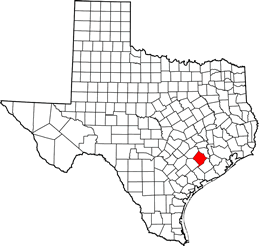
in Colorado County and centered close to the intersection of FM155
& FM2144. - William
Beauchamp |
 |
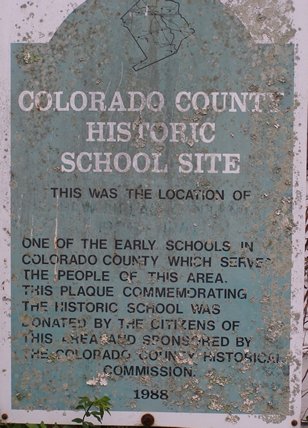
Colorado
County Historic School Site plaque
Photo courtesy William
Beauchamp, December 2009 |
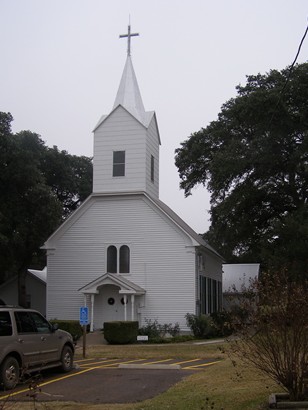
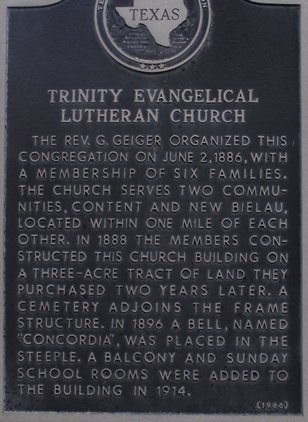
Trinity Evangelical
Lutheran Church
in Content and New Bielau
|
Historical Marker
Trinity Evangelical
Lutheran Church
The Rev. G. Geiger
organized this congregation on June 2, 1886, with a membership of
six families. The church serves two communities, Content
and New Bielau, located within one mile of each other. In 1888 the
members constructed this church building on a three-acre tract of
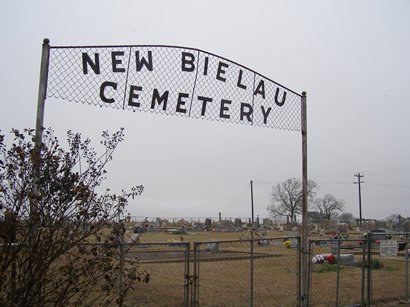
land they purchased two years later. A cemetery adjoins the frame
structure. In 1896 a bell, named "Concordia," was placed in the steeple.
A balcony and Sunday School rooms were added to the building in 1914. |
| Texas
Escapes, in its purpose to preserve historic, endangered and vanishing
Texas, asks that anyone wishing to share their local history, stories,
landmarks and vintage/historic photos, please contact
us. |
|
|
 HOME
HOME

 Texas
Gulf Coast
Texas
Gulf Coast East
Texas
East
Texas Central
Texas North
Central
Texas North Central
Texas South
Central
Texas South Texas
Panhandle
Texas
Panhandle South
Texas
South
Texas Texas
Hill Country
Texas
Hill Country West
Texas
West
Texas Texas
Ghost Towns
Texas
Ghost Towns Texas
Counties
Texas
Counties