|
“Hogtown,
for sheer bad manners, was the worst oil boom town in Texas history,
according to those myth-making experts who followed oil booms,”
A.C. Greene wrote of the town. Tales of Hogtown during the wicked
oil days are too lurid for these pages but we can say that its debauchery
might be so well remembered because so much of it supposedly took
place in broad daylight and sometimes not in private.
The discovery of oil near Desdemona
came as no great surprise to residents of the community. In 1914,
the entire town, all 100 people, met at the Hog Creek School and
formed the Hog Creek Oil Co. Hog Creek itself often had oil scum
on it and the wells gave off the same whiff as the shallow oil wells
that had been found at Strawn,
but the first four years of drilling yielded nothing.
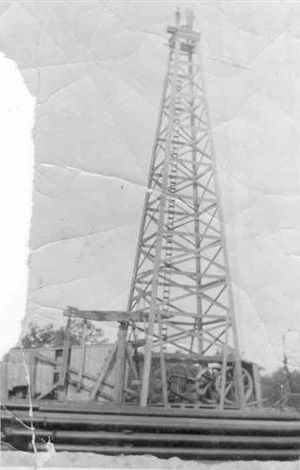
Finally, after a new Hog Creek Oil Company was formed, oil was struck
on the night of Sept. 2, 1918. The well promptly caught fire and
burned for three days before it could be extinguished. Even with
this inauspicious beginning, the Desdemona
oil field was soon producing 20,000 barrels a day. The producing
well was just 100 yards from where the first of several dry holes
had been drilled.
Desdemona even
took a walk on what might be widely viewed as the wild side of political
life as the Texas socialist movement flourished there; oil made
some of those socialists downright rich. The socialists even had
their own baseball team, the Desdemona Socialists. The other town
team was known as the Desdemona Democrats. We’re not sure how the
rivalry turned out on the baseball diamond but in terms of real
estate dealings, the Socialists scored a decisive victory.
Thomas
Hickey, one of the country’s leading socialist’s orators and writers,
had moved to Texas in 1907 and began publishing “The Rebel,”
a socialist newspaper, in Hallettsville.
The government suppressed it by not allowing it into the post office
system during World War
I.
That was about the point where Hickey and some other socialists
did something that most socialists did not do in those days; they
invested in the oil fields of Eastland County, including Desdemona.
They formed the National Workers Drilling and Production Company
and flaunted their politics on the baseball diamond, which wason
land owned by an ardent antisocialist by the name of S.E. Snodgrass.
Though the Socialists and the Democrats apparently had a friendly
rivalry on the field, off the field Snodgrass’ antipathy toward
the Socialists was more than he could bear; he banned them from
playing on the field. The Socialists offered to buy it and Snodgrass
said they could have the acre-and-a-half for the exorbitant sum
of $50. The Socialists raised the money through the Desdemona Oil
News, where Hickey was the advertising manager.
When oil was discovered near where the pitcher’s mound used to be,
that $50 piece of land was worth $40,000. The infield and outfield
and beyond soon sprouted oil wells and many of Hickey’s socialist
comrades became quite rich.
Hickey, however, withdrew from the National Workers Drilling and
Production Company and moved to a farm near Stamford
and continued traveling the state, writing stories about oil workers,
for the rest of his life.
The Desdemona field turned out to be shallow and only about three
feet by three feet; it was quickly pumped dry. When the oil was
gone, so was the lawless and lascivious element that had followed
it. Hogtown became Desdemona
again.
© Clay Coppedge
January 27, 2012 Column
More "Letters from Central Texas"
|
 HOME
HOME