|
Roy
Bedichek has been called the most civilized soul Texas ever produced.
If that's so - and it has never been seriously disputed - the seeds
of Bedichek's civilized nature and his love of the natural world were
sown in Falls County,
where he grew up.
Roy Bedichek left to Texas two lasting legacies. He was director of
the University Interscholastic League for a quarter of a century;
in that capacity he set the foundation for the state's UIL competitions
in athletics and academics. An Austin
middle school is named for him. |
Today
he is perhaps best known as the author of Adventures of a Texas Naturalist,
a book the late A.C. Greene of Salado
included in his The Fifty Best Books on Texas.
Of the book Greene wrote: "Without Thoreau's political asides, Bedichek
offers nature as the best solution to mankind's private despairs.
The book is as fresh today as it might have been if you had accompanied
Bedichek on the travels around the state he describes." |
|
Born
in Illinois, Bedichek moved to Texas when he was six. He told long
time friend and fellow writer William A. Owens his first impression
of Falls County in
the early 1880s.
"I remember that it was just a bald prairie," he said. "My mother,
who had been used to pioneer conditions, cried all the way from the
train to the place six miles away that we went to."
The place they went was the community of Blevins,
where Roy's father, James Madison Bedichek, founded a school.
Later, the family moved to Eddy
where the elder Bedichek founded the Literary and Scientific Institute.
The two foundations of Bedichek's life were formed at that early age:
a love of reading and a love of the natural world.
Lyman
Grant, who co-edited the book The Letters of Roy Bedichek, suggests
newcomers to Texas be given a copy of Adventures With A Texas Naturalist
along with the hot sauces, pecans, and packets of bluebonnet seeds
so often used to characterize the state.
"In (the book's) pages, newcomers can discover the best that Texas
has to offer and, if they let it, the kind of person Texas can inspire
them to become," Grant wrote.
Bedichek died in 1959, supposedly waiting for his wife's cornbread
to come out of the oven. He is buried at the Bruceville-Eddy
cemetery. His grave there is marked by a Texas Historical Commission
marker outlining his contributions to Texas education and literature.
Filmmaker
Ron Tranchin began in Falls
County when he set out to trace the many roads Bedichek traveled
for his documentary "Roy Bedichek's Vanishing Frontier." Reading Bedichek's
book as an adult, Tranchin was reminded of the joy he found in the
natural world as a boy. In Bedichek, he discovered a fellow Texan
who never lost that joy. |
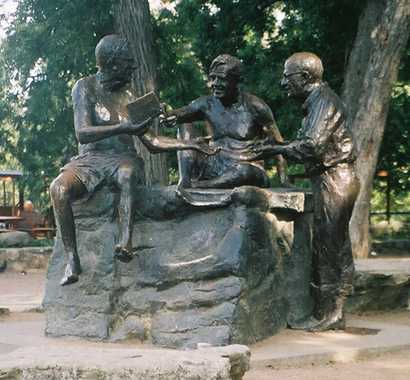 |
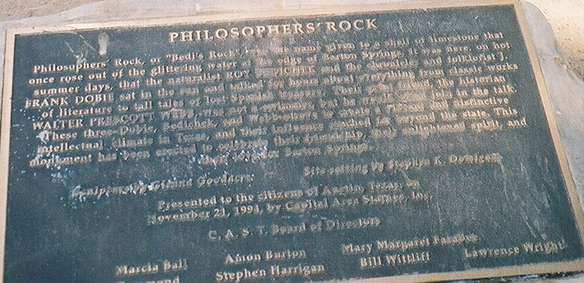
Philosophers'
Rock (Click on photo for plaque)
Photo courtesy Chia-Wei Wang, August 2006 |
Tranchin visited
Barton
Springs Pool in Austin
where a statute of Bedichek, J. Frank Dobie and Walter Prescott Webb
commemorates "Philosopher's Rock," the place where the three men often
gathered to discuss weighty matters of man and beast.
The filmmaker also pays a visit to an heir of Bedichek's literary
legacy, writer John Graves of Glen
Rose, who wrote another Texas classic, Good-bye To A River. Like
Bedichek, Graves holds a special affection for the mockingbird.
Intrigued by the mutual interest, Tranchin visited a graduate student
studying the mating rituals of mockingbirds. He learned that Graves
and Bedichek were on to something; there is more to the noisy and
ubiquitous bird than meets the untrained eye.
And so it seemed fitting last week at the Bruceville cemetery when
a mockingbird alighted atop Bedichek's historical marker. The bird
peered down at what was written there, as if reading the words upside
down. The bird then flitted away to rest atop Bedichek's headstone.
A photograph snapped to record the symbolic image showed the headstone
but no bird. Its shrill, mocking call faded away over a remnant of
the old, bald prairie Bedichek first saw more than a century ago.
|
|
|
 HOME
HOME