|
|
The Glenwood
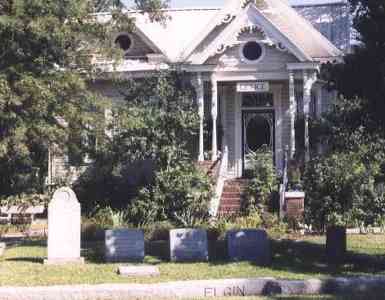
Cemetery Office and Elgin Plot
TE Photo
May 2003 |
While
working on this issue’s Elgin
article, we decided to visit the gravesite of the town’s namesake,
Robert Morris Elgin. The Elgin Family Plot is located in Houston’s
Glenwood Cemetery, 2525 Washington Avenue. At one time this was Washington
Road and connected Houston
proper with Camp Logan, a WW
I Army training facility that is now Memorial Park.
Upon entering the Cemetery, Houstonians will immediately recognize
many familiar names. Allen, Binz, Cummings, Foley, and Settegast to
name a few. Like the Elgin name, most have streets named after them
in varying degrees of magnitude and asphalt.
Besides being a final resting-place for Houston’s
former VIPs, Glenwood also contains the earthly remains of Dr.
Anson Jones, the last President of the Republic of Texas. Glenwood
is also a showplace for late 19th and early 20th
century funerary monuments. |
|
TE
photo, May 2003 |
We went to the
office (a charming Victorian cottage formally used as the caretaker’s
residence) to see if they had a directory, and they did. The Elgin
plot seemed close, but the map wasn’t to scale. After a few minutes
of wading through squirrels, we were back just a headstone’s throw
from the door of the office. Although the surrounding grass was thin,
inside the Elgin space it grew as if fertilized. You might say, "the
plot thickened", then again, you might not want to say that.
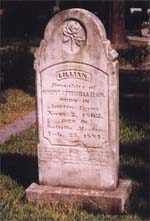
Ol’ Bob was a molding or a moldering, or whatever John Brown’s body
was doing in that old song. And he was doing it right next to his
daughter! She died in Saltillo, Mexico, and I suspect there
is an interesting story there. The Elgin Courier’s account of that
would be in storage, so it will take a more persistent or curious
detective than yours truly to write that saga. |
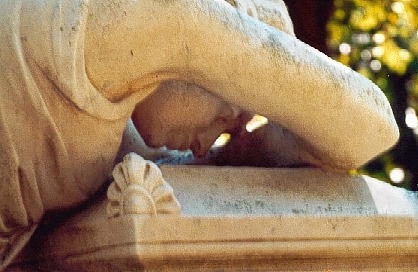
Detail of the
Angel in the Hill Family plot
TE Photo
May 2003 |
The Old and
the Restful
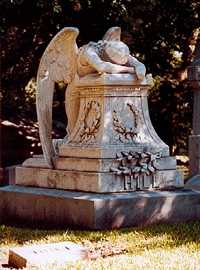
Shrouded obelisks (symbols of lives cut short), weeping
Angels and willows are nearly as abundant as squirrels, but executed
several degrees finer than you’ll find in most cemeteries. An art
deco Diana and an elaborate Egyptian motif plot add variety as the
road winds and dips through this unintended arboretum. The southern
boundary surprises you with the sudden appearance of Memorial Parkway,
and off to the left at a distance is the abandoned Jefferson Davis
hospital. Once known as ‘the baby factory" because it was the
County’s primary maternity hospital, there is an irony that it would
overlook the city’s pantheon. Eat your vegetables, pick up your toys,
make friends, marry well, vote, pay your taxes, provide for your heirs
and we’ll bury you across the street. |
|
|
The
Weeping Angel in Glenwood Cemetery showing vandalism to the left arm.
TE photo,
May 2003
More Weeping
Angels |
Dead Folks
– Live Oaks
Houston has many beautiful examples of Live Oak Trees, but one of
the most beautiful specimens is near the SE corner of Glenwood. The
spread of the tree comes close to that of the Goose
Island Oak in Rockport,
the Champion Live Oak in Texas. The branching pattern is "text
book", growing conditions are ideal and if your compost is as
rich, then the police might want to talk to you. Recently the tree
has been cabled, which detracts from it’s natural elegance, but it’s
a precaution that is usually thought of too late. |
A Doctor with
a Heart of Stone
The famed heart surgeon and humanitarian, Dr. Denton Cooley was once
photographed in the Houston Medical Center standing beside a beautiful
stylized heart sculpted from exotic wood. A larger replica of this
heart, carved from marble graces the Cooley Family plot. |
|
Prior to the
current care-taking provided by Glenwood Cemetery Inc. Glenwood
was plagued by vandals. A particularly destructive rampage left
shattered an exquisite angel that had stood over the grave of florist
Leonard Tharp. Perhaps this was the incident that caused the awareness
of vulnerability and prompted the current protective measures. The
cemetery is open seven days, dawn to dusk.
|
| Texas
Escapes, in its purpose to preserve historic, endangered and vanishing
Texas, asks that anyone wishing to share their local history and vintage/historic
photos, please contact
us. |
|
|
 HOME
HOME