|
Confederate
President Jefferson Davis called the Battle of Sabine Pass, fought
on September 8, 1863, for control of the inlet from the Gulf of Mexico
to Sabine Lake and southeast Texas, one of the most significant military
engagements in world history.
Davis was grasping for any Confederate success just two months after
the losses at Gettysburg and Vicksburg, so such hyperbole is understandable.
Actually, the facts were spectacular: less than fifty Confederate
artillerists kept approximately 4,000 Union troops and seventeen vessels
from coming through the pass. If one leaves the story there, the battle
does seem amazing.
Here is the rest of the story. General N.P. Banks, following the Union's
Anaconda plan to defeat the Confederate by dividing it into portions,
sent General William B. Franklin's command by sea to invade the Louisiana-Texas
coast via Sabine
Pass. The goal was to stay aboard the ships as long as possible
before disembarking and marching north to interrupt rail connections
between the two states.
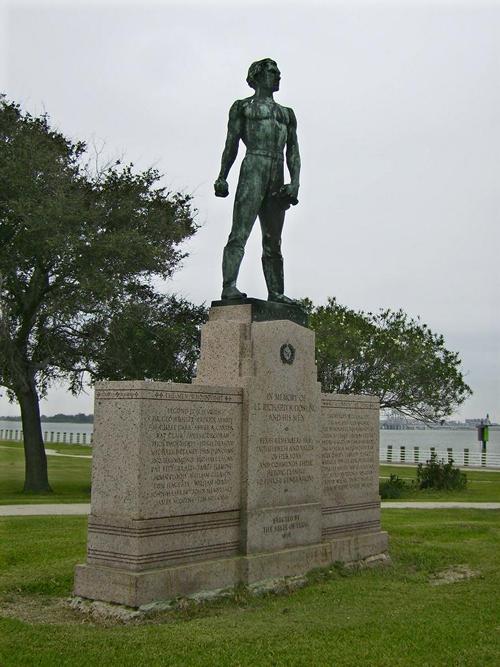
The Davis Guards, or Company F of the First Texas Heavy Artillery
Regiment, commanded by Captain Frederick Oldham, defended the coast,
and on the day of the attack Lieutenant Dick
Dowling had the duty at Sabine
Pass.
The defenders previously had sighted their guns on the narrow channel
in the pass, so when the Union vessels started through the pass they
fired away when the ships reached their line of fire. They disabled
the Sachem and the Clifton, and these ships then blocked the pass,
preventing the others from proceeding.
What is strange is that Franklin did not attempt to disembark his
troops and go around the artillery on land. He withdrew entirely,
and Banks did not attempt to revisit Sabine
Pass, instead attempting to gain entre into Texas via the Red
River. This effort, too, was rebuffed by Confederates at the Battle
of Mansfield early in the summer of 1864.
The Confederate victory at Sabine
Pass may not have justified President Davis' boast, yet some pride
is justified. Controlling Texas was not a major Union goal on its
way to victory in the Civil War, which probably is why Banks did not
receive orders from U.S. Grant to try the Pass again, but the battle
did have some consequences. War weariness in the North was a potentially
fatal issue for the Lincoln Administration, and one more time the
Confederates seemed unconquerable.
Grant eventually gave President Abraham Lincoln the victories that
preserved the Union. But for a while, Dick
Dowling and his Texas gunners helped to keep the issue in doubt.
|
 |
|
All
Things Historical May
27 - June 2, 2001 Column
Published by permission.
(Archie P. McDonald is Director of the East Texas Historical Association
and author or editor of over 20 books on Texas)
|
|
|
 HOME
HOME