|
When
I was in the sixth grade in Beaumont,
I attended the Dick Dowling Junior High School. We young scholars
knew only vaguely that Dowling was some kind of hero and that other
public schools in town bore the names of VIPs of Texas and local history.
As an aside, all the Catholic schools were named for saints. There
is not much chance of confusion between the two sources of names.
Dowling is primarily known for commanding Fort
Griffin, the location of the artillery battery that defended Sabine
Pass, when Union Army and Navy forces attempted to sail through
the pass into Sabine Lake on September 8, 1863. They planned to disembark
near a rail line that connected Houston
and New Orleans, a route had been completed after the beginning of
the Civil War. |
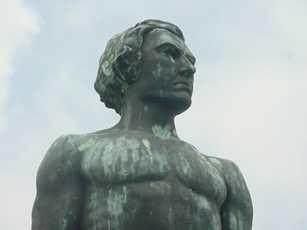
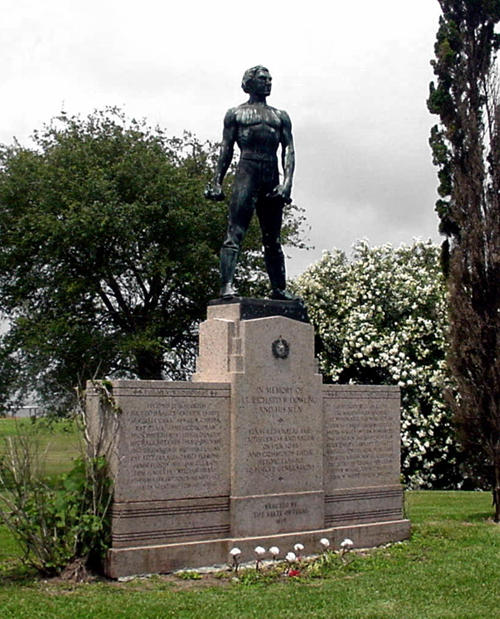
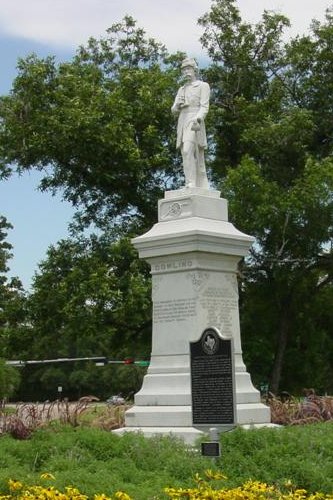
The statue and
pedestal inscribed with the names of Dowling's command.
TE photo 2003 |
Dowling
was born in Galway County, Ireland, in 1838. His family left Erin
for America in 1846. They arrived in New Orleans, but Dowling moved
west to Houston early in
the 1850s following the death of both parents. Though only twenty-three
years of age when the War began, Dowling was already a seasoned and
successful businessman who had operated three saloons, the Shades,
the Bank of Baccus, and the Hudgpeth Bathing Saloon. He also operated
a liquor import business in Galveston.
Dowling joined the Jefferson Guards, commanded by Captain Frederick
H. Odlum. They fought for former Federal posts along the border with
Mexico until they were secured, then participated in reclaiming control
of Galveston
on January 1, 1863.
The remainder of Dowling's year was spent guarding the upper Texas
coast in command of Fort
Griffin. And there he and his forty-seven artillerymen became
Confederate heroes. |
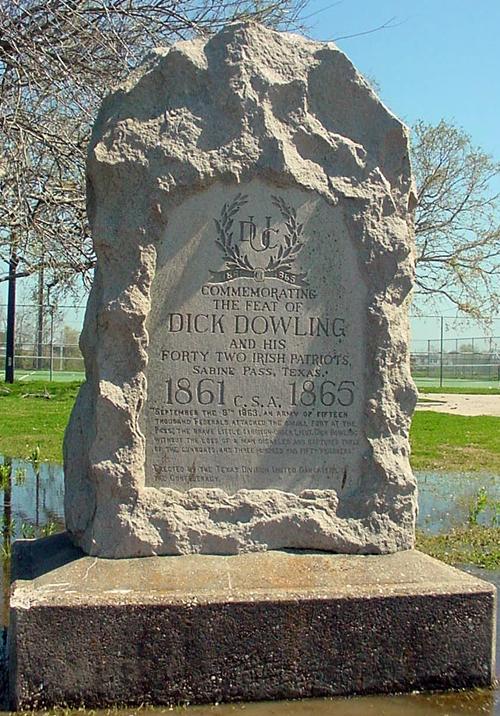 |
The
Federals attempted to run seventeen ships carrying approximately 5,000
solders past the fort so they could travel by water rather than march
overland to their objective in their guns on the channel previously,
so they did not even have to aim.
Salvos disabled the Sachem and the Clifton, which blocked the channel,
and somewhat surprisingly, the other vessels put back to sea. Confederate
President Jefferson Davis, hungry for any kind of victory after the
losses of Gettysburg and Vicksburg only two months previously, hailed
the Battle
of Sabine Pass as one of the greatest military victories in history.
That was surely an exaggeration, but then they did name a school after
Sabine Pass' commander, Lieutenant Richard William Dowling. |
 |
All
Things Historical Sept.
21-27, 2003 column
A syndicated column in over 40 East Texas newspapers
This column is provided as a public service by the East Texas Historical
Association. Archie P. McDonald is director of the Association and
author of more than 20 books on Texas. |
|
|
 HOME
HOME