|
Kazuo Sakamaki,
only Japanese survivor of the midget submarine attack on Pearl Harbor
seven years ago today, has had enough of war.
He says he is "not so happy" about the world situation, but adds:
"If another war comes along, I would want to stay out of it — remain
strictly neutral."
Sakamaki, 30, works as a clerk in the Toyota truck company here.
He is a moderately happy man, married to a bride of his choice and
the father of a round-cheeked, almond-eyed son.
He no longer believes that he disgraced himself, his family, his
ancestors, his country, the Imperial Japanese Navy and his emperor
by being captured after his submarine grounded off Pearl Harbor.
He is glad he became the first Japanese war prisoner of World
War II.
But seven years ago, Sakamaki was one of five officers who set forth
in five midget submarines ready, indeed eager, to die for the glory
of his country in the attack on Pearl Harbor.
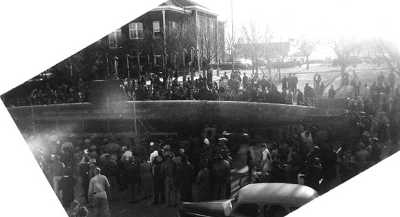
Each submarine carried two persons each was 74 feet long, weighed
30 tons, had a maximum speed of 24 knots and a cruising range of
about 400 miles, and was equipped with radio transmitters and two
bow torpedoes.
Sakamaki trained long and hard for what he sincerely believed was
his date with destiny. He studied at the naval academy, learned
to fly at Kasumigatura, practiced seamanship aboard the training
ship Abukuma and underwent special training at Chujo Bay, which
closely resembles Pearl Harbor. He was commissioned a sub-lieutenant.
He recalled vividly how his midget submarine was launched from its
"hanger" on the afterdeck of a mother submarine off Pearl Harbor
on the moonlight night of Dec. 6. He was 23 years old then.
His orders read to coordinate an underwater attack with the aerial
bombardment of Pearl Harbor. He was instructed to attack, in order,
aircraft carriers, battleships, and heavy cruisers.
The instructions said that he should rendezvous after the attack
at point 7 off Lanai Island. But he knew that was only a formality.
All were expected to die for their country.
"I said good-bye to the captain of the mother sub and 10 minutes
later we surfaced so that we could enter our midget submarines,"
he said.
"It was then I got a nasty shock. My gyrocompass was out of commission.
Why, I don't know. There was no time for repairs. After consulting
the captain, I decided to attempt to make the journey anyway."
Without the gyrocompass, Sakamaki said he found his craft almost
unnavigable and unmaneuverable.
"But I finally got to the entrance to Pearl Harbor just before 7
a.m.," he said. "We were to attack at 7:50."
For the next three hours, he said, he "hung around" Pearl Harbor
trying to make repairs and trying to find a target.
Several times he surfaced and was depth-charged. He saw several
small craft — mine sweepers and destroyers — but he wanted to save
his torpedoes for bigger game. Through his periscope he saw columns
of smoke rising over the harbor.
The midget submarine grounded several times on reefs. Bilge water
spread to the battery racks and deadly gases began to fill the submarine.
Depth charges rocked in.
Their senses dulled, Sakamaki and his fellow crewman, Petty Officer
Kiyoshi Inazaki, decided to try to make Lanai. Then the ship grounded
for the 10th and last time.
Sakamaki swam for the shore of what he thought was Lanai. His companion
drowned.
Collapsing on the shore, Sakamaki remembered nothing until he was
shaken by an American soldier pointing a pistol at him, he had been
traveling in circles and was back on Oahu.
"I was terribly ashamed," Sakamaki said. "I asked for an opportunity
to die an honorable death, but they just laughed at me."
The commanders and crewmen of the other midget submarines were lost
and were enshrined by the Japanese as "war Gods" soon after Pearl
Harbor Day. The Japanese made no mention that Sakamaki had fallen
into American hands.
Lone Star Diary July
2001 Column
Published with author's permission.
|
 HOME
HOME