|
|
On
December 6, 1941, the day before the Japanese attacked Pearl Harbor,
U.S. Navy Gunner's Mate First Class Victor H. Lively, stationed
on the battleship USS Nevada, went ashore to Honolulu
to buy Christmas gifts for his family. The last thing on anyone's
mind was war. Those gifts were never to be placed in their hands.
Shore leave
lasted from noon to midnight. Procedure was to walk up the gangplank
to the main gate, show the pass, and catch a taxi into town. He
remembers paying about twenty-five cents to ride in a new DeSoto
cab.
|
|
|
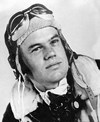
Vic
Lively in uniform
Photo
Courtesy of Vic Lively |
Vic
describes Honolulu as a "quaint town" where the tallest building was
three or four stories high. There were nightclubs and dance halls,
but Vic spent his time walking around, looking at the shops and eating
snacks at one of many sidewalk cafes. "Hawaii was full of Japanese
spies at that time," he adds.
The attack came early Sunday, December 7. Vic heard the alert,
"Man the battle stations!" His post was in the foremast of
the Nevada where he served as director of operations
for broadside guns. Broadside guns were designed to shoot horizontally
at ships, not vertically at planes, so they were powerless in the
attack that raged from above.
"If I'd had a .22, I could have shot planes - that's how close they
were," Vic remarks. "The bombs and guns sounded like "h-e-double-l."
The battle had been going for about an hour when, during a lull, he
started to climb down from the observation tower. A bomb suddenly
hit at the spot below him, killing everyone there. He couldn't help
but think that had he started down a few seconds earlier, he would
have been killed, but death did not have its way with Vic. |
|
|
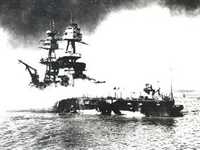
USS
Nevada in sinking condition December 7, 1941.
Vic Lively was there.
Photo Courtesy of Vic Lively |
Of
the 1700 crewmen aboard the Nevada, about 150 died,
most of whom were topside. Fire, smoke, and body parts were everywhere.
Even the water was on fire. Vic watched men jumping from the mast
of the USS Oklahoma into the fiery water. The only injury
Vic received was a burn on his hand when he grabbed a hot railing.
When he was able to get below decks, he helped tear up sheets for
bandages and pump out water.
Of the seven ships on battleship row, only the USS Nevada
was able to back out and get underway thanks to the foresight of Lt.
Comdr. Donald K. Ross (later Admiral Ross).
This was due to the line-up of ships in port. The Nevada
happened to be on the end by itself. The others were tied together
by twos and couldn't move. As the Nevada pulled away, it was followed
and attacked by fifty Japanese bombers and torpedo planes "thick
as flies," Vic says. The ship was so badly damaged that it began to
sink. Orders came to pull it onto a sandbar to avoid blocking the
harbor. |
|
|
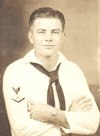
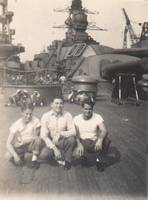
Vic
Lively and buddies on USS Nevada.
Photo
Courtesy of Vic Lively |
|
Hearing the
reports of the attack, his family agonized for his safety. All they
could do was wait and pray. Shortly after the attack, each sailor
was given a postcard to send home. However, Vic's postcard was delayed
in the mail and took two or three weeks to get back to Texas.
The Nevada was sent to Bremerton, Washington, where
crews of two to three thousand worked day and night to complete
massive renovations to the ship. When Vic reboarded, he saw that
the ship hardly looked the same. "His" broadside
guns had been removed!
How
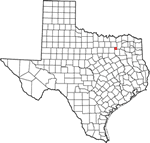
did this boy from Slocum,
Texas (Anderson
County) come to join the navy? It was spring of his senior year
at Slocum High School when he saw an article in the paper about
navy recruiting. He saw the navy as "a good way to get off the farm"
with its required hard labor in hot fields. His family had a large
garden that yielded produce to sell to city folks in Palestine.
Peas (not English peas), watermelons, blackberries, and peaches
from a ten-acre orchard, corn, cantaloupe, and cotton. They had
three hen houses for 1000 laying hens. Those little ladies produced
forty-eight dozen eggs per week. Vic's "Papa" was quite a
salesman who developed a route of grocery stores that bought his
goods. Milk and butter were also sold. The kids not only worked
in the fields, but also packaged the items after school for the
next day's delivery.
|
|
|
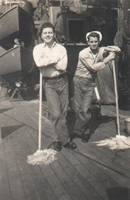
Vic
Lively and buddy clowning around on board USS Nevada.
Photo Courtesy of Vic Lively |
|
Those were the
days, my friend, when a man and wife could live off a piece of land
in America with the help of six sons, four daughters, and a little
hired help without worrying about high taxes and government regulations.
Self-sufficiency is a wonderful commodity called freedom.
Vic says, "I
wouldn't take anything for what I learned on the farm."
Vic hitched
a ride to the naval recruiting station, took a test, passed it -
and signed up. There was no war and no hurry. It was Sept 3, 1940,
when he began his service. The train ride on a Pullman coach took
six days to reach the San Diego Naval Training Station. After
training, he shipped out on the aircraft carrier Saratoga
to reach his assignment - the USS Nevada in Pearl
Harbor.
Manning the
40 mm guns did leave room for recreation. Since Long Beach, California,
was the Nevada's homeport, the ship sometimes anchored
ten miles off the coast. Visitors like Bob Crosby and his
band and trumpeter Ray Anthony would take boats out to entertain
the troops. Even Actresses like Lucille Ball paid a call.
For more home-grown entertainment, Vic (on guitar) and others formed
a seven-string band and got permission to play cowboy and pop songs
over the ship's P.A. system.
The guys also had "Saturday Smokers," such as boxing, wrestling,
pie eating contests, quiz contests, and movies. "Okinawa Recreation"
was comprised of drinking two hot beers, although Vic himself never
drank beer.
|
|
|
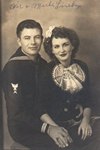
Vic
and Merle
Courtesy of Vic (and Merle) Lively |
On
leave, back home, he met a pretty girl named Merle Wolf whose
family lived about "five fields away" from Vic's. They married in
October 1942. To avoid the censor's black pen, Vic and Merle developed
a secret code in their letters. His family tells the story of how
he informed them of the ship's next secret stop by telling them that
it had the "same name as Papa"; they looked on the map and knew he
would soon be at the Marshall Islands.
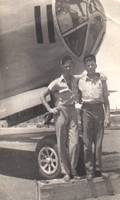
"You have a visitor," someone told Vic one day. There in front
of him was younger brother Everett. Everett was a gunner
on a B-29 who flew many missions over Toyko. He was based
on an island when the Nevada pulled up offshore with the rest
of the fleet. Somehow Everett- found out which ship was the Nevada
and arranged to visit.In the middle of the Pacific Ocean, Everett
had found him. |
|
|
Vic
and Everett ( left) Lively in front of B-29
on which Everett was a gunner.
Photo Courtesy of Vic Lively |
As
the war progressed, the Japanese became desperate and hit the Nevada
with Kamikaze raids, killing 15 of the 120 marines who served
onboard manning 20 mm anti-aircraft guns. Sailors called them "sea-going
bellhops."
Vic was like Forrest Gump - but only in the sense that
he happened to show up at practically every major event of his day.
He was everywhere because the Nevada went everywhere.
A local newspaper headline read, "Victor Lively, Whose Battleship
Was Crippled at Pearl Harbor, Rides Her Into Normandy Beachhead
On D-Day."
The Nevada was also at Cherbourg, Toulon, Marseille,
Algiers, and Corsica. In the Pacific they sailed to Okinawa, Saipan,
Guam, Leyte, and Attu. Vic even saw the famous raising
of the American flag on Mt. Surabashi on Iwo Jima.
When the A-bombs hit Japan, the Nevada was six
hours out of the Philippines. The sailors knew that this signified
the war's end. That ship never saw such revelry. Cheering, music,
dancing! To heck with regulations! |
|
|
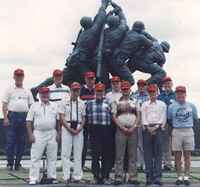
Taken
in front of replica of the famous statue of
Americans raising the flag at Iwo Jima, Harlingen, Texas, 1992.
Vic is front and center in plaid shirt.
Photo
Courtesy of Vic Lively |
When
time came for discharge, Vic was sent from one situation to another,
traveling extensively, even back via the Panama Canal. He was discharged
5 years 11 months and 30 days after joining up. It was September 2,
1946.
Back to civilian life at last, Vic and Merle wanted their own home.
Like most other young postwar couples, they could find no housing
because no building had been going on during the war. They stayed
with relatives while he attended air conditioning trade school in
Ft. Worth. Later they moved to Houston where he worked and eventually
retired from the VA Medical Center.There he had been overseeing the
cooling, heating, and steam generating plants, the grounds, and drivers
for patients. They settled in Anderson County and built a house in
Palestine.
They have one son, a daughter-in-law, and two grandchildren. Vic still
attends meetings of Pearl Harbor survivors. |
|
|
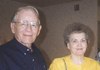
Vic
and Merle Lively today
Courtesy
of Vic Lively, 2001 |
|
A soft-spoken,
good-humored southern gentleman, Vic tells his story in an almost
matter-of-fact manner, painting himself as neither victim nor hero.
Sometimes heroes are those who simply do their duty. They don't
choose the drama, but they perform their role with skill and fidelity.
May 2001
© Sandy
Fiedler
More World
War II
Pearl Harbor Survivors Association, Inc.
8217 Fox Meadows Place, Citrus Heights, CA 95610-3241
|
Forum
Subject:
USS Nevada
I am President of a local History and Heritage Society in Benton,
Arkansas. We received a diary written by Horace Call who served
on the Nevada from early 1944 until after WWII. Apparently he went
aboard after it was repaired from damages during Pearl Harbor Attack.
This diary is a day by day account of all activities. He mentions
the hot weather on Litchi, Shelling Iwo Jima, Mog Mog, Mr. Best,
Clayton McClintock, getting hit by Japanese “Zeke”, Okinawa, Suicide
planes attack, Sipan, etc. - Art Wilson, May 29, 2006
My grandfather,
James (Bud) I. Page was also on the USS NEVADA, and was also a gunner.
He has passed now, but I would like to know if Mr Livley knew him.
- Suzie Breedlove Georgia, July 11, 2002
More
World War II
WWI
People
Texas
|
|
|
 HOME
HOME