|
Winds of Change
Leaves Waneta Community In the Dust of the Past
By Dana
Goolsby |
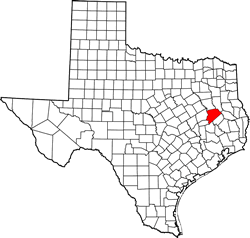
The oldest county
in Texas was a booming place in the Pineywoods many years ago. Early
settlers chose to make their homes under the pine tree canvas of Houston
County, and tame the area. Communities began to take shape and
lives were lived as the winds of change blew.
Remains of one early East
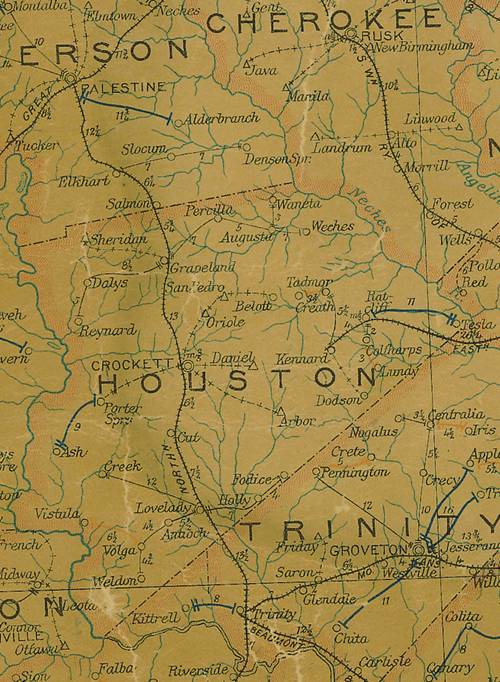
Texas settlement can be found down a winding red dirt road approximately
12 miles east of Grapeland,
near present day Percilla
Community. Though little remains of a once thriving community
known as Waneta, an oak frame school house still stands today.
|
 |
Some say the
settlement of the Waneta Community can been traced back to 1835, when
a man by the name of Frank Austin arrived in the area. Austin is said
to have built a general store of which he dubbed the Waneta Store.
Other early settlers began to followed suit and purchased land within
the area. Ruben Lively, Charles W. Butler, William L. Dickey and George
Daniel Scarborough, were among respected landowners in the Waneta
Community. Other families such as the Herringtons, Barnes, Goffs,
Richs, Teems, Brumleys, and Hendricks also helped settle the area
as they arrived from what is believed to have been Alabama, Georgia,
and Mississippi. Still, other families poured into the area and the
community began to thrive.
Farming was the main source of income for Waneta families during the
early days. Several cotton gins were located there, one of which was
the Sewall Gin. Waneta farmers would harvest the cotton
and transport it by wagon into Grapeland
where they would sell it.
The little community of Waneta was well-rounded. There was also a
blacksmith shop run by a man who was affectionately known throughout
the community as “Dad” Graves, as well as a small church known as
the New Hope Baptist Church.
In 1852 a man named Charles W. Butler, who would later make a contribution
to the community, purchased land and established a farm. By the 1870s
a number of families were living in the vicinity and the rural community
was bustling.
A post office was established by 1899 in Waneta, and served the community
for many years. The post office was located on property owned at that
time by Charlie and Mary Ramey. The post office was later moved to
Percilla, and eventually
became part of the Grapeland
postal system.
An article from a 1901 edition of the Grapeland Messenger portrayed
the Waneta Community through a “strangers” eyes. The reporter used
the term “versts” (Russian or Swedish measure equal to .66 of a mile)
to explain the location of the community, an area which the writer
said “revels in quasi-city luxury of one general store and a post
office.”
According to the reporter, the general store in Waneta was an excellent
place to shop. The reporter said “everything from a paper of pins
to a gang plow; from a pair of socks to a suit of clothes are constantly
on tap.”
The reporter described the area to his readers with fondness, and
facts. His article included a lay of the land, which was a combination
of rich soil capable of yielding a bale of cotton per acre, and good
quality sandstone that could be quarried from the hills. According
to the reporter, the sandstone could be quarried for a nominal cost
and used for building.
“Easy terms are given on realty, and to buy land and build a home
is a comparatively easy matter,” the article stated.
According to the visiting reporter, the diversification idea had not
been practiced in this area. He stated, “Fertilizers and “pore” folks
are alike unknown qualities, and the people, without an exception,
seem to be prosperous, happy and contented,” in regard to Waneta and
its citizens.
The reporter recorded his experience as a fond one, as he told of
the Waneta Community’s “open-handed hospitality” and noted, such treatment
was not reserved for only the good citizens of Waneta. He was a stranger
within the Waneta Community, yet treated exceptionally and as if one
of their own. His article told of “pressing invitations” that were
extended to anyone who arrived at any of the Waneta citizen’s home
near meal times.
“No antebellum slave king could more royally entertain than these
good people, and as we ride way beneath the golden glory, the billow
bronze and velvet azure of a winter sky, we devoutly wish that all
the world was peopled with such as these,” the reporter stated at
the close of his article.
With a post office, a general store, cotton gins, and a black smith
in the community the only thing missing was a school. |
 |
The first school
that was established in Waneta was called Red Prairie School.
The school was located on land owned Augustus Peterson of Sweden.
A few years later the school was moved to the William Lively place.
In 1913 the school was again moved, this time to land donated by Charles
W. Butler. Red Prairie School and New Hope School were
then consolidated and named Waneta School. The Waneta school
opened in 1914.
The first and original school was first under the direction of two
teachers, Mae Rae and Lola Dennis. When the Waneta School was built,
a third teacher was added to accommodate the school population of
approximately 200 students. Some years later an auditorium was added
and church services were also held in the building.
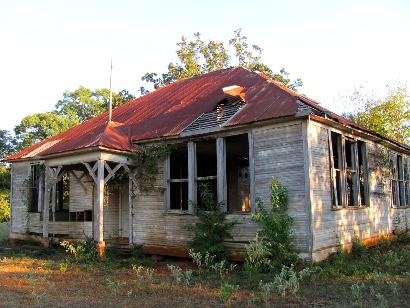
The oak frame school house with two chimneys served the Waneta Community
until 1949, when it was consolidated with the Grapeland school system
and closed its doors. The community only declined after the 1940s,
leaving little more than the school house and memories. Weekly church
services and an annual reunion for ex-students were still held in
the old school house until the late 1970s. |
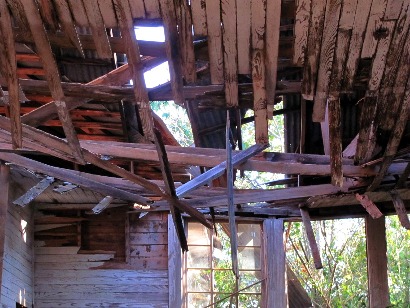 |
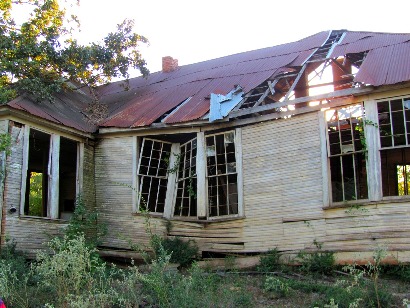
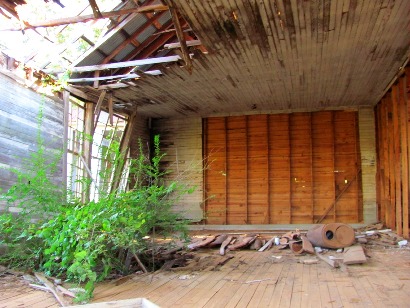
| The Waneta School,
which is still standing in the same place, looks as if it will soon
blow away with the winds of change. A sagging rusty barbed wire fence
nailed to old cedar posts encompasses the site. The school is an interesting
building to behold, despite the state of ill repair it is in. The
weather beaten tin roof has turned a brilliant rusty maroon over the
years. Trees have pushed up from beneath the wooden floors, reaching
for the light that streams in from gaping holes in the ceiling. Vines
attempt to choke the building, and snake in and out of the windows.
Portions of the building are also caving in. |
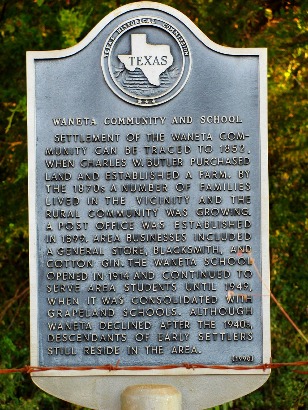
Waneta Community
and School Historical Marker
Photo by Dana Goolsby,
October 2010 |
According to
some who have visited the site in recent years, voo doo dolls left
by witches can be found on occasion. Alters built as a tribute to
headless dolls have been seen in the old school house as well. Local
ghost hunters do not linger long at the Waneta School, and often talk
about a strange feeling that can be felt by those brave enough to
enter. Stragglers and wanderers also hole up in the historic building
despite the dangers of the dilapidating building, in order to take
refuge from whatever they are straying from.
The Waneta Community has joined the dust of the past as the winds
of change have blown about in the Pineywoods. Waneta is no longer
a bustling and thriving community, and only recognizable due to a
historic marker that sits in front of the lone school house from the
past, and by way of local legends and a few old photographs. An old
school house and memories of the early settlers who lived, worked
and died there remain, but both are quickly fading.
© Dana Goolsby
"In The Pines With Dana Goolsby"January
16, 2011 Column
Reporter of The Grapeland Messenger |
 |
| Texas
Escapes, in its purpose to preserve historic, endangered and vanishing
Texas, asks that anyone wishing to share their local history, stories,
landmarks and recent/vintage/historic photos, please contact
us. |
|
|
 HOME
HOME