|
|
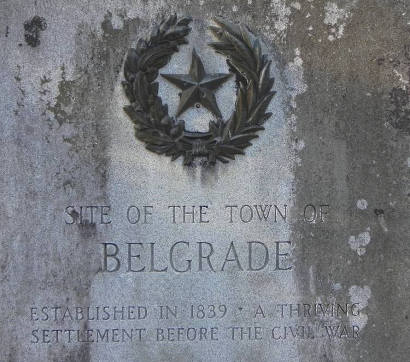
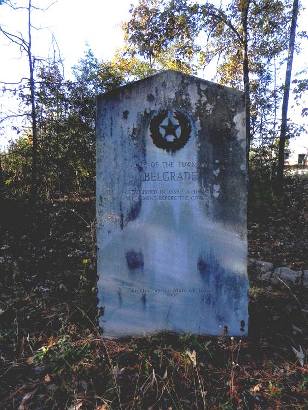
"Site
of the Town of Belgrade" Texas Centennial Marker
Photo courtesy Barclay
Gibson, December 2010 |
History
in a Pecan Shell
The site was called Biloxi by Indians although it isn't clear
why or if there is any connection to the place of the same name on
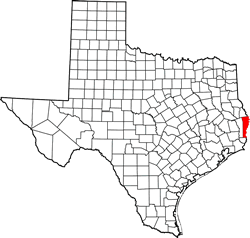
the Mississippi coast. William McFarland settled here in 1837, making
it the oldest settlement in what would become Sabine
County.
The name was borrowed from the capital of (what was then) Serbia in
hopes it would become as successful a riverport as that city. McFarland
sold lots here for $100 - a hefty price when vast plots sold for pennies
per acre. It did develop as a port during the 1840s and 50s and due
to a huge raft of logs upstream, Belgrade was the last navigable point
on the river.
Belgrade was granted a post office by 1840 and 13 years later
the name of Biloxi resurfaced. It went as Biloxi for about
seven years when the townsfolk (and postal authorities) changed it
back to Belgrade. River commerce was dampened by the ever-expanding
railroads in the 1880s and Belgrade's commerce declined accordingly.
While its location on the river was advantagous for floating logs
to market downstrean, the inland sawmills and the railroads killed
all hope of Belgrade developing a sustaining industry. After the Civil
War, the post office closed, reopened around 1880 and closed again
in 1906. It opened again in 1910 and remained open until 1936 - the
year the Centennial marker was installed.
Although the original townsite was abandoned years ago, nearby communities
of Upper and Lower Belgrade are currently inhabited.
|
Photographer's
Note:
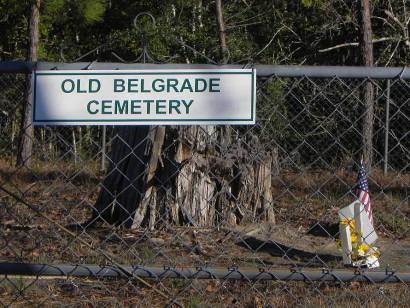
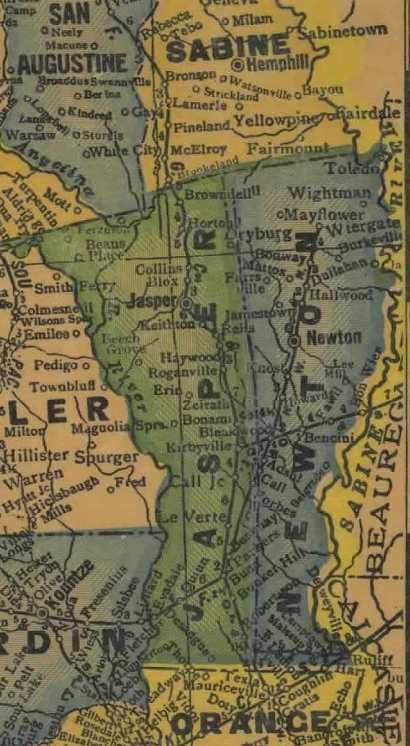
Subject: Newton County: "Old" Belgrade
"This is a strange one. It's up to you to figure it out. Dig
out your map of Newton County.
Belgrade, as currently shown on the map, is located about 12.5 miles
southeast of Newton on FM 1416.
The Belgrade Centennial Marker is two miles SSW of Belgrade near the
Sabine River, or one mile SE of Sandjack.
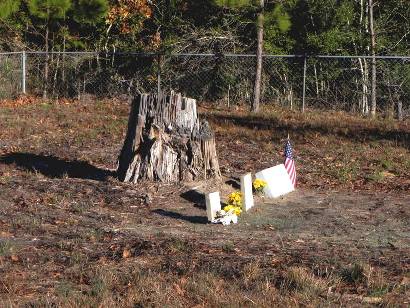
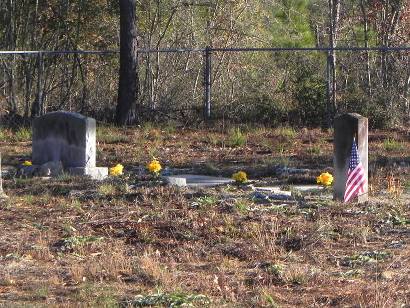
The Old Belgrade Cemetery is located 2 miles SW of Belgrade or 0.3
miles south of Sandjack. - Barclay
Gibson, December 2010 |
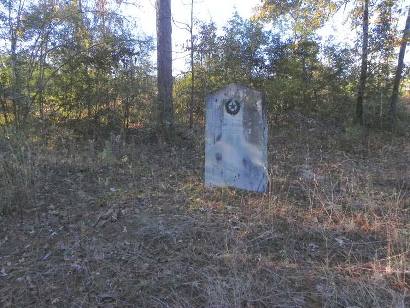
Centennial
Marker Full View
Photo courtesy Barclay
Gibson, December 2010 |
PEOPLE:
Heavyweight
champ Jack Johnson by Bob Bowman
Heavyweight champ Jack Johnson was arrested for boxing in 1903 in
Galveston. Johnson, who was born in Galveston and honed his physical
skills by lifting cotton bales as a youngster in the Newton County
river port of Belgrade, became the heavyweight title in 1910 when
he defeated Jim Jeffries...
Francis
Wilson
|
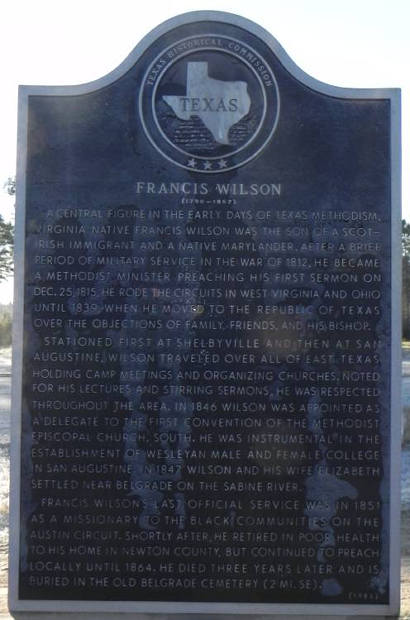
Francis
Wilson Historical Marker
On FM 1416 "6 miles SE of Bon Wier"
Photo courtesy Barclay
Gibson, December 2010 |
Historical
Marker:
Francis Wilson
(1790-1867)
A central figure in the early days of Texas Methodism,
Virginia native Francis Wilson was the son of a Scot-Irish immigrant
and a native Marylander. After a brief period of military service
in the War of 1812, he became a Methodist minister, preaching his
first sermon on Dec. 25, 1815. He rode the circuits in West Virginia
and Ohio until 1839, when he moved to the Republic
of Texas over the objections of family, friends, and his bishop.
Stationed first at Shelbyville
and then at San
Augustine, Wilson traveled over all of East
Texas, holding camp meetings and organizing churches. Noted for
his lectures and stirring sermons, he was respected throughout the
area. In 1846 Wilson was appointed as a delegate to the first convention
of the Methodist Episcopal Church, South. He was instrumental in the
establishment of Wesleyan Male and Female College in San
Augustine. In 1847 Wilson and wife Elizabeth settled near Belgrade
on the Sabine River.
Francis Wilson's last official service was in 1851 as a missionary
to the black communities on the Austin circuit. Shortly after, he
retired in poor health to his home in Newton
County, but continued to preach locally until 1864. He died three
years later and is buried in the Old Belgrade Cemetery (2 mi. SE).
|
Photographer's
Note:
The Francis Wilson Historical Marker (poor photo due to camera
facing the sun) is located at Sandjack on FM1416. It states that Wilson
is buried in the Old Belgrade Cemetery, "2 mi SE" (of Sandjack). The
current Old Belgrade Cemetery is only 0.3 miles south of the marker.
????" - Barclay
Gibson, December 2010 |
| Texas
Escapes, in its purpose to preserve historic, endangered and vanishing
Texas, asks that anyone wishing to share their local history, stories,
landmarks and recent or vintage photos, please contact
us. |
|
|
 HOME
HOME

 Texas
Gulf Coast
Texas
Gulf Coast East
Texas
East
Texas Central
Texas North
Central
Texas North Central
Texas South
Central
Texas South Texas
Panhandle
Texas
Panhandle South
Texas
South
Texas Texas
Hill Country
Texas
Hill Country West
Texas
West
Texas Texas
Ghost Towns
Texas
Ghost Towns Texas
Counties
Texas
Counties