|
 |
History
THE COURTHOUSES OF MONTGOMERY COUNTY
by Terry
Jeanson
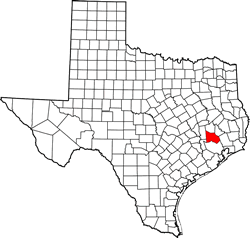
The third county established after the birth of the Republic of Texas,
Montgomery
County was organized in 1837, cut from neighboring Washington
County. The county was named for Montgomery,
the county’s largest settlement at the time, which was named for early
settler and veteran of the battle
of San Jacinto, Andrew Jackson Montgomery. Montgomery was a descendant
of Revolutionary War general Richard Montgomery. Montgomery
County would later be divided to create Grimes,
Madison, San
Jacinto, Walker
and Waller counties.
The town of Montgomery served as
the first county seat and the first courthouse, a two-room log structure,
was built there in 1838. This courthouse was replaced
by a two-story building of hand-hewn lumber in 1842.
In 1855, a large Greek Revival-style brick building was completed
and served as the county’s third courthouse.
When the railroad arrived in Montgomery County in the 1870s, it bypassed
the town of Montgomery. The town
of Willis, north of present day Conroe,
was established on the railroad and in 1874, an election moved the
county seat to Willis. However, when
the Houston and Texas Central was built through Montgomery
in 1880, the county seat was returned there. In 1881, Houston
lumberman Isaac Conroe opened a sawmill at the center of the county
near the future junction of the I&GN and the Gulf, Colorado and Santa
Fe Railway. He later moved his sawmill to the railroad junction and
it served as a station on the I&GN Railroad. A town developed at the
junction, named Conroe’s Switch, and the county seat was moved there
in 1889. The town was renamed Conroe
in the 1890s. A residence donated by Isaac Conroe
served as a temporary courthouse until a permanent brick structure
was built in 1891.
The 1891 courthouse in Conroe, the fourth
courthouse for the county, was designed by Houston
architect Eugene
T. Heiner in the Second Empire style that he employed in many
of his previous Texas county courthouses, most notably the 1888
Austin County courthouse, the 1888
Falls County courthouse and the 1888
Walker County courthouse. Heiner
also designed a separate jail at the same time and it stood until
1931 when it burned down. Fires in 1901 and 1911 near the courthouse
square destroyed much of the business district, but the courthouse
survived. In 1922 the courthouse grounds became the scene of communal
violence when a 19-year old black mill worker, Joe Winters, was accused
of raping a young white girl and was burned alive. The 1891 courthouse
stood until it was demolished for the construction of the present
courthouse in 1936.
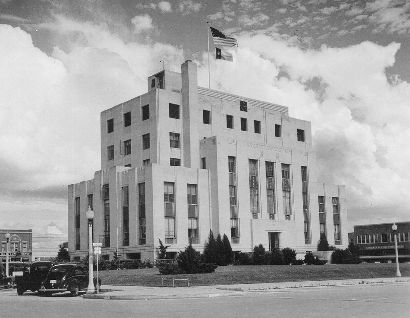
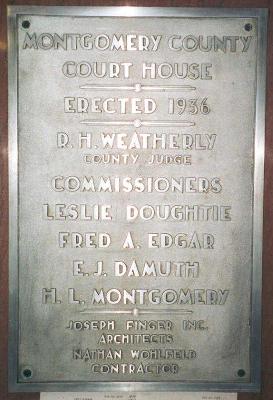
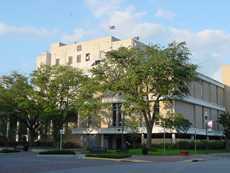
The 1936 Montgomery County courthouse was designed by Austrian-born
Houston architect Joseph
Finger, who is probably best remembered for designing the 1939 Houston
City Hall and other buildings in Houston.
Finger also designed the 1952 Harris County courthouse with his architectural
partner, George W. Rustay, but died before it was completed. The design
of the 1936 courthouse reflected many of the Art-Moderne style courthouses
already built in Texas during the 1930s
which consisted of a large central masses with flanking blocks. The
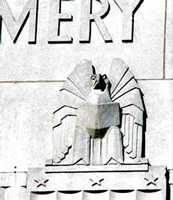
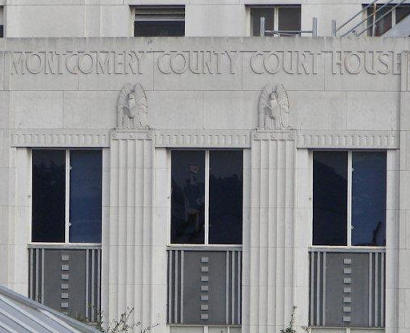
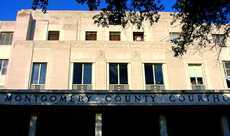
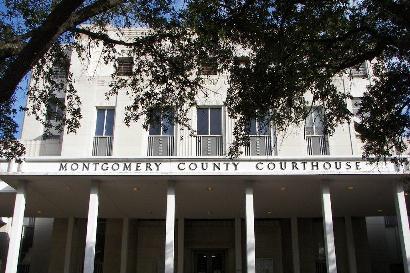
ornamentation on the 1936 courthouse is sparse, consisting of carved
stripes in the limestone, stars and stylized eagles and the county
name over the east and west side entrances. In place of a clock tower,
a small, square, numberless clock sits in the middle of the central
mass at the roofline. This courthouse was built with a jail on the
top floor which was used until 1965 when the courthouse was remodeled.
It was at this time that the 1936 courthouse was surrounded by two-story
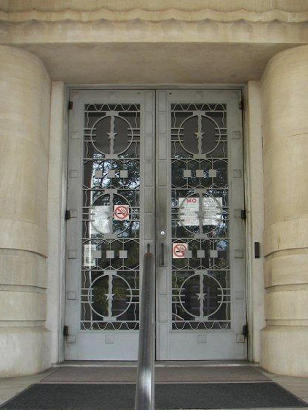
brick additions with a parking garage beneath them. Columned porticoes
were also added to the east and west side entrances. The 1936 courthouse
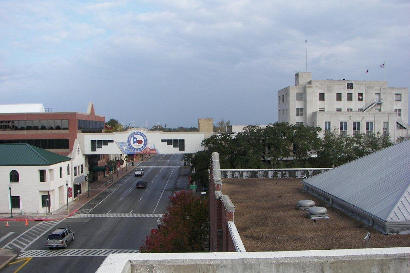
is still in service today with a sky bridge connecting the north side
of the 1965 addition to the courthouse annex across West Davis Street.
- Terry
Jeanson, March 12, 2011
References: Courthouse and county history from the Handbook
of Texas Online and “The Courthouses of Texas” by Mavis P. Kelsey,
Sr. and Donald H. Dyal. Jail information from “Wanted: Historic County
Jails of Texas” by Edward A. Blackburn, Jr.
Book
Hotel Here >
Conroe
Hotels |
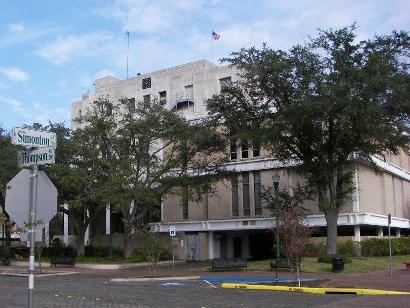 |
The 1936 courthouse
seen from the southwest corner, barricaded by the 1965 additions.
Photo courtesy Terry
Jeanson, December 2007 |
The
Present Montgomery County Courthouse -
Conroe
Date - 1936
Architect - Joseph Finger, Inc.
Style - Moderne
Material - Limestone
The 1965 remodeling altered the look of the courthouse. |
Montgomery County
courthouse as it appeared in 1939
Photo courtesy TXDoT |
Courthouse west
side entrance
Photo courtesy Terry
Jeanson, December 2007 |
1936 courthouse
details
TE Photo |
1936 courthouse
details
Photo courtesy Terry
Jeanson, December 2007 |
The 1936 courthouse
with its 1965 additions (right) is connected to the courthouse annex
(left) by a sky bridge.
Photo courtesy Terry
Jeanson, December 2007 |
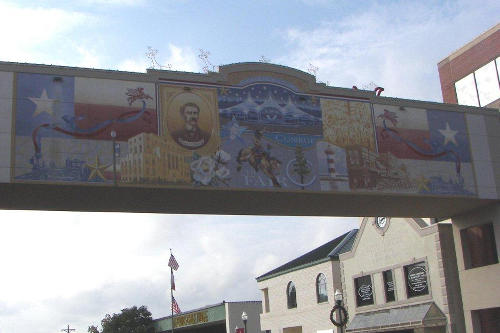
The east side
of the sky bridge includes a mural depicting people and places in
Montgomery
County history.
Photo courtesy Terry
Jeanson, December 2007 |
Montgomery County
Courthouse plaque
Photo courtesy Terry
Jeanson, March 2005 |
|
|
Montgomery
County Courthouse
TE photo, June 2004 |
|
|
Montgomery
County Courthouse close up
TE photo, June 2004 |
|
|
 HOME
HOME